

 Send
Send Share
Share
 Details

 Download
 Similars
 Diaporama
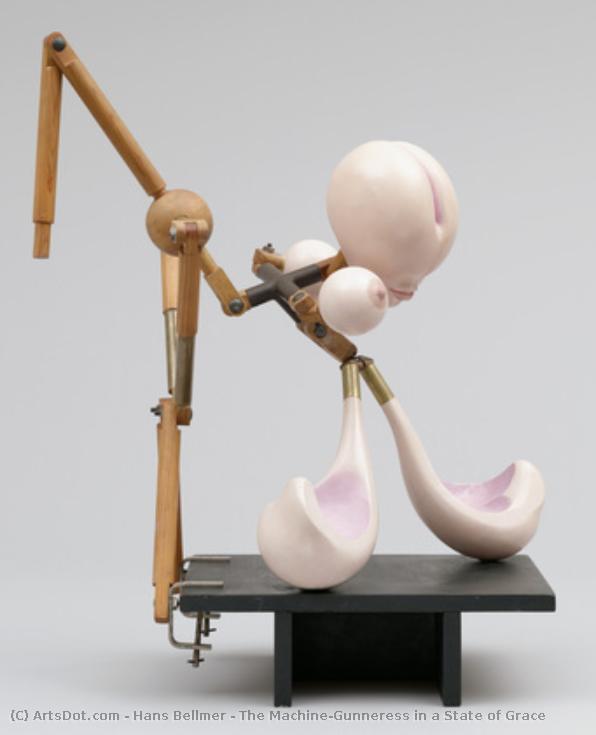
The Machine-Gunneress in a State of Grace


 Read More
Purchase a high-resolution, enhanced digital image, far superior to the online preview.
Each file is meticulously prepared by our in-house specialists using advanced tools and expert manual retouching. We ensure every image has exceptional clarity, precise color accuracy, and fine detail.
The final file is delivered via email within 72 hours, optimized for immediate use in professional, editorial, and print environments. This is the same quality trusted by top-tier design studios, publishers, and galleries.
Digital Image
Download a high-resolution file for personal display, printing, and creative projects. ( Buy Print Buy Hand Made Painting)
Included in Every Digital Image Order
Expert Digital Delivery, Guaranteed
When you choose ArtsDot.com, you're not just getting an image - you're receiving a professionally enhanced digital artwork, crafted with precision and backed by a satisfaction guarantee. Here's everything that comes with your order, automatically:

Fast Email Delivery
Your high-resolution digital image file will be emailed to you within 72 hours of ordering - ready for immediate use.

AI-Enhanced Digital File
Your artwork is professionally optimized using advanced AI tools and manual editing, ensuring maximum detail, clarity, and color accuracy.

Free Lifetime Re-Delivery
Accidentally deleted or lost your file? No worries - we'll resend it to you anytime, free of charge.

No Import Fees - Ever
Enjoy your artwork instantly with zero customs, duties, or delivery fees - digital downloads are always tax-free.

Color Accuracy Guarantee
We ensure your digital image reflects the original colors as closely as possible using professional tools and color management.

60-Day Satisfaction Guarantee
If you're not satisfied with your digital image, we'll revise it or refund 100% within 60 days - no questions asked.

100% Money-Back Guarantee
Not satisfied? Get a full refund within 60 days of receiving your digital file - no questions asked.

Bulk Order Discounts
Buy 3 images, save 10% - Buy 5, save 15% - Buy 10+, save 20%. Great for creative projects, galleries, and agencies.
Collectible Description
A Fragmented Vision: Hans Bellmer’s “The Machine-Gunneress”
Hans Bellmer's "The Machine-Gunneress in a State of Grace," created in 1937, isn’t merely a sculpture; it’s an unsettling plunge into the subconscious, a meticulously crafted collision of beauty and brutality. Born in Poland amidst political turmoil and personal tragedy, Bellmer channeled his anxieties – fueled by the rise of fascism, familial discord, and a potent fascination with the female form – into this profoundly disturbing yet undeniably captivating work. The piece immediately confronts the viewer with its fragmented composition: a doll-like figure, seemingly caught mid-action, fused with mechanical elements that speak to both control and vulnerability. It’s a visual paradox, demanding prolonged contemplation and inviting multiple interpretations.
The sculpture's core is a meticulously assembled doll – a porcelain-skinned torso anchored by broomstick legs and adorned with a hauntingly blank mask. This isn’t the idealized beauty of traditional dolls; rather, it’s a deliberately distorted representation, hinting at a suppressed or corrupted femininity. Crucially, this figure is integrated into a complex wooden framework resembling a camera tripod or robotic arm, suggesting a loss of agency, a reduction to an object within a system of observation and control. The deliberate imbalance of the composition – the doll's head tilted precariously, limbs awkwardly positioned – amplifies the sense of unease and instability.
Surrealist Techniques & Materials: A Dance Between Organic and Inorganic
Bellmer’s artistic process was characterized by a radical deconstruction and reconstruction. He began with existing dolls, meticulously disassembling them and altering their proportions – elongating limbs, distorting faces, and removing features altogether. This technique, combined with the use of wood, metal, and glass, creates a jarring juxtaposition between organic fragility and cold, mechanical precision. The smooth porcelain-like surface of the doll contrasts sharply with the grainy texture of the wood, while the glass eyes offer an unnerving gaze. The incorporation of ball joints, inspired by antique articulated dolls, further emphasizes this interplay – suggesting a rigid structure beneath a veneer of apparent life.
Bellmer’s approach wasn't simply about assembling disparate parts; it was about creating a new, unsettling reality. He employed techniques reminiscent of early photography, utilizing a staged presentation to heighten the sculpture’s impact. The lighting, diffused and even, minimizes shadows, lending a clinical quality to the scene – as if observing this disturbing tableau through a detached lens. This deliberate flattening of perspective contributes to the work's two-dimensional feel, intensifying its surreal and dreamlike atmosphere.
Symbolism & Historical Context: Fascination, Control, and Resistance
“The Machine-Gunneress” is deeply rooted in the anxieties of its time. Created during the rise of Nazism, it’s often interpreted as a veiled critique of totalitarian control and the dehumanizing effects of mass culture. Bellmer himself alluded to his father's authoritarian personality and the oppressive atmosphere of post-war Germany as influences on his work. The machine gun itself – a symbol of violence and destruction – is inextricably linked to the doll, suggesting a merging of innocence and aggression, vulnerability and power.
Furthermore, the doll figure can be seen as an allegory for the female body under patriarchal control. Its fragmented form and unsettling gaze evoke themes of objectification, repression, and the struggle for agency. The title itself – “in a State of Grace” – is profoundly ironic, juxtaposing beauty with violence, suggesting a corrupted ideal of femininity. Despite the sculpture’s disturbing nature, it also carries a subtle undercurrent of resistance—a defiant assertion of individuality against overwhelming forces.
A Legacy of Unease: Bellmer's Enduring Influence
Hans Bellmer remains one of the most significant figures in Surrealist art. “The Machine-Gunneress in a State of Grace” stands as a testament to his unique vision and unsettling ability to explore the darkest corners of the human psyche. His work continues to resonate with contemporary audiences, prompting reflection on themes of identity, control, and the complex relationship between technology and humanity. Reproductions of this powerful sculpture offer a compelling glimpse into Bellmer’s world—a world where beauty and horror coexist in a perpetually unsettling dance.
Related Artworks



Artist Biography
Hans Bellmer: A Surrealist’s Twisted Embrace of the Female Form
Hans Bellmer (1902-1975) remains one of the most unsettling and profoundly influential figures in 20th-century art. His work, particularly his life-sized “doll” series, transcends simple categorization, occupying a complex space between Surrealism, photography, sculpture, and even a disturbing commentary on societal anxieties surrounding beauty, sexuality, and control. Born in Katowice, Poland – then part of the German Empire – Bellmer’s artistic journey was shaped by personal trauma, political upheaval, and an increasingly acute awareness of the manipulation inherent within mass culture.
Bellmer's early life offered little indication of the artist he would become. He began as a draftsman for his own advertising company, a pragmatic profession that provided a stark contrast to the intensely emotional and often nightmarish world he would later create. However, a pivotal moment arrived in 1926 when he abandoned this career path, declaring an intention not to produce work that could serve the burgeoning fascist regime of Nazi Germany. This decision, fueled by a deep-seated resentment towards his authoritarian father – a man whose severity and humorlessness profoundly impacted Bellmer’s psyche – became the bedrock for his most enduring project: the construction of his “artificial girls.”
The genesis of these dolls is inextricably linked to a confluence of personal events. A significant encounter in 1932 with a beautiful teenage cousin, coupled with his attendance at a performance of Jacques Offenbach’s *Tales of Hoffmann*, which featured an automaton – a mechanical figure mimicking human movement – proved to be transformative. Bellmer was captivated by the idea of a being devoid of genuine life, yet capable of eliciting intense emotion. Further fueling this fascination was a visit to the Kaiser Friedrich Museum in Paris in 1935, where he encountered a pair of sixteenth-century articulated wooden dolls. These dolls, with their intricate ball joints and unsettlingly posed figures, provided a crucial technical inspiration for his own creations.
Bellmer’s dolls are not merely decorative objects; they are meticulously constructed embodiments of anxiety and desire. Constructed from wood, plaster, metal, and glass eyes, these figures were deliberately dismembered and reassembled in bizarre, often violent configurations. The “ball joint” mechanism, borrowed from the antique dolls, allowed for an unprecedented degree of manipulation – a visual representation of control and fragmentation. Bellmer’s intention was to challenge the prevailing cult of the perfect body, prevalent in Germany at the time, by presenting distorted, unsettling versions of femininity. He deliberately sexualized these figures, imbuing them with a potent blend of vulnerability and menace.
The Dolls and Surrealist Influences
Bellmer’s work is undeniably rooted in Surrealism, though he resisted easy categorization within the movement. His fascination with automatons – mechanical beings mimicking human actions – echoes the broader Surrealist interest in exploring the subconscious and challenging rational thought. The influence of Oskar Kokoschka's letters, particularly his exploration of “fetish” objects, provided a crucial theoretical framework for Bellmer’s artistic vision. Kokoschka’s writings on the power of inanimate objects to evoke intense emotional responses resonated deeply with Bellmer’s own experiences and anxieties.
The creation of the first series of dolls in 1934 was documented through a series of photographs, meticulously hand-colored by Bellmer himself. These images, published in his privately printed book *Die Puppe* (The Doll), were initially met with obscurity within Germany due to the artist’s deliberate isolation and the political climate. However, following the war, Bellmer's work gained recognition within Surrealist circles in Paris, where he sought refuge from Nazi persecution. The second series of dolls, produced between 1936 and 1938, was even more fragmented and disturbing than the first, reflecting a deepening sense of unease and disillusionment.
Photography and Artistic Technique
While primarily known for his dolls, Bellmer’s photographic work is equally significant. His photographs are characterized by a stark, almost clinical aesthetic, often employing unusual lighting and unsettling compositions. He frequently staged his subjects in provocative poses, blurring the boundaries between reality and fantasy. Bellmer's use of photography served not merely as documentation but as an integral part of his artistic process – a means of manipulating perception and creating a sense of unease.
The construction of the dolls themselves involved a complex interplay of techniques. Bellmer utilized a combination of modeling, plaster casting, woodworking, and metalworking to create these intricate figures. The “ball joint” mechanism, inspired by the antique dolls, allowed for an unprecedented degree of flexibility and manipulation – enabling him to construct poses that were both unsettling and strangely compelling. The hand-coloring of the photographs further enhanced the surreal quality of his work, adding layers of ambiguity and emotional resonance.
Legacy and Historical Significance
Hans Bellmer’s work continues to provoke debate and fascination decades after his death in 1975. His dolls are not simply unsettling images; they represent a profound critique of societal norms, particularly those surrounding beauty, sexuality, and control. Bellmer's exploration of the fragmented self – both literal and metaphorical – resonates powerfully with contemporary anxieties about identity and alienation.
Furthermore, Bellmer’s artistic resistance to fascism is often cited as a key element in understanding his work. By refusing to create art that served the Nazi regime, he positioned himself as an artist of dissent, using his creations to challenge prevailing ideologies and expose their inherent contradictions. His dolls, with their distorted forms and unsettling poses, can be interpreted as a visual metaphor for the dehumanizing effects of totalitarianism.
Bellmer’s influence extends far beyond the realm of Surrealism. His work has been cited by numerous artists and filmmakers, including David Lynch and Terry Gilliam, who have drawn inspiration from his disturbing imagery and unsettling aesthetic. Hans Bellmer remains a vital figure in the history of art – an artist whose work continues to challenge our perceptions and force us to confront the darker aspects of human experience.

Hans Bellmer
1902 - 1975 , Germany
Quick Facts
- Artistic Movement Or Style: Surrealism, Photography
- Artists Or Movements Influenced By This Artist: ['André Breton']
- Artists Who Influenced This Artist: ['Oskar Kokoschka']
- Date Of Birth: 1902-03-13
- Date Of Death: 1975-02-24
- Full Name: Hans Bellmer
- Nationality: German
- Notable Artworks: ['Die Puppe (The Doll)']
- Place Of Birth: Katowice, Poland

