 Preview
 Send
Send Share
Share
 Details

 Download
 Similars
 X-Ray
X-Ray Diaporama
 Stats
StatsDouble Virginal

 Read More
Hand Made Oil Reproduction
Hand-painted oil on canvas in your size and frame, made to order by our artists. ( Switch to Print Switch to Digital Image)




































Pick from our preset sizes that match the artwork's original proportions.

You may enter your own dimensions to fit a specific frame or space. If your selected size does not match the original image's proportions, we will either crop the artwork or extend the painting with additional hand-painted elements. A digital mockup will be sent for your approval before production begins.
Please note that the on-screen preview does not reflect the actual cropping or extension. Only the mockup will accurately show the final composition.
While custom sizes are available, we recommend selecting a dimension from the predefined list to preserve the original proportions.
After order, ArtsDot.com team will email client for instructions and provide a mockup preview
Worldwide Delivery () in 3/4 weeks instead of standard 5 weeks. (7 September). No compromise on quality.

Free Worldwide Express Shipping

High-Quality Linen Canvas

Full Shipping Insurance

Customs Tax Refund Guarantee

True Color Matching Guarantee

100-Day Return Policy (Defects Only)

100% Money-Back Guarantee

Bulk Discount Offer
 Glass option is only available in size under 110 CM

Double Virginal
Reproduction Medium
Reproduction Size
-


Total Price
$ 263
Related Artworks






Artist Biography
The Architect of Harmony: The Legacy of Hans the Elder Ruckers
In the vibrant tapestry of the Flemish Renaissance, few names resonate with as much structural and melodic importance as Hans the Elder Ruckers. Born in Mechelen, Belgium, around 1540, Ruckers was far more than a mere craftsman; he was the progenitor of a musical dynasty that would dictate the sonic landscape of Europe for over a century. While his early years remain partially veiled by the mists of history, his emergence as a master artisan in the mid-sixteenth century signaled a transformative era for keyboard instrument construction. His workshop did not merely produce tools for music; it birthed masterpieces where the boundaries between fine art and acoustic engineering dissolved into a singular, breathtaking expression of Renaissance virtuosity.
The essence of Ruckers’s genius lay in his ability to marry technical precision with an opulent visual language. His instruments, primarily virginals and harpsichords, were designed to be as much a feast for the eyes as for the ears. He possessed a profound understanding of the era's aesthetic currents, weaving intricate geometric patterns, delicate floral motifs, and regal gilded medallions into the very fabric of his work. These decorations often featured the profile portraits of Philip II of Spain and his consort Anne of Austria, serving as a sophisticated nod to the political and social hierarchies of the time. Through these embellishments, Ruckers elevated the harpsichord from a functional object to a symbol of prestige and cultural refinement.
A Symphony of Craft and Influence
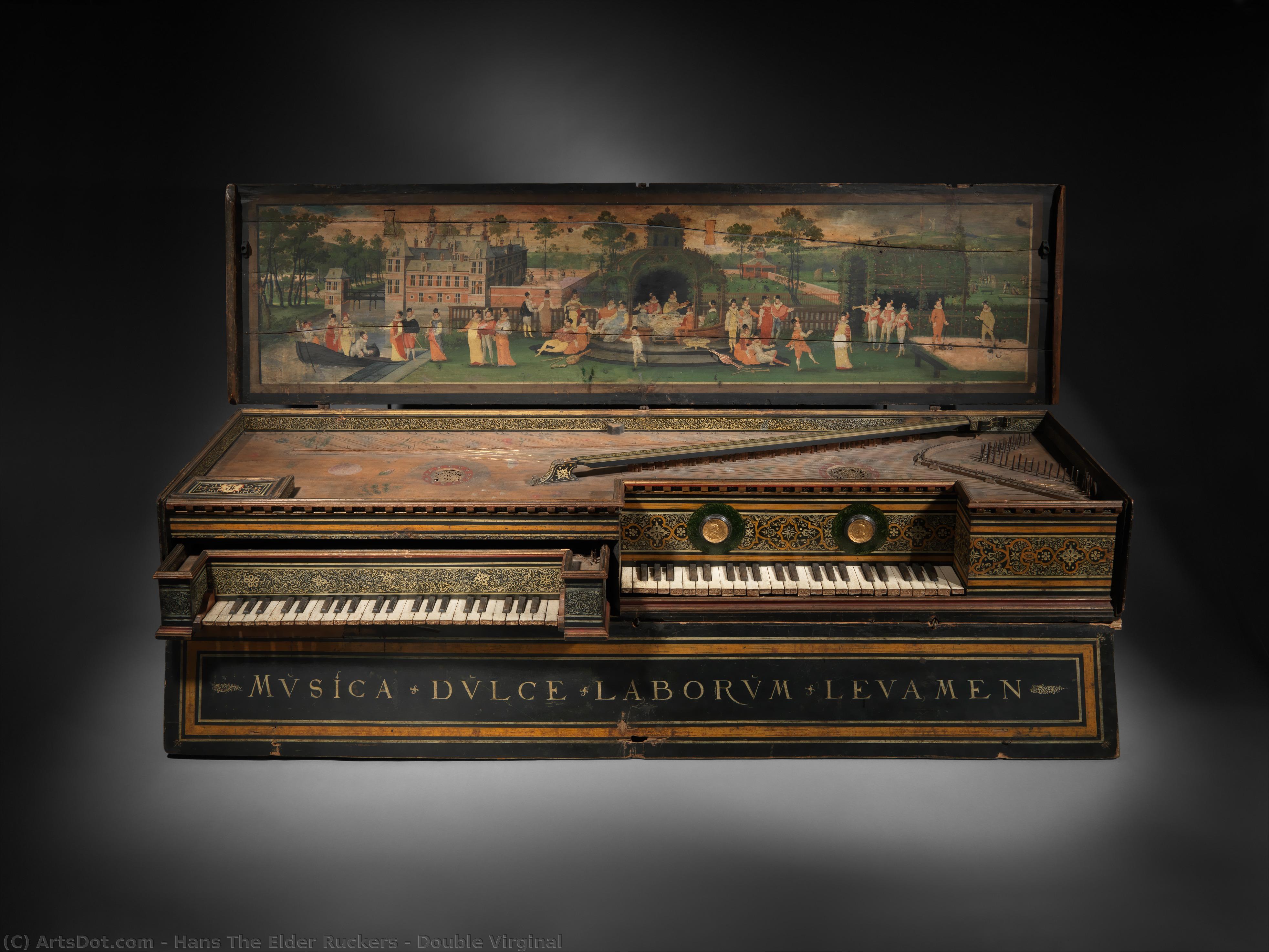
The artistry found within a Ruckers instrument often mirrored the broader movements of the Italian Renaissance and the burgeoning Flemish school. The decorative programs found inside his virginals—revealed only when the lid is lifted—suggested a world of grandeur and sophistication reminiscent of Florentine palaces. One can observe the subtle influence of contemporary painters such as Lodewijk Toeput and David Vinckboons in the painted scenes that adorn his work. These miniature landscapes, often depicting idyllic garden parties or fête champêtre settings, provided a poetic counterpoint to the mechanical complexity of the instrument's interior.
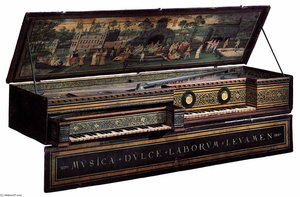
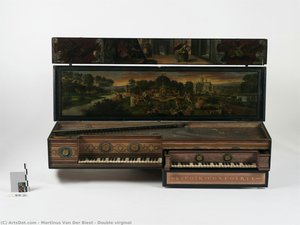
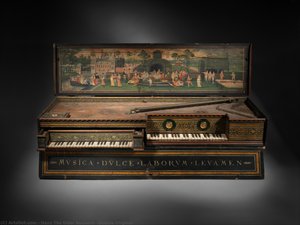
Perhaps the most striking example of his technical and artistic summit is the celebrated double virginal, a rare treasure that exemplifies his mastery. This particular instrument, featuring a "mother" and a "child" keyboard, showcases the innovative spirit of the Ruckers lineage. Within its structure, one finds:
- Intricate Carvings: Meticulous woodwork that demonstrates a high level of sculptural skill.
- Latin Inscriptions: Poetic phrases such as Mvsica Dvlce Laborvm Levamen (Sweet music is a balm for toil), which imbue the instrument with philosophical depth.
- Acoustic Innovation: The ingenious design allowing the smaller virginal to be played in octaves with the larger one, a precursor to more complex keyboard developments.
The Enduring Resonance of a Dynasty
Hans the Elder Ruckers’s impact extended far beyond his lifetime, as his workshop established a lineage of makers whose influence stretched into the 18th century. His descendants and kin continued to refine the technical development of the harpsichord, pioneering features like the second manual that would become standard in later centuries. The quality of his craftsmanship was so profound that the name "Ruckers" became synonymous with excellence, much as the name Stradivarius is to the violin family. His ability to blend the mechanical requirements of string tension and pitch with the delicate demands of ornamental painting ensured that his work would be preserved in the world's most prestigious collections, from the Metropolitan Museum of Art to the halls of Yale University.
Ultimately, the historical significance of Hans the Elder Ruckers lies in his role as a bridge between the medieval artisan tradition and the high Renaissance. He transformed the act of instrument making into a multidisciplinary art form, integrating musicology, woodworking, painting, and heraldry. As we look upon the surviving remnants of his workshop today, we do not merely see antique keyboards; we witness the enduring heartbeat of a period when craftsmanship was the highest form of devotion to beauty and harmony.
hans the elder ruckers
1540 - 1598 , Belgium
Quick Facts
- Artistic Movement Or Style: Renaissance
- Artists Or Movements Influenced By This Artist:
- Lodewijk Toeput
- David Vinckboons
- Date Of Birth: ca. 1545
- Full Name: Hans Ruckers the Elder
- Nationality: Flemish
- Notable Artworks: ['Double Virginal']
- Place Of Birth: Mechelen, Belgium