


 Preview
 Send
Send Share
Share
 Details

 Download
 Similars
 X-Ray
X-Ray Diaporama
 Stats
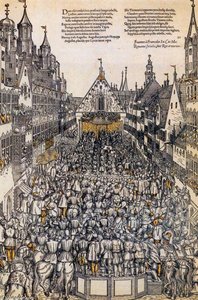
StatsInvestiture of the Elector of Saxony in the Weinmarkt, Augsburg
 1566
1566 536.0 x 359.0 cm
 Städtische Kunstsammlungen
 Read More
Purchase a high-resolution, enhanced digital image, far superior to the online preview.
Each file is meticulously prepared by our in-house specialists using advanced tools and expert manual retouching. We ensure every image has exceptional clarity, precise color accuracy, and fine detail.
The final file is delivered via email within 72 hours, optimized for immediate use in professional, editorial, and print environments. This is the same quality trusted by top-tier design studios, publishers, and galleries.
Digital Image
Download a high-resolution file for personal display, printing, and creative projects. ( Switch to Print Buy Hand Made Painting)
Included in Every Digital Image Order
Expert Digital Delivery, Guaranteed
When you choose ArtsDot.com, you're not just getting an image - you're receiving a professionally enhanced digital artwork, crafted with precision and backed by a satisfaction guarantee. Here's everything that comes with your order, automatically:

Fast Email Delivery
Your high-resolution digital image file will be emailed to you within 72 hours of ordering - ready for immediate use.

AI-Enhanced Digital File
Your artwork is professionally optimized using advanced AI tools and manual editing, ensuring maximum detail, clarity, and color accuracy.

Free Lifetime Re-Delivery
Accidentally deleted or lost your file? No worries - we'll resend it to you anytime, free of charge.

No Import Fees - Ever
Enjoy your artwork instantly with zero customs, duties, or delivery fees - digital downloads are always tax-free.

Color Accuracy Guarantee
We ensure your digital image reflects the original colors as closely as possible using professional tools and color management.

100-Day Satisfaction Guarantee
If you're not satisfied with your digital image, we'll revise it or refund 100% within 100 days - no questions asked.

100% Money-Back Guarantee
Not satisfied? Get a full refund within 100 days of receiving your digital file - no questions asked.

Bulk Order Discounts
Buy 3 images, save 10% - Buy 5, save 15% - Buy 10+, save 20%. Great for creative projects, galleries, and agencies.
Related Artworks



Artist Biography
A Renaissance Visionary: The Life and Legacy of Hans Tirol
In the vibrant, bustling atmosphere of sixteenth-century Augsburg, a period defined by profound intellectual and artistic shifts, the name Hans Tirol emerged as a symbol of creative versatility. Born around 1505, Tirol was far more than a mere practitioner of the brush; he was a polymath of the Northern Renaissance, navigating the complex intersections of painting, architecture, and publishing. His life, spanning from the early decades of the 1500s to his passing around 1575, mirrored the very evolution of German art as it moved from the meticulous traditions of the Flemish Primitives toward a more structurally ambitious era. While history often reserves its brightest spotlights for contemporaries like Holbein, Tirol’s footprint in the Holy Roman Empire remains indelibly etched through his dual mastery of the canvas and the cityscape.
The foundations of Tirol’s artistry were laid within the prestigious workshops of Augsburg, a city that served as a vital commercial and cultural artery of Europe. His early years were deeply intertwined with the local artistic elite; notably, he resided in the house of the renowned painter Jörg Breu the Elder, eventually entering this illustrious family through marriage to Breu’s daughter, Anna. This connection was not merely familial but profoundly pedagogical. Through such associations, Tirol absorbed the meticulous realism and devotional intensity characteristic of the Flemish tradition—an influence seen in the works of masters like Jan van Eyck. This stylistic lineage provided him with a technical vocabulary of light, texture, and profound religious symbolism that would later inform his more expansive architectural endeavors.
The Convergence of Artistry and Architecture
As his career matured, Tirol’s ambitions expanded beyond the confines of the frame. He transitioned from a painter of exquisite detail to a Stadtbaumeister (city architect) for Augsburg, serving in this capacity between 1542 and 1548. This evolution represents a rare and seamless transition from the micro-level precision of oil painting to the macro-level complexity of urban design. His ability to conceptualize space allowed him to contribute significantly to the physical fabric of his home city, designing structures that balanced aesthetic grace with the structural innovations required by a growing Renaissance metropolis. His work on the wall paintings of the Augsburger Weberhaus, alongside Jörg Breu the Younger, stands as a testament to his ability to transform civic spaces into narrative triumphs.
Beyond the physical structures he designed, Tirol’s influence extended into the realm of intellectual dissemination. As a publisher, he played a crucial role in the circulation of knowledge and imagery during an age of burgeoning literacy and print culture. His involvement in publishing works such as the Römer Kaiserl. Maiestat Carolij der Fünfften Belehrung demonstrated his capacity to bridge the gap between visual art and the written word, utilizing engravings and drawings to communicate complex political and cultural messages to a wider audience. This multifaceted career—encompassing the delicate touch of the painter, the structural mind of the architect, and the distributive power of the publisher—marks him as a quintessential Renaissance man.
Historical Significance and Artistic Enduring Spirit
The historical significance of Hans Tirol lies in his role as a cultural bridge. He stood at the nexus where the late Gothic sensibilities of Germany met the burgeoning humanism of the Renaissance. His work helped facilitate a stylistic convergence between the traditions of Augsburg and the innovative spirit of Antwerp, ensuring that the artistic innovations of the Low Countries found fertile ground in German soil. Even as his individual paintings may be rarer to encounter than those of his more famous peers, his impact on the architectural and civic identity of Augsburg remains a cornerstone of the city's heritage.
To study the life of Hans Tirol is to witness the heartbeat of the sixteenth century—a period of immense growth, religious tension, and artistic flowering. His legacy is found in:
- The Synthesis of Disciplines: The rare ability to command both the fine details of religious iconography and the grand scale of urban architecture.
- Cultural Connectivity: Acting as a vital link between the German and Flemish artistic traditions, enriching the Northern Renaissance tapestry.
- Civic Contribution: Leaving a permanent mark on the landscape of Augsburg through his roles as an architect and city official.
- The Power of Print: Utilizing publishing to ensure that art and information reached the hands of the burgeoning middle class.
hans tirol
1505 - 1575 , Germany
Quick Facts
- Artistic Movement Or Style: Flemish Primitives
- Artists Or Movements Influenced By This Artist: ['Hans Baldung Grien']
- Artists Who Influenced This Artist:
- Hans Holbein the Younger
- Rogier van der Weyden
- Date Of Birth: 1505
- Full Name: Hans Tirol
- Nationality: German
- Notable Artworks:
- Escudo da Galiza na obra de Hans Tirol (1548)
- Eton-Codex 1541 Triumph des Lucius Tarquinius Eton College
- Place Of Birth: Augsburg, Germany