 Preview
 Send
Send Share
Share
 Details

 Download
 Similars
 X-Ray
X-Ray Diaporama
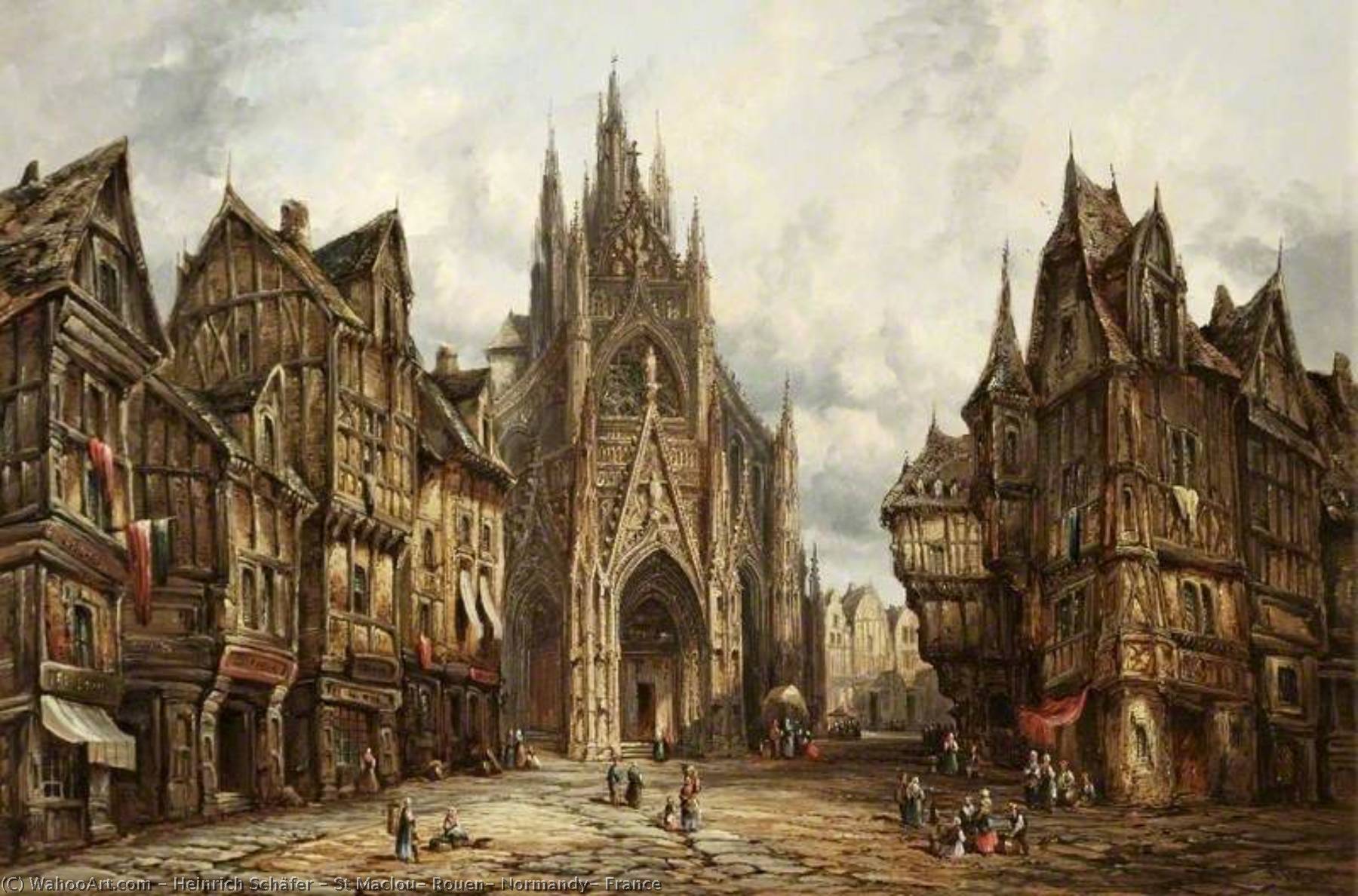
St Maclou, Rouen, Normandy, France
 1871
1871 50.0 x 77.0 cm
 Read More
Giclée / Art Print
Museum-quality giclée or canvas print with fast production and flexible finish options. ( Buy Hand Made Painting Buy Image)




































Pick from our preset sizes that match the artwork's original proportions.

You may enter your own dimensions to fit a specific frame or space. If your selected size does not match the original image's proportions, we will either crop the artwork or extend the image with a mirrored or solid-fill edge. A digital mockup will be sent for your approval before production begins.
Please note that the on-screen preview does not reflect the actual cropping or extension. Only the mockup will accurately show the final composition.
While custom sizes are available, we recommend selecting a dimension from the predefined list to preserve the original proportions.
Worldwide Delivery () in 2 weeks instead of standard 4/5 weeks. (23 August)

Free Worldwide Express Shipping

High-Quality Linen Canvas

Full Shipping Insurance

Customs Tax Refund Guarantee

True Color Matching Guarantee

60-Day Return Policy (Defects Only)

100% Money-Back Guarantee

Bulk Discount Offer
 Glass option is only available in size under 110 CM

St Maclou, Rouen, Normandy, France
Giclée / Art Print
Reproduction Size
-


Total Price
$ 63
Collectible Description
The Painting's Composition
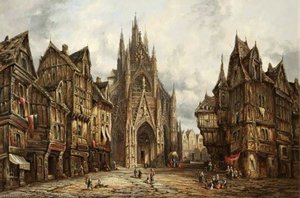
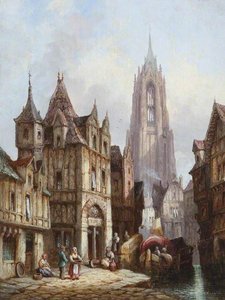
The scene depicts a city street with a large cathedral in the background, surrounded by buildings on both sides. The street is bustling with people, each going about their daily activities. In total, there are 13 people visible in the image, adding to the sense of movement and energy. The cathedral stands tall above the surrounding buildings, drawing attention as an important landmark within the cityscape. Key Features of the painting include its use of color and light, which creates a sense of depth and atmosphere. The artist's attention to detail is also evident in the intricate architecture and the people's clothing and accessories. For more information on Heinrich Schäfer and his works, visit /art/list/?Filter=ARAF2Q-Heinrich-Schafer-St-Maclou-Rouen-Normandy-France.Similar Works by Other Artists
Other notable artists have also captured the beauty of Rouen, Normandy. For example, Claude Monet painted The Rue Saint-Denis, 30th of June 1878, which can be found at /art/list/?Filter=8YDSF3-Claude-Monet-The-Rue-Saint-Denis-30th-of-June-1878. Additionally, Monet's Rouen Cathedral, Symphony in Grey and Rose is a captivating piece that showcases the cathedral's beauty, available at /art/list/?Filter=8YDSBT-Claude-Monet-Rouen-Cathedral-Symphony-in-Grey-and-Rose.- Jean Goujon, a French Renaissance sculptor and architect, also worked on the church of Saint-Maclou in Rouen, as mentioned on https://ArtsDot.com/@/Jean-Goujon.
- The Rouen Cathedral has been a significant cultural and historical landmark since the 10th century, as noted on /art/list/?Filter=A@D3CHNK-The-Museum-Cathedral-of-Rouen-France.
The painting St Maclou, Rouen, Normandy, France by Heinrich Schäfer is a remarkable piece that showcases the city's rich history and architectural beauty. With its stunning composition and attention to detail, it is a must-see for art enthusiasts and historians alike. Visit https://ArtsDot.com to explore more hand-made oil painting reproductions of this and other notable works.
Related Artworks










Artist Biography
A Life Etched in Stone: The Architectural Visions of Heinrich Schäfer
Heinrich Schäfer, a name often whispered among connoisseurs of 19th-century European painting, occupies a fascinating niche as a chronicler of architectural beauty. While biographical details remain somewhat elusive—a common fate for artists whose prolific output overshadowed the need for extensive personal documentation—Schäfer’s canvases speak volumes about his dedication to capturing the grandeur and intricate detail of cities across Europe. Born in Halberstadt, Germany, in 1815, Schäfer initially trained at the Düsseldorf Academy under C.F. Sohn, a foundation that instilled in him a rigorous approach to draftsmanship and composition. However, it was his travels—and subsequent specialization in town scenes throughout France, Germany, and the Netherlands—that truly defined his artistic trajectory. He wasn’t merely painting buildings; he was documenting a world undergoing rapid transformation, preserving moments of architectural splendor before they succumbed to the relentless march of modernity.The Allure of European Cities: A Painterly Pilgrimage
Schäfer's work is characterized by a remarkable consistency in subject matter. He gravitated towards scenes brimming with life and historical resonance—the bustling marketplaces of French towns, the serene canals of Dutch cities, and, perhaps most notably, the majestic cathedrals that punctuated the European landscape. Toledo Cathedral appears frequently in his oeuvre, rendered with painstaking accuracy and an almost reverential attention to light and shadow. His paintings aren’t grand statements about faith or power; rather, they are intimate observations of architectural form, imbued with a quiet sense of wonder. This focus on detail wasn't simply technical prowess; it reflected a deeper appreciation for the craftsmanship and artistry inherent in these structures. He exhibited at the British Institution in 1860, signaling his growing recognition within the international art community. The simplicity and charming quality of his work proved popular during his lifetime, and continues to resonate with collectors today.Navigating Attribution: The Schafer Conundrum
The story of Heinrich Schäfer is complicated by a persistent issue of attribution. A French artist named Henri Schäfer (1833-1916), who also painted similar subjects and was active during overlapping periods, frequently has his work misattributed to our Heinrich Hermann Schäfer. This confusion stems from the similarity in names, shared artistic interests, and occasional residence in Britain by Henri Schäfer. Auction house catalogs often conflate the two artists, leading to biographical inaccuracies and challenges for collectors. Distinguishing between them requires careful examination of signatures—Heinrich Hermann Schäfer typically signed “Herm. Schaefer”—and a nuanced understanding of stylistic differences. The French artist studied at the l’Ecole National de Beaux-Arts in Paris, while Heinrich Hermann Schäfer's training was rooted in the Düsseldorf tradition. Resources like the Frederick Ferdinand Schafer Painting Catalog and online databases are invaluable tools for discerning authenticity.Technique and Style: A Blend of Realism and Romantic Sentiment
Schäfer’s technique is best described as a blend of realism and romantic sentiment. He possessed an exceptional ability to render architectural details with precision, capturing the texture of stone, the play of light on facades, and the intricate patterns of stained glass windows. However, his paintings aren't merely photographic reproductions; they are infused with a sense of atmosphere and emotional resonance. He often employed a soft, diffused lighting scheme that enhances the beauty of his subjects and creates a feeling of tranquility. His compositions are carefully balanced, drawing the viewer’s eye to key architectural features while simultaneously conveying a sense of bustling urban life. While not overtly dramatic, his work possesses a quiet dignity and an understated elegance that sets it apart.A Lasting Legacy: Preserving Architectural Memory
Heinrich Schäfer's historical significance lies in his role as a documentarian of 19th-century European architecture. His paintings offer a valuable glimpse into the urban landscapes of a bygone era, preserving moments of architectural splendor for future generations. While he may not be a household name like some of his contemporaries, his work continues to captivate art lovers with its meticulous detail, atmospheric beauty, and quiet sense of wonder. His canvases serve as a testament to the enduring power of architecture, and a reminder of the importance of preserving our cultural heritage. Schäfer’s legacy is one of dedication, observation, and a profound appreciation for the artistry that shapes our world.
Quick Facts
- Artistic Movement Or Style: Victorian painting
- Artists Who Influenced This Artist: ['C.F. Sohn']
- Date Of Death: Living
- Full Name: Heinrich Schäfer
- Nationality: German
- Notable Artworks:
- Town scenes in France
- Dutch street scenes
- Cathedral interiors
- Place Of Birth: Halberstadt, Germany