 Preview
 Send
Send Share
Share
 Details

 Download
 Similars
 X-Ray
X-Ray Diaporama
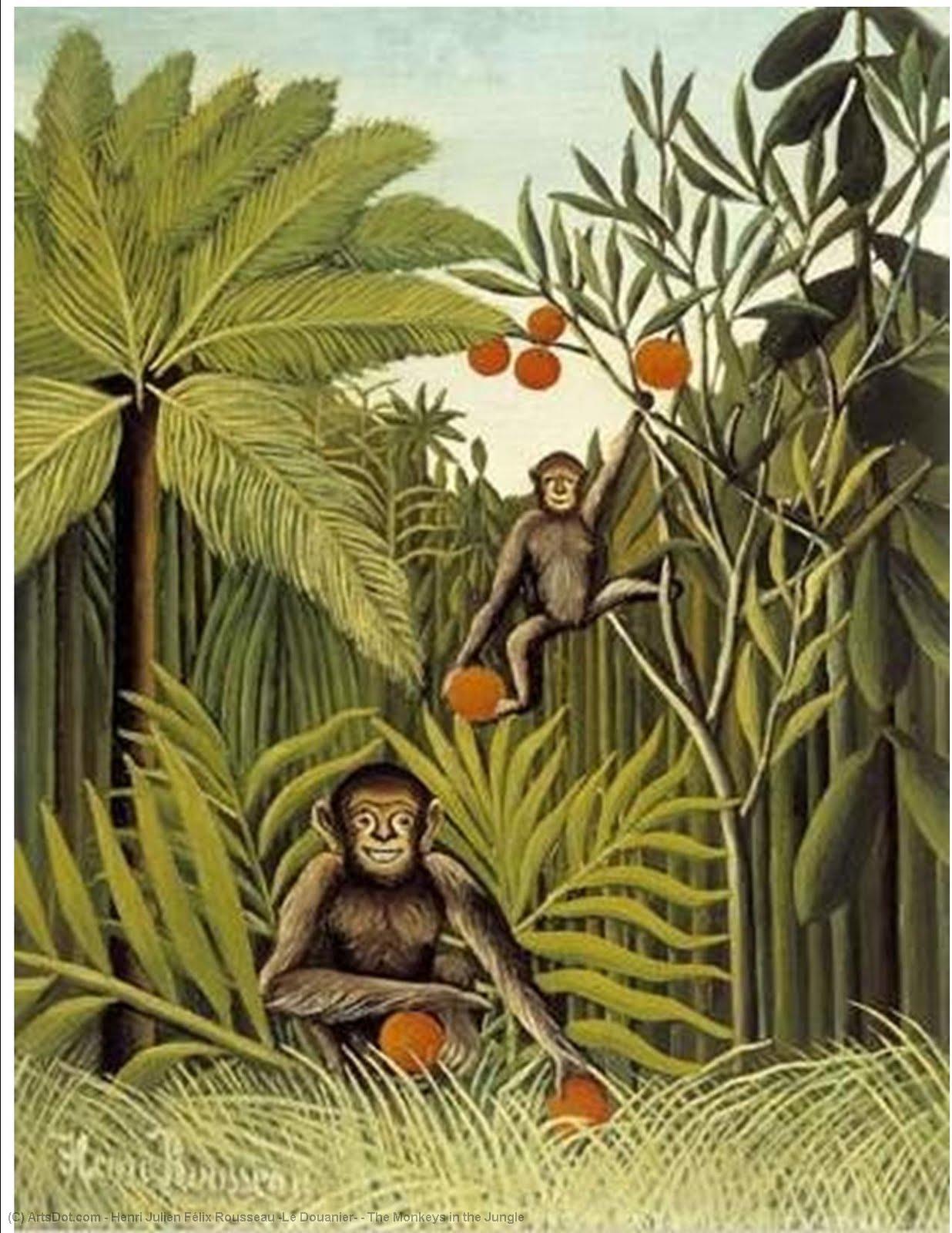
The Monkeys in the Jungle


 Read More
Giclée / Art Print
Museum-quality giclée or canvas print with fast production and flexible finish options. ( Buy Hand Made Painting Buy Image)




P118B $10

P118H $10

P118W $10

P438Z $10

P508JH $12

P508YH $12

P805H $10

P805Z $10

P919BZ $10

P919G $10

P919XJ $10

P959ZH $10

P968JZ $12

W106C $8

W218G $10

W218JH $8

W218Y $10

W307PJ $10

W316G $10

W316PJ $8

W316Y $10

W398PJ $8

W4111J $10

W500HY $15

W500JH $15

W692G $12

W849H $8

W940BG $15

W953PJ $8




Pick from our preset sizes that match the artwork's original proportions.

You may enter your own dimensions to fit a specific frame or space. If your selected size does not match the original image's proportions, we will either crop the artwork or extend the image with a mirrored or solid-fill edge. A digital mockup will be sent for your approval before production begins.
Please note that the on-screen preview does not reflect the actual cropping or extension. Only the mockup will accurately show the final composition.
While custom sizes are available, we recommend selecting a dimension from the predefined list to preserve the original proportions.
Worldwide Delivery () in 2 weeks instead of standard 4/5 weeks. (16 August)

Free Worldwide Express Shipping

High-Quality Linen Canvas

Full Shipping Insurance

Customs Tax Refund Guarantee

True Color Matching Guarantee

60-Day Return Policy (Defects Only)

100% Money-Back Guarantee

Bulk Discount Offer
 Glass option is only available in size under 110 CM

The Monkeys in the Jungle
Giclée / Art Print
Reproduction Size
-


Total Price
$ 63
Collectible Description
A Dreamscape of Primal Harmony
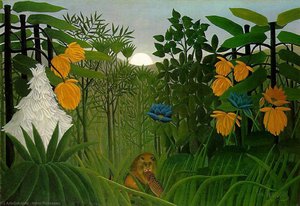
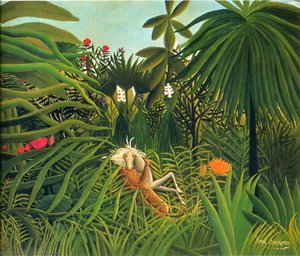
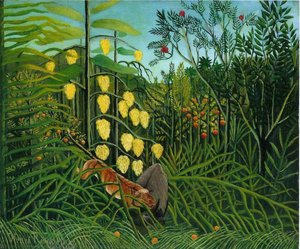
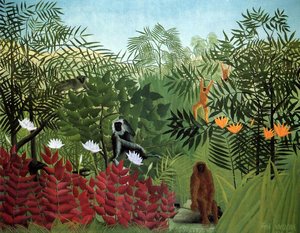
In the lush, emerald heart of a forgotten world, Henri Julien Félix Rousseau captures a moment of pure, unadulterated joy in his 1909 masterpiece, The Monkeys in the Jungle. This enchanting scene invites the viewer to step away from the complexities of modern life and into a vibrant, dreamlike sanctuary where nature exists in perfect equilibrium. The painting presents a trio of monkeys navigating a dense, verdant landscape; one sits peacefully on the forest floor cradling fruit, another stands alert amidst the foliage, and a third swings gracefully from a sturdy branch. Scattered throughout this botanical paradise are bright apples, some nestled in the earth and others suspended like jewels from the trees, adding a sense of abundance and sweetness to the composition.
Rousseau’s unique approach to the jungle subject matter transcends mere botanical illustration, offering instead a window into a subconscious Eden. The atmosphere is one of profound playfulness and harmony, where the boundaries between the animals and their environment seem to blur. There is a rhythmic quality to the way the greenery envelops the subjects, creating a sense of depth that feels both intimate and expansive. For the collector or interior designer, this piece serves as a captivating focal point, bringing a breath of fresh, organic life into any space, whether it be a sophisticated gallery setting or a cozy, sunlit study.
The Naïve Visionary and His Technique
To understand the magic of The Monkeys in the Jungle, one must look to the singular hand of "Le Douanier." As a self-taught artist who spent much of his life as a customs officer, Rousseau brought a refreshing, unburdened perspective to the canvas. His style, often categorized as Naïve or Post-Impressionist, eschews traditional academic rules of perspective in favor of flat, layered planes and simplified, iconic forms. This technique allows the colors to vibrate with an almost supernatural intensity. The deep, saturated greens of the jungle foliage are punctuated by the bright, rhythmic pops of red from the scattered apples, creating a visual melody that is as much about pattern as it is about subject matter.
The artist’s mastery lies in his ability to evoke complex emotions through simplified shapes and bold color palettes. There is no need for intricate shading or realistic anatomical detail when the sheer vibrancy of the scene communicates such potent vitality. This stylistic choice lends the work a timeless, almost folkloric quality that resonates deeply with contemporary tastes. For those seeking a high-quality reproduction, the charm of Rousseau’s brushwork lies in its ability to transform a domestic interior into a portal to another realm—a place where the wild and the wonderful coexist in eternal, colorful peace.
Related Artworks
Artist Biography
Henri Julien Félix Rousseau: A Life in Art
Early Life and Background
- Born on May 21, 1844, in Laval, France, Henri Julien Félix Rousseau led an unconventional life before becoming a renowned artist.
- His early years were marked by modest circumstances; his father was a tinsmith, and Rousseau himself worked various jobs throughout his youth.
- He received some formal education, showing aptitude for drawing, but ultimately pursued a career as a toll collector – earning him the nickname “Le Douanier” (the customs officer).
- Rousseau served in the military for four years before settling into his role at the Paris octroi, collecting taxes on goods entering the city.
Artistic Development and Style
- Rousseau was largely self-taught as an artist, beginning to paint seriously in his early forties after receiving encouragement from a friend.
- His style is characterized by its naïve or primitive quality, marked by flat perspectives, simplified forms, and vibrant, often unrealistic colors.
- He drew inspiration from botanical gardens, illustrated magazines, and visits to the Jardin des Plantes in Paris, rather than direct observation of nature.
- Rousseau’s paintings often feature lush jungle scenes, exotic animals, portraits, and depictions of everyday life, all rendered with a unique sense of wonder and imagination.
Influences and Artistic Context
- While largely self-taught, Rousseau was aware of the artistic movements of his time – Impressionism and Post-Impressionism – but developed a distinctly personal style that set him apart.
- He admired artists like Eugène Delacroix and drew inspiration from their use of color and exotic subject matter.
- Rousseau’s work predates and anticipates aspects of Surrealism and other early 20th-century avant-garde movements.
Major Works and Achievements
- Some of Rousseau's most celebrated paintings include:
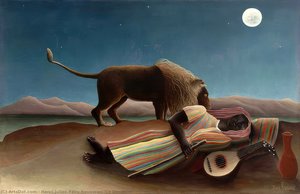
- The Sleeping Gypsy (1897) – a dreamlike depiction of a woman asleep in a jungle setting.
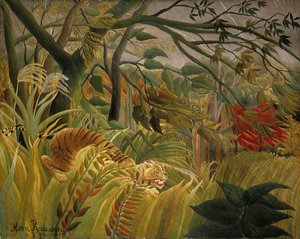
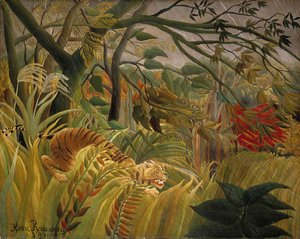
- Tiger in a Tropical Storm (Surprised!) (1891) – showcasing his dramatic use of color and composition.
- Self-Portrait (1890) - A formal portrait showing the artist with a palette and brushes.
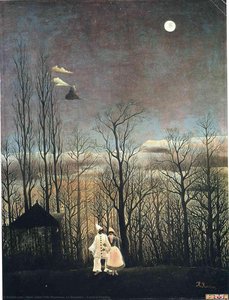
- The Carnival Evening (1886) – capturing a festive scene with intricate details.
- He exhibited regularly at the Salon des Indépendants, gaining recognition among fellow artists and gradually attracting critical attention.
Historical Significance and Legacy
- Initially ridiculed by many critics for his unconventional style, Rousseau’s work eventually gained appreciation as a unique expression of artistic vision.
- He became an inspiration to several prominent artists, including Pablo Picasso and other members of the avant-garde movement.
- In 1908, Picasso famously organized “Le Banquet Rousseau,” a celebratory event honoring the artist and acknowledging his influence.
- Rousseau’s paintings continue to captivate audiences today with their dreamlike quality, vibrant colors, and imaginative subject matter.
- His work remains a testament to the power of self-expression and the enduring appeal of naïve art.
Death and Posthumous Recognition
- Henri Rousseau died on September 2, 1910, in Paris.
- His legacy continued to grow after his death, solidifying his place as a significant figure in modern art history.
- Today, his works are displayed in major museums worldwide and continue to inspire artists and art lovers alike.
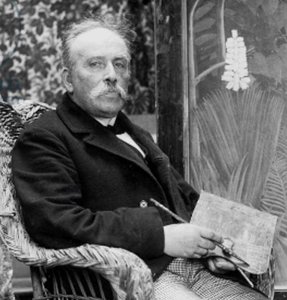
henri julien félix rousseau (le douanier)
1844 - 1910
Quick Facts
- Birth Date: April 17, 1844
- Birth Place: Laval, France
- Death Date: September 2, 1910
- Influenced:
- Vincent van Gogh
- Paul Gauguin
- Influenced By: Impressionist and Post-Impressionist contemporaries
- Movement: Post-Impressionism, Naive art
- Name: Henri Julien Félix Rousseau
- Nationality: French
- Notable Works:
- Sleeping Gypsy
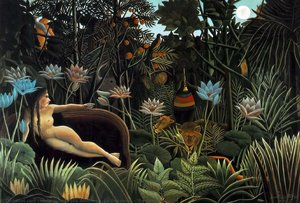
- The Dream
- Carnival Evening
- Tiger in a Tropical Storm
- The Toll House
Related Articles
Verdant Visions: Exploring the Symbolism & Aesthetic Impact of Green in Art History
Explore the rich history & symbolism of green in art! Discover iconic paintings, techniques, and how to bring verdant harmony into your home with ArtsDot's expert guide.
Dark Olive Green Masterpieces: 10 Iconic Paintings & Decor Ideas
Explore 10 iconic paintings where dark olive green reigns supreme! From Van Gogh to Rembrandt, discover art history's most captivating masterpieces & the stories behind them. Find museum-quality reproductions and curated decor ideas at .
Sage Green Masterpieces: 10 Famous Paintings & Timeless Decor Inspiration
Explore 10 famous paintings dominated by serene sage green tones! Discover Monet, Renoir & Manet masterpieces. Learn art history & find museum-quality reproductions for your home decor on .
Chrome Green Masterpieces: 10 Famous Paintings & Their Alluring Hues |
Explore 10 famous paintings where 'Chrome Green' reigns supreme! Discover Monet, Manet & Van Gogh’s masterpieces. Learn the stories behind these iconic artworks and find museum-quality art reproductions for your home at .
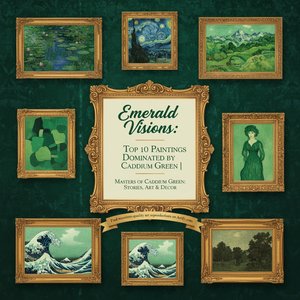
Emerald Visions: Top 10 Paintings Dominated by Cadmium Green |
Explore 10 iconic paintings where cadmium green reigns supreme! From Monet to Van Gogh, discover the stories behind these masterpieces & the power of color. Find museum-quality art reproductions and elevate your home decor on .