

 Preview
 Send
Send Share
Share
 Details

 Download
 Similars
 X-Ray
X-Ray Diaporama
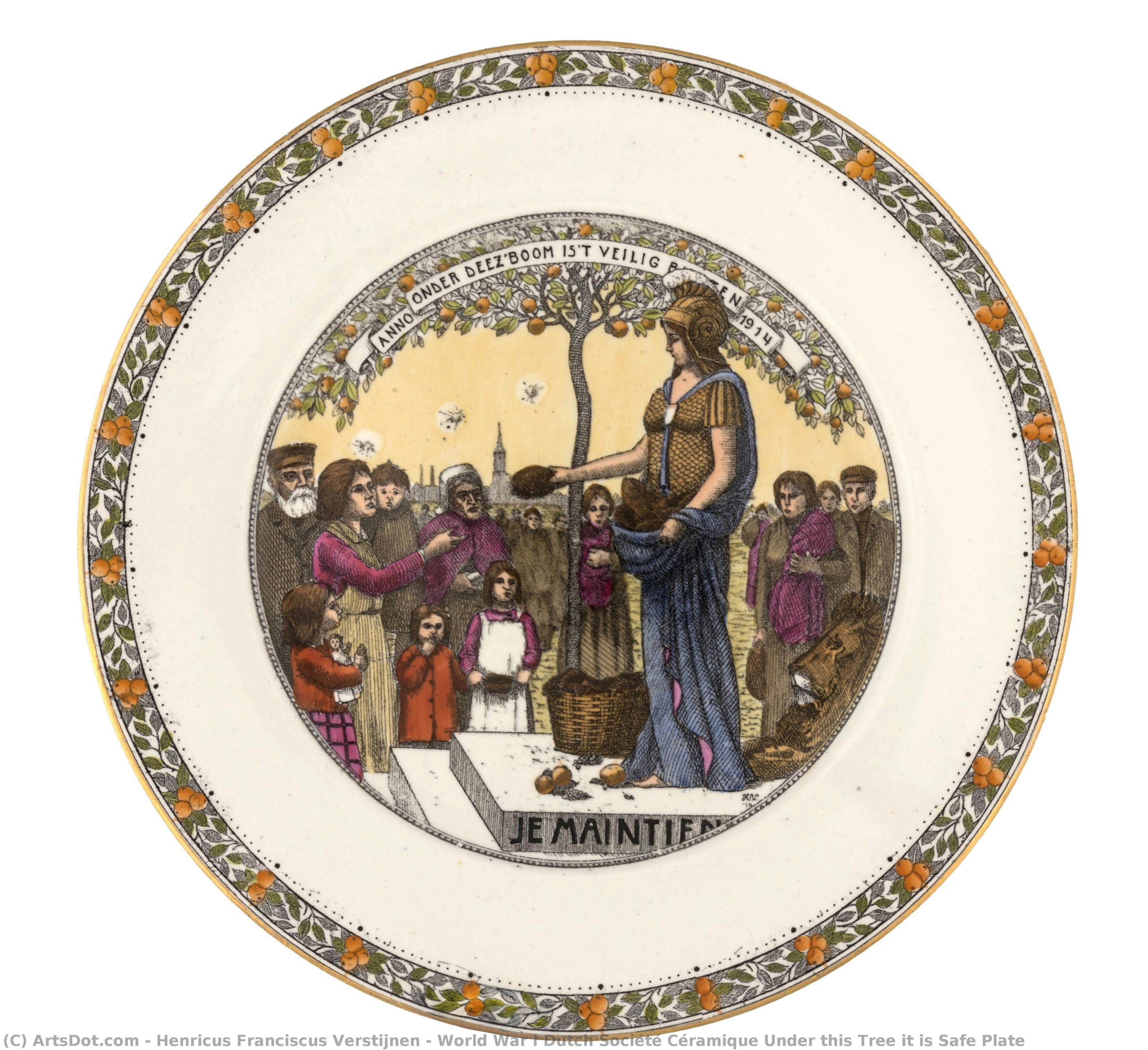
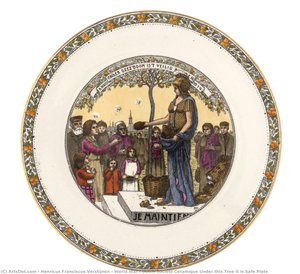
World War I Dutch Société Céramique Under this Tree it is Safe Plate
 1914
1914 25.0 x 3.0 cm
 University of Pretoria Museums
 Read More
Purchase a high-resolution, enhanced digital image, far superior to the online preview.
Each file is meticulously prepared by our in-house specialists using advanced tools and expert manual retouching. We ensure every image has exceptional clarity, precise color accuracy, and fine detail.
The final file is delivered via email within 72 hours, optimized for immediate use in professional, editorial, and print environments. This is the same quality trusted by top-tier design studios, publishers, and galleries.
Digital Image
Download a high-resolution file for personal display, printing, and creative projects. ( Buy Print Buy Hand Made Painting)
Included in Every Digital Image Order
Expert Digital Delivery, Guaranteed
When you choose ArtsDot.com, you're not just getting an image - you're receiving a professionally enhanced digital artwork, crafted with precision and backed by a satisfaction guarantee. Here's everything that comes with your order, automatically:

Fast Email Delivery
Your high-resolution digital image file will be emailed to you within 72 hours of ordering - ready for immediate use.

AI-Enhanced Digital File
Your artwork is professionally optimized using advanced AI tools and manual editing, ensuring maximum detail, clarity, and color accuracy.

Free Lifetime Re-Delivery
Accidentally deleted or lost your file? No worries - we'll resend it to you anytime, free of charge.

No Import Fees - Ever
Enjoy your artwork instantly with zero customs, duties, or delivery fees - digital downloads are always tax-free.

Color Accuracy Guarantee
We ensure your digital image reflects the original colors as closely as possible using professional tools and color management.

60-Day Satisfaction Guarantee
If you're not satisfied with your digital image, we'll revise it or refund 100% within 60 days - no questions asked.

100% Money-Back Guarantee
Not satisfied? Get a full refund within 60 days of receiving your digital file - no questions asked.

Bulk Order Discounts
Buy 3 images, save 10% - Buy 5, save 15% - Buy 10+, save 20%. Great for creative projects, galleries, and agencies.
Related Artworks



Artist Biography
Charles Sheeler: Capturing the Steel and Light of Modern America
Born in Philadelphia in 1883, Charles Rettrew Sheeler Jr.’s artistic journey was a fascinating evolution, shaped by early instruction in industrial drawing and the applied arts at the School of Industrial Art – a surprisingly fertile ground for developing an eye attuned to the burgeoning world of modern industry. This foundation, coupled with formal training at the Pennsylvania Academy of the Fine Arts, provided him with a solid technical base, yet it was his travels abroad, particularly during the years 1904-5 and again in 1908-9, that truly ignited his artistic vision. These experiences exposed him to the profound influence of Italian masters like Giotto, Masaccio, and Piero della Francesca – artists who prioritized clarity of form, monumental scale, and a directness of representation. Sheeler wasn’t simply copying these figures; he was absorbing their approach to massing forms, distilling it into a core principle that would underpin his entire career.
Returning to America, Sheeler found himself drawn to the rapidly transforming landscape of the early 20th century – a nation gripped by industrialization and urbanization. He began documenting this shift with a keen eye for detail, initially focusing on vernacular architecture, particularly barns in Pennsylvania’s countryside. He recognized in these structures a powerful beauty: their honest construction, their functional design, and their ability to withstand the elements. His photographs of barns weren't romanticized; they were objective studies of form and structure, reflecting his belief that “the builders weren’t building a work of art. . If it’s beautiful to some of us afterward, it’s beautiful because it functioned.” This pragmatic approach, combined with an appreciation for geometric precision, would become hallmarks of his style.
A pivotal moment in Sheeler's artistic development occurred around 1909 when he and his friend Morton Schamberg rented a dilapidated stone house in Doylestown. This became their studio – a space they meticulously shaped with light and shadow, transforming the rough-hewn interior into a series of interlocking planes and volumes. Simultaneously, Sheeler began to seriously pursue photography, initially documenting the architecture around him but soon turning his lens toward the burgeoning industrial landscape of New York City. This dual focus—painting and photography—proved remarkably synergistic. He used photographs as visual studies, dissecting complex forms and compositions before translating them onto canvas. His early photographic work for architects like Albert Barnes and galleries such as Knoedler & Co. provided him with invaluable experience in capturing the essence of industrial design and architectural detail.
The Precisionist Movement and Early Modernism
Sheeler’s artistic trajectory intersected significantly with the emergence of the Precisionist movement, a loosely defined group of artists working in the early 20th century who sought to depict modern life with remarkable clarity and objectivity. Influenced by the work of Édouard Manet – particularly his depictions of urban scenes and his rejection of traditional academic painting conventions – Sheeler embraced a style characterized by sharp lines, flattened perspective, and an emphasis on geometric forms. This approach was partly inspired by the Italian Renaissance masters he had studied, but also reflected a desire to capture the dynamism and energy of the modern world.
His collaboration with Paul Strand on *Manhatta* (1920) is considered a seminal work in the development of Precisionism. The film’s stark, angular compositions and dramatic use of light and shadow powerfully conveyed the scale and momentum of the Ford Motor Company's factory – an embodiment of American industrial might. Sheeler continued to explore these themes throughout the 1920s, documenting the vast machinery of the Rouge Plant in River Rouge, Michigan, and capturing the towering skyscrapers of New York City. These photographs weren’t simply records; they were carefully constructed compositions that celebrated the power and efficiency of modern industry.
A Shift Towards Abstraction
While Sheeler remained committed to depicting industrial subjects throughout his career, he gradually moved towards a more abstract style in the 1930s. Influenced by Cubism and the work of Piet Mondrian, he began to reduce forms to their essential geometric components – lines, rectangles, and circles – creating dynamic compositions that explored spatial relationships and visual rhythms. This shift was partly driven by the economic realities of the Great Depression, which forced him to seek commercial commissions for his artwork.
Despite this stylistic evolution, Sheeler never abandoned his roots in realism or his fascination with industrial design. His later works often combined elements of abstraction and representation, creating complex visual puzzles that challenged viewers to decipher the underlying structures of modern life. His paintings from this period are characterized by a remarkable clarity of form and a subtle use of color – a testament to his enduring artistic vision.
Legacy and Influence
Charles Sheeler’s work had a profound impact on American art, shaping the course of Precisionism and influencing generations of artists. His meticulous attention to detail, his innovative use of photography, and his ability to capture the essence of industrial design established him as one of the most important figures in 20th-century American art. His photographs are now recognized for their historical significance and their aesthetic beauty, while his paintings continue to be admired for their clarity, dynamism, and formal innovation.
Beyond his artistic achievements, Sheeler’s career exemplifies a remarkable adaptability and resilience. He navigated the changing landscape of the American art world with grace and determination, embracing new technologies and stylistic trends while remaining true to his own unique vision. Charles Sheeler's legacy endures as a testament to the power of observation, the beauty of industrial design, and the enduring appeal of modern abstraction.
henricus franciscus verstijnen
1883 - 1947 , Netherlands
Quick Facts
- Artistic Movement Or Style:
- Precisionism
- Photography
- Artists Or Movements Influenced By This Artist:
- Cubism
- Impressionism
- Artists Who Influenced This Artist:
- Édouard Manet
- William Chase
- Date Of Birth: 1883
- Date Of Death: 1965
- Full Name: Charles Sheeler
- Nationality: American
- Notable Artworks:
- Manhatta
- Ford Factory Views
- Place Of Birth: Philadelphia, USA

