Preview
 Send
Send Share
Share
 Details

 Download
 Similars
 X-Ray
X-Ray Diaporama
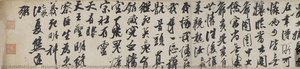
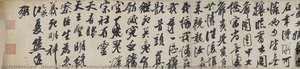
A Transcription of the “Grievance in Prison”in Running Script(handscroll)-1

 Read More
Giclée / Art Print
Museum-quality giclée or canvas print with fast production and flexible finish options. ( Buy Hand Made Painting Buy Image)




































Pick from our preset sizes that match the artwork's original proportions.

You may enter your own dimensions to fit a specific frame or space. If your selected size does not match the original image's proportions, we will either crop the artwork or extend the image with a mirrored or solid-fill edge. A digital mockup will be sent for your approval before production begins.
Please note that the on-screen preview does not reflect the actual cropping or extension. Only the mockup will accurately show the final composition.
While custom sizes are available, we recommend selecting a dimension from the predefined list to preserve the original proportions.
Worldwide Delivery () in 2 weeks instead of standard 4/5 weeks. (29 August)

Free Worldwide Express Shipping

High-Quality Linen Canvas

Full Shipping Insurance

Customs Tax Refund Guarantee

True Color Matching Guarantee

60-Day Return Policy (Defects Only)

100% Money-Back Guarantee

Bulk Discount Offer
 Glass option is only available in size under 110 CM

A Transcription of the “Grievance in Prison”in Running Script(handscroll)-1
Giclée / Art Print
Reproduction Size
-


Total Price
$ 63
Related Artworks







Artist Biography
A Legacy of Ink and Iron: The Dual Life of Hsiung Ting-Pi
In the turbulent twilight of the Ming dynasty, few figures embodied the intersection of scholarly grace and martial fortitude as profoundly as Hsiung Ting-Pi. A man whose life was defined by both the delicate tip of a calligraphy brush and the heavy weight of imperial command, he remains a singular icon in Chinese history. Born around 1583, his existence was a constant dance between the quiet contemplation of the literati and the high-stakes strategy of the battlefield. While many of his contemporaries sought refuge in the purely aesthetic or the strictly political, Ting-Pi navigated a path that demanded excellence in both, carving out a legacy that is as much about the strength of character as it is about the elegance of line.
His early years were steeped in the rigorous traditions of Confucian scholarship. Raised with an appreciation for moral philosophy and social order, his education provided the intellectual scaffolding upon which his artistic vision was built. This foundation allowed him to master the complexities of calligraphy and poetry, disciplines that require not just technical skill, but a deep understanding of symbolism and emotional resonance. To Ting-Pi, a single brushstroke was never merely an aesthetic choice; it was an expression of cosmic balance and ethical clarity. This scholarly upbringing ensured that even when he transitioned into the brutal realities of military governance, his perspective remained infused with the poetic sensitivity of a true master.
The Strategist’s Brush: Artistry Amidst Conflict
The trajectory of Ting-Pi’s life took a dramatic turn as he rose through the imperial ranks to become a vital defender of China's borders. Appointed as a military governor tasked with bolstering defenses against Mongol incursions along the Great Wall, his life became a whirlwind of mobilization and strategic innovation. As the Junior Vice-President of the Ministry of War and later the Chief Military Director of the Liaodong area, he faced the daunting task of securing the empire against the encroaching Later Jin forces. It was during this period of immense pressure that his artistic and military identities merged into a singular, powerful expression of resilience.
His most poignant works often emerged from the shadows of political strife and personal hardship. The famous “Grievance in Prison” handscroll serves as a haunting testament to his turbulent later years. This work, rendered in a masterful running script, transcends simple transcription; it is a visceral outpouring of the soul, capturing the profound injustice he faced when powerful factions sought to dismantle his career. Through the fluid, energetic movements of his calligraphy, one can sense the tension between his disciplined military mind and the raw, unyielding spirit of a man facing wrongful execution. His art became a vessel for truth in an era of political deception.
Historical Significance and the End of an Era
The tragedy of Hsiung Ting-Pi’s life lies in its conclusion, yet his impact on Chinese art and history remains indelible. Despite his successes in stabilizing the Liaodong region and his ability to command respect even from formidable adversaries, he fell victim to the machinations of the powerful eunuch Wei Zhongxian. In 1622, during the second year of the Tianqi period, Ting-Pi was executed for crimes he did not commit, a loss that signaled a dark chapter for the Ming administration. However, the death of the man did not silence the voice of the artist.
Today, we remember Hsiung Ting-Pi not merely as a fallen commander, but as a pioneer who bridged the gap between the martial and the lyrical. His contributions to calligraphy and his ability to infuse ink with the gravity of historical struggle continue to inspire. His life serves as a powerful reminder that true artistry is often forged in the crucible of adversity, and that the most enduring legacies are those written with both courage and grace.
hsiung t’ing-pi
1625 , China
Quick Facts
- Artistic Movement Or Style: Ming Dynasty Art
- Date Of Death: 1625
- Full Name: hsiung t’ing-pi
- Nationality: Chinese
- Notable Artworks: ['Grievance in Prison Scroll']
- Place Of Birth: China