 Preview
 Send
Send Share
Share
 Details

 Download
 Similars
 X-Ray
X-Ray Diaporama
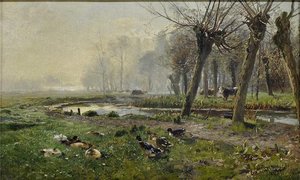
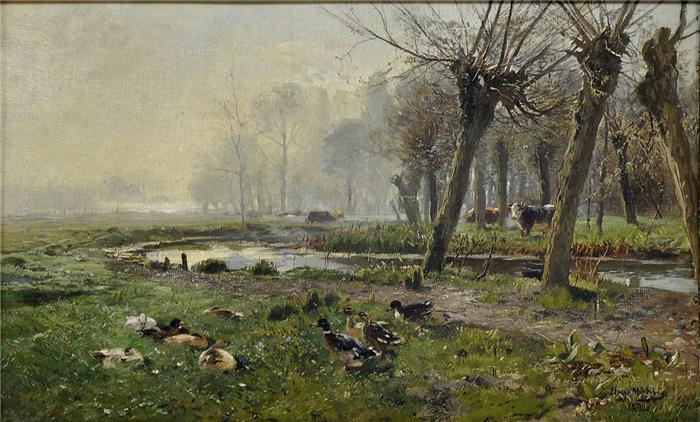
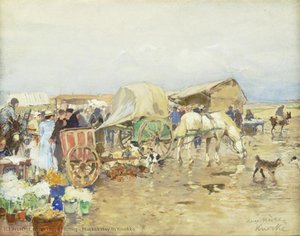
Lower Rhine Landscape (also known as Niederrheinische Landschaft)
 1890
1890 36.0 x 59.0 cm
 Read More
Hand Made Oil Reproduction
Hand-painted oil on canvas in your size and frame, made to order by our artists. ( Buy Print Buy Image)




































Pick from our preset sizes that match the artwork's original proportions.

You may enter your own dimensions to fit a specific frame or space. If your selected size does not match the original image's proportions, we will either crop the artwork or extend the painting with additional hand-painted elements. A digital mockup will be sent for your approval before production begins.
Please note that the on-screen preview does not reflect the actual cropping or extension. Only the mockup will accurately show the final composition.
While custom sizes are available, we recommend selecting a dimension from the predefined list to preserve the original proportions.
After order, ArtsDot.com team will email client for instructions and provide a mockup preview
Worldwide Delivery () in 3/4 weeks instead of standard 5 weeks. (25 August). No compromise on quality.

Free Worldwide Express Shipping

High-Quality Linen Canvas

Full Shipping Insurance

Customs Tax Refund Guarantee

True Color Matching Guarantee

60-Day Return Policy (Defects Only)

100% Money-Back Guarantee

Bulk Discount Offer
 Glass option is only available in size under 110 CM

Lower Rhine Landscape (also known as Niederrheinische Landschaft)
Reproduction Medium
Reproduction Size
-


Total Price
$ 263
Related Artworks










Artist Biography
Hugo Mühlig (1854 - 1929): A Pioneer of Impressionistic Landscape Painting
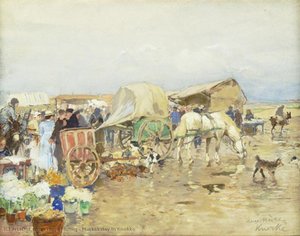
Hugo Mühlig was a German Impressionist painter who emerged as a significant figure in Düsseldorf’s artistic landscape during the late Victorian era. Born in Dresden to parents deeply rooted in the art world – his father, Meno Mühlig, himself a celebrated landscape artist – and nephew to Bernhard Mühlig, another influential painter of serene landscapes – Hugo was nurtured within an environment that fostered artistic exploration and innovation. This familial legacy profoundly shaped his own creative trajectory, establishing him as a son of tradition yet simultaneously embracing the transformative impulses of Impressionism. His formative years were spent honing his skills at the Dresden Academy of Fine Arts, where he studied under Viktor Paul Mohn, absorbing the principles of Ludwig Richter’s realist school before embarking on a decisive shift toward capturing fleeting moments and vibrant colors characteristic of the Impressionist movement. Recognizing the limitations of academic conventions, Hugo sought inspiration in the picturesque landscapes of Düsseldorf—particularly the Schwalm region—where he established a prolific artistic practice alongside fellow Secessionists. This environment fostered experimentation and encouraged artists to break free from rigid stylistic constraints. Hugo’s artistic vision centered on portraying rural life with remarkable sensitivity and detail. He meticulously rendered scenes of farmers, hunters, musicians, and everyday individuals immersed in the radiant glow of sunlight—a technique directly influenced by Monet and Renoir—resulting in paintings imbued with an unparalleled luminosity and textural richness. Unlike many of his contemporaries who adhered to formal academic standards, Hugo prioritized capturing the essence of human experience within a natural setting, prioritizing emotional resonance over mere visual representation. His oeuvre comprises approximately 110 paintings predominantly focused on landscapes and genre scenes. Notable works include “Market Day in Knokke,” depicting a bustling marketplace bathed in sunlight; “The Hunters’ Breakfast,” portraying a convivial gathering amidst the tranquil beauty of the countryside; and “Medieval Houses,” capturing architectural details with meticulous precision. These pieces exemplify Hugo's mastery of Impressionistic technique—particularly his skillful use of brushstrokes to convey atmospheric conditions and illuminate surfaces—demonstrating an unwavering commitment to artistic excellence. Hugo Mühlig’s paintings are housed in prominent museums across Germany, including the Neue Galerie Berlin, Kunstmuseum Düsseldorf, Neue Galerie Kassel, and Wallraf-Richartz Museum Cologne, cementing his place as a cornerstone of German Impressionism. His legacy extends beyond his individual artworks; he served as an inspiring mentor to younger artists and championed the pursuit of artistic freedom—a testament to his enduring influence on the development of modern art.- Notable Achievements: Recognized for his contribution to Impressionistic landscape painting.
- Influences: Ludwig Richter’s School, Viktor Paul Mohn
- Location: Düsseldorf
hugo mühlig
1854 - 1929
Quick Facts
- Artistic Movement Or Style: Impressionism
- Artists Or Movements Influenced By This Artist:
- Monet
- Renoir
- Artists Who Influenced This Artist:
- Ludwig Richter
- Viktor Paul Mohn
- Date Of Death: 1929
- Full Name: Hugo Mühlig
- Nationality: German
- Notable Artworks:
- Market day in Knokke
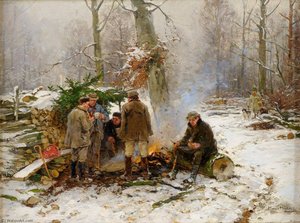
- The Hunters' Breakfast
- Medieval Houses
- Place Of Birth: Dresden, Germany