

 Preview
 Buy Print
 Send
Send Share
Share


 Download
 Similars
 X-Ray
X-Ray Diaporama
Allegory of the Good Government


A Window into Siena’s Soul: Ambrogio Lorenzetti's ‘Allegory of Good Government’
Within the Palazzo Pubblico in Siena, Italy, resides a monumental fresco – the “Allegory of Good and Bad Government” by Ambrogio Lorenzetti. Painted between 1338 and 1339, this isn’t merely a decorative mural; it's a profound civic statement, a visual treatise on governance designed to guide the nine magistrates who ruled the Republic of Siena. More than just a historical record, it’s a vibrant tableau brimming with symbolism, offering a rare glimpse into the values and aspirations of a thriving medieval city-state. The fresco, originally spanning three walls of the Sala dei Nove (Salon of Nine), speaks volumes about Siena's commitment to republican ideals and its understanding of the delicate balance required for a just and prosperous society.
A Symphony of Figures: Style and Technique
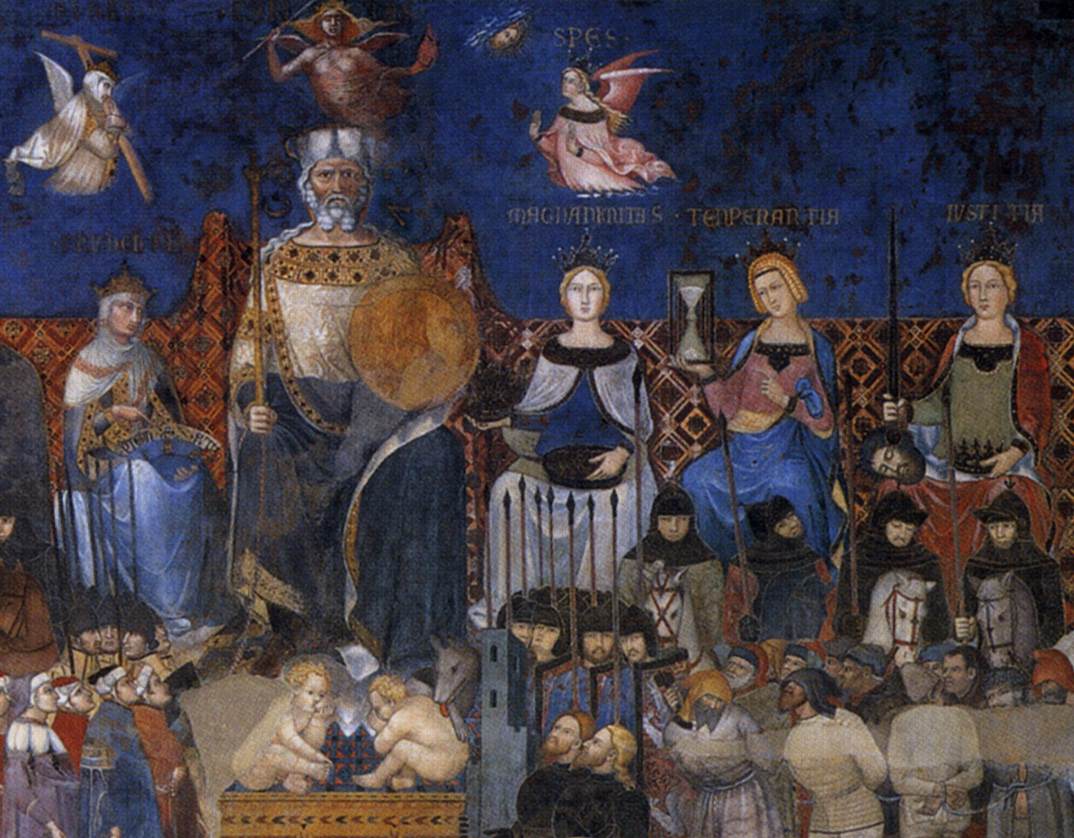
Lorenzetti’s style is a captivating blend of influences – the solemn grandeur of Byzantine art, the classical ideals of antiquity, and the burgeoning naturalism that would define the Renaissance. The fresco's composition unfolds in three distinct horizontal bands. The foreground depicts a bustling scene of Siena’s citizens, interwoven with symbolic figures representing the virtues essential for good governance. Above them, on a stage-like structure, reside allegorical representations of these virtues – Justice, Fortitude, Prudence, Magnanimity, Temperance, and Wisdom – each rendered in exquisite detail and adorned with crowns, signifying their elevated status. The use of color is remarkably sophisticated; deep blues and greens dominate the background, creating a sense of depth and stability, while the figures are depicted in rich reds, golds, and browns, adding to the overall visual impact. Notably, Lorenzetti employed a technique that anticipates linear perspective, subtly guiding the viewer’s eye through the complex arrangement of figures and architectural elements – a revolutionary approach for his time.
The fresco's execution is remarkable considering its age. The meticulous detail in each figure, from the folds of their garments to the expressions on their faces, speaks to Lorenzetti’s exceptional skill as a painter. He masterfully integrated architectural elements into the composition, creating a cohesive and immersive experience for the viewer. The overall effect is one of dynamic movement and harmonious balance – a testament to Lorenzetti's artistic vision.
Decoding the Symbols: A Language of Governance
The “Allegory of Good Government” isn’t simply a beautiful painting; it’s a complex visual lexicon. The central figures, a seated authority representing power and another holding a scroll symbolizing knowledge or law, are surrounded by a multitude of allegorical representations – angels at the corners perhaps signifying divine guidance, a castle and cityscape suggesting stability and prosperity, and various figures embodying virtues like wisdom, strength, and prudence. The inclusion of children within the composition is particularly significant, potentially representing the future generations who will inherit the benefits of good governance. The text woven into the lower border further elucidates the principles of virtuous leadership – emphasizing unity, justice, and the importance of prioritizing the common good.
A Legacy Enduring: Historical Context and Significance
Created during a turbulent period in Siena’s history—a time marked by political instability and civic strife—the fresco served as a potent reminder to the city's ruling council of their responsibilities and the importance of upholding republican values. Lorenzetti’s work reflects the broader Renaissance interest in classical ideals of governance, while simultaneously grounding these concepts within the specific context of Siena’s civic identity. The “Allegory of Good Government” stands as a remarkable achievement – not only for its artistic merit but also for its enduring significance as a visual representation of political philosophy and civic responsibility. It remains a powerful testament to the belief that art can be used to shape public discourse and inspire virtuous leadership, a message that resonates even today.
Ambrogio Lorenzetti (1290 – 1348)
Explore Ambrogio Lorenzetti (c.1290-1348), a pioneering Sienese painter famed for his frescoes like 'Good & Bad Government.' Discover his innovative blend of Byzantine, classical, and naturalistic styles!
Palazzo Pubblico (Siena, Italy)
Explore the Palazzo Pubblico in Siena, Italy – a stunning medieval town hall with breathtaking frescoes by Lorenzetti & Martini. Discover civic art, climb the Torre del Mangia for panoramic views, and delve into Sienese history!
About this artwork
- Title: Allegory of the Good Government
- Artist: Ambrogio Lorenzetti
- Year: 1338
- Format: Panoramic
- Copyright status: Public domain
- Where to see it: Palazzo Pubblico
- Movement: Early Renaissance
- Medium: Acrylic On Canvas
- Creative period: Early Renaissance
- Color palette: Earthy
Quick Facts
- Notable elements or techniques: Symbolic imagery
- Movement: Early Renaissance
- Artistic style: Sienese School
- Artist: Ambrogio Lorenzetti
- Year: 1338
- Location: Palazzo Pubblico, Siena
- Subject or theme: Good Governance
QR Code


