 Preview
 Send
Send Share
Share
 Details

 Download
 Similars
 X-Ray
X-Ray Diaporama
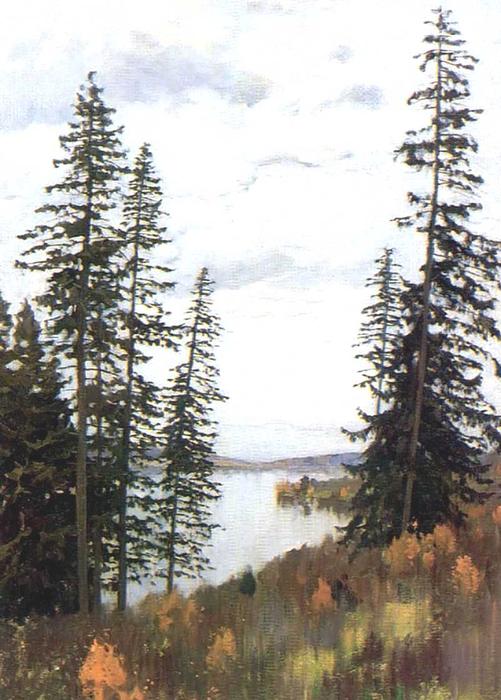
In the North
 Oil
Oil- WallArt
- Realism with Impressionistic tendencies
 1896
1896 106.0 x 77.0 cm
 Tretyakov Gallery
 Read More
Hand Made Oil Reproduction
Hand-painted oil on canvas in your size and frame, made to order by our artists. ( Buy Print Buy Image)




P118B $10

P118H $10

P118W $10

P438Z $10

P508JH $12

P508YH $12

P805H $10

P805Z $10

P919BZ $10

P919G $10

P919XJ $10

P959ZH $10

P968JZ $12

W106C $8

W218G $10

W218JH $8

W218Y $10

W307PJ $10

W316G $10

W316PJ $8

W316Y $10

W398PJ $8

W4111J $10

W500HY $15

W500JH $15

W692G $12

W849H $8

W940BG $15

W953PJ $8




Pick from our preset sizes that match the artwork's original proportions.

You may enter your own dimensions to fit a specific frame or space. If your selected size does not match the original image's proportions, we will either crop the artwork or extend the painting with additional hand-painted elements. A digital mockup will be sent for your approval before production begins.
Please note that the on-screen preview does not reflect the actual cropping or extension. Only the mockup will accurately show the final composition.
While custom sizes are available, we recommend selecting a dimension from the predefined list to preserve the original proportions.
After order, ArtsDot.com team will email client for instructions and provide a mockup preview
Worldwide Delivery () in 3/4 weeks instead of standard 5 weeks. (17 August). No compromise on quality.

Free Worldwide Express Shipping

High-Quality Linen Canvas

Full Shipping Insurance

Customs Tax Refund Guarantee

True Color Matching Guarantee

60-Day Return Policy (Defects Only)

100% Money-Back Guarantee

Bulk Discount Offer
 Glass option is only available in size under 110 CM

In the North
Reproduction Medium
Reproduction Size
-


Total Price
$ 263
Artwork Description
The Soul of the Frozen Land: Isaak Levitan’s “In the North”
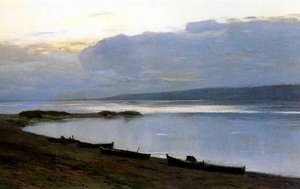
Isaak Ilyich Levitan's "In the North" (1896) isn’t merely a landscape painting; it’s a profound distillation of the Russian soul, a poignant exploration of solitude and the sublime beauty found within the austere embrace of the Arctic wilderness. Painted during a period of intense introspection for the artist – marked by personal loss and a deep connection to the natural world – this work transcends simple representation, becoming a visual poem about resilience, melancholy, and the enduring power of nature.
Levitan, a master of what he termed “mood landscapes,” eschewed the bright, idealized depictions favored by some of his contemporaries. Instead, he sought to capture not just the appearance of a place, but its very essence – the feeling it evokes within the viewer. "In the North" achieves this with remarkable skill, utilizing a muted palette dominated by cool greens, browns, and blues that evoke the perpetual twilight of the high latitudes. The sky, heavy with clouds, presses down upon the scene, creating an atmosphere of quiet contemplation and subtle foreboding.
A Symphony of Verticality: Composition and Technique
The painting’s composition is strikingly vertical, dominated by the towering pine trees that punctuate the foreground. These aren't individual trees, but rather a unified mass, their dark forms rising like silent sentinels against the hazy horizon. This deliberate emphasis on verticality draws the eye upwards, creating a sense of scale and emphasizing the immensity of the landscape. Levitan’s technique is characterized by loose, expressive brushstrokes – a hallmark of Impressionism blended with a distinctly Russian sensibility. He employs *alla prima* painting, working directly onto the canvas without extensive underpainting, resulting in a vibrant, almost luminous quality to the colors.
Notice how he subtly renders the water’s surface; it's not a mirror reflecting the sky, but rather an active element, imbued with movement and depth. The use of atmospheric perspective – softening distant objects and reducing their detail – further enhances the sense of vastness and distance. The subtle gradations of tone, achieved through layering thin washes of paint, create a remarkable illusion of light and shadow, capturing the diffused quality of sunlight filtering through the clouds.
Symbolism in the Silence: Interpreting the Arctic
“In the North” is rich with symbolic meaning. The dominant pine trees, deeply rooted in the harsh northern soil, represent resilience, endurance, and a connection to ancient traditions. They are not merely trees; they are witnesses to centuries of solitude and hardship. The muted colors evoke feelings of melancholy and introspection – a reflection of Levitan’s own emotional state during this period of his life. The absence of human figures reinforces the painting's theme of isolation, inviting the viewer to contemplate their place within the vastness of nature.
Furthermore, the painting can be interpreted as an allegory for Russia itself – a land of immense beauty and profound melancholy, grappling with its own history and identity. The northern landscape, often associated with hardship and remoteness, mirrors the challenges faced by the Russian people during the late 19th century.
A Legacy of Mood: Levitan’s Enduring Influence
Isaak Levitan's "In the North" stands as a testament to his mastery of capturing the emotional essence of the Russian landscape. It is a painting that continues to resonate with viewers today, offering a glimpse into a world of quiet contemplation and profound beauty. His work profoundly influenced generations of Russian landscape painters, establishing a tradition of “mood landscapes” that prioritized atmosphere and emotion over mere topographical accuracy. Reproductions of this iconic piece offer a powerful way to bring the spirit of the Arctic into any space, evoking feelings of peace, solitude, and a deep connection to the natural world.
Related Artworks
Artist Biography
A Symphony of the Russian Soul: The Life and Art of Isaak Ilyich Levitan
Isaak Ilyich Levitan, a name synonymous with the evocative power of Russian landscape painting, was more than just a chronicler of nature; he was a poet of the land, a translator of its moods into visual form. Born in 1860 in Kibarty (present-day Lithuania) to a Jewish family who later settled in Moscow, Levitan’s life was marked by both profound hardship and an unwavering dedication to his art. The early loss of his mother and father cast a long shadow, instilling within him a sensitivity that would permeate his canvases with a melancholic beauty. This sense of longing, coupled with the restrictions imposed upon Jewish communities in Tsarist Russia, fueled a desire to find solace and expression in the natural world. He entered the Moscow School of Painting, Sculpture and Architecture in 1873, where he came under the tutelage of Alexei Savrasov, whose influence would prove pivotal in shaping Levitan’s artistic vision. It was Savrasov who nurtured his student's innate ability to capture not merely the appearance of nature, but its very essence—its atmosphere, its emotional resonance.The Birth of a ‘Mood Landscape’
Levitan quickly distinguished himself as an artist capable of conveying profound emotion through landscape. He wasn’t interested in topographical accuracy for its own sake; rather, he sought to imbue his paintings with a sense of *mood*, a feeling that resonated deep within the viewer's soul. This approach earned him the title of pioneer of the “mood landscape,” a genre that moved beyond simple representation to explore the spiritual connection between humanity and nature. His palette was often subdued, favoring naturalistic colors and poetic elements over vibrant displays. He masterfully employed light and shadow, creating atmospheric effects that evoked feelings of tranquility, solitude, or even quiet despair. Works like *Autumn Day. Sokolniki* (1879), painted when he was just nineteen years old, already demonstrated this remarkable ability to capture the subtle nuances of the Russian countryside. The painting’s muted tones and delicate rendering of light create a sense of wistful nostalgia, hinting at the transience of beauty and the inevitability of change. Later masterpieces such as *The Vladimirka Road* (1892) and *Eternal Rest* (1894), prominently displayed in the Tretyakov Gallery, further solidified his reputation as a master of emotional landscape painting.Influences and Artistic Kinships
While deeply indebted to Savrasov’s influence, Levitan was also receptive to other artistic currents. He collaborated with fellow artists like Konstantin Korovin, Mikhail Nesterov, and Nikolai Chekhov—the brother of the renowned playwright Anton Chekhov, who became a lifelong friend. This circle fostered an environment of creative exchange and mutual support. Though he briefly experimented with Impressionistic techniques, Levitan never fully embraced the movement, maintaining a uniquely Russian sensibility in his work. He found inspiration not only in the visual world but also in music and literature, seeking to translate their emotional power into his paintings. His designs for scenery for Savva Mamontov’s private Russian Opera demonstrate his versatility and willingness to explore different artistic mediums. The influence of these collaborations and experiences can be seen in works like *Spring Flood*, *Stormy Day*, *Vesper Chimes* and *Silent Cloister*, each a testament to his evolving style and deepening understanding of the emotional landscape.Legacy and Enduring Resonance
In 1897, Levitan was elected to the Imperial Academy of Arts, a recognition of his growing stature within the Russian art world. He subsequently became head of the landscape studio at his alma mater in 1898, dedicating himself to nurturing the next generation of Russian landscape painters. His influence extended far beyond his students, however. Levitan’s work played a crucial role in shaping the development of Russian landscape painting, elevating it from mere depiction to a powerful vehicle for emotional and spiritual expression. He instilled within his canvases a sense of national identity and an appreciation for the beauty of the Russian countryside that continues to resonate with audiences today. His untimely death in 1900 at the age of forty left a void in the art world, but his legacy endures as a master of atmospheric landscape painting and a profound interpreter of the Russian soul. In 1941, a poignant tribute was paid to his memory when his remains were moved to the Novodevichy Cemetery in Moscow, where he rests beside Anton Chekhov—a symbolic union of two artistic kindred spirits who captured the essence of their time and place with unparalleled sensitivity and grace. Isaak Ilyich Levitan’s paintings remain a testament to the enduring power of art to evoke emotion, inspire contemplation, and connect us to the beauty and mystery of the natural world.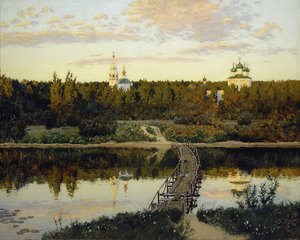
Isaak Ilyich Levitan
1860 - 1900 , Russia
Quick Facts
- Artistic Movement Or Style: Mood Landscape, Realism
- Artists Or Movements Influenced By This Artist: ['Russian Landscape painters']
- Artists Who Influenced This Artist:
- Alexei Savrasov
- Vasily Perov
- Vasily Polenov
- Date Of Birth: August 30, 1860
- Date Of Death: July 22, 1900
- Full Name: Isaak Ilyich Levitan
- Nationality: Russian
- Notable Artworks:
- Autumn Day. Sokolniki
- The Vladimirka Road
- Eternal Rest
- Spring Flood
- Stormy Day
- Vesper Chimes
- Place Of Birth: Kibarty, Lithuania
Related Articles
Serene Visions: Exploring Themes of Tranquility in Art History & Contemporary Practice
Explore the history of serene landscape art & discover artists who evoke tranquility. Find the perfect calming artwork for your home with expert guidance from ArtsDot.

John Constable's Masterpieces: Explore 25 Iconic Landscapes for Your Home
Journey through John Constable's 25 most celebrated landscapes. Explore Romanticism, Dedham Vale & his masterful use of light in iconic paintings like 'Hay Wain'. Find museum-quality art reproductions and elevate your home decor on ArtsDot.com.
Serene Masterpieces: 10 Artworks That Define Tranquility | ArtsDot
Find peace with 10 iconic artworks embodying tranquility! Explore Monet's water lilies, Van Gogh’s starry night & more. Discover the stories behind these serene masterpieces and bring calming art into your home with museum-quality reproductions from ArtsDot.com.

Beyond the Horizon: 10 Landscape Masterpieces for Your Home Decor
Journey through 10 breathtaking landscape paintings by Monet, Van Gogh & more! Explore iconic artworks, artistic techniques & find inspiration for your home decor. Museum-quality reproductions at ArtsDot.com. Discover all masterpieces on ArtsDot.com
Evoking Tranquility: A Study of Serene Beauty in Visual Art Across Historical Movements
Explore the history of serene art & discover how landscape paintings evoke tranquility across movements. Find inspiration for calming home decor & museum-quality reproductions at ArtsDot.