 Preview
 Send
Send Share
Share
 Details

 Download
 Similars
 X-Ray
X-Ray Diaporama
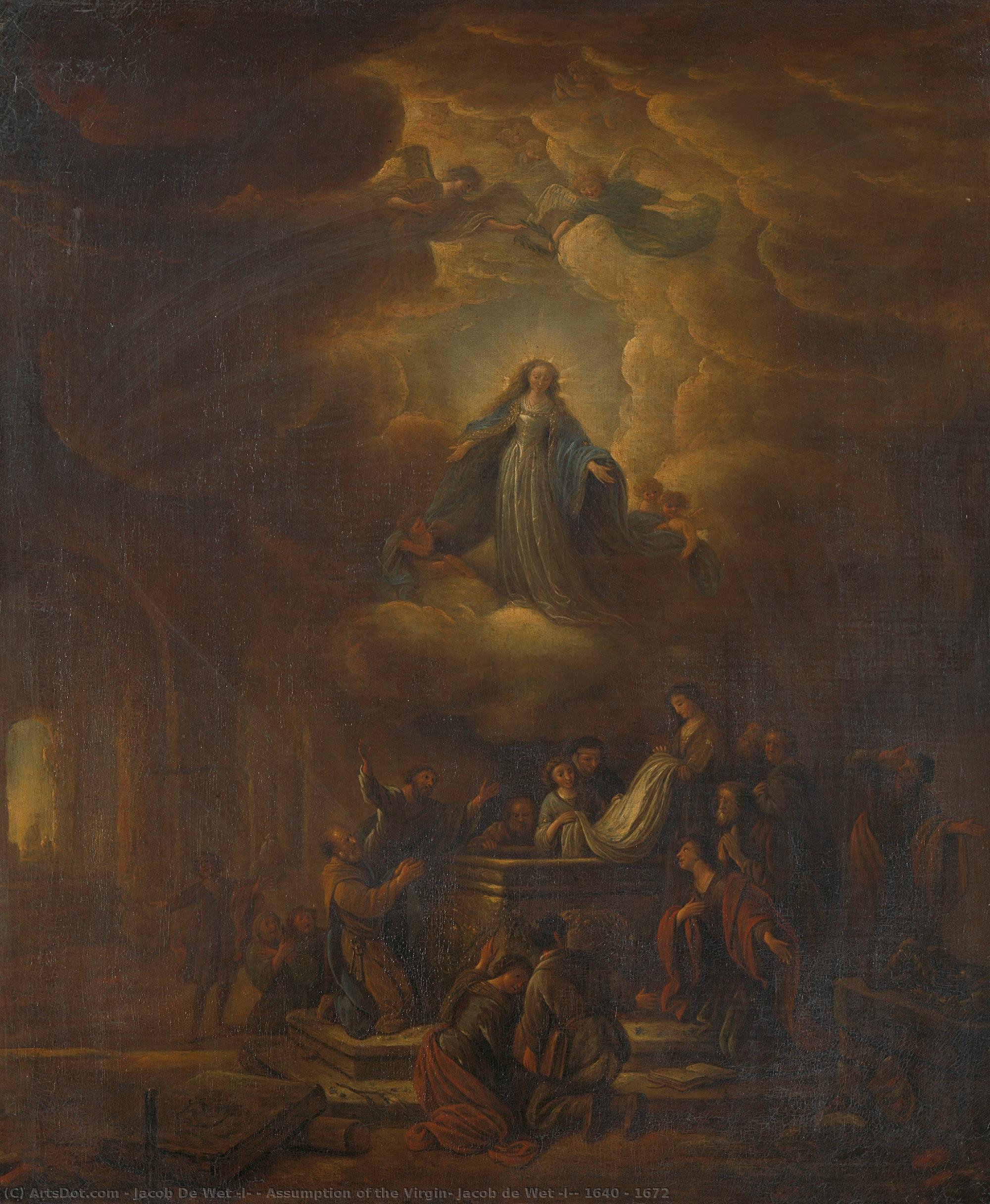
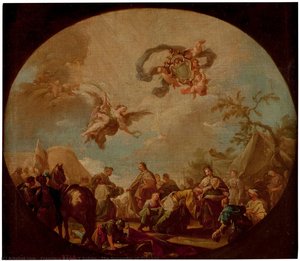
Assumption of the Virgin, Jacob de Wet (I), 1640 - 1672


 Read More
Hand Made Oil Reproduction
Hand-painted oil on canvas in your size and frame, made to order by our artists. ( Buy Print Buy Image)




































Pick from our preset sizes that match the artwork's original proportions.

You may enter your own dimensions to fit a specific frame or space. If your selected size does not match the original image's proportions, we will either crop the artwork or extend the painting with additional hand-painted elements. A digital mockup will be sent for your approval before production begins.
Please note that the on-screen preview does not reflect the actual cropping or extension. Only the mockup will accurately show the final composition.
While custom sizes are available, we recommend selecting a dimension from the predefined list to preserve the original proportions.
After order, ArtsDot.com team will email client for instructions and provide a mockup preview
Worldwide Delivery () in 3/4 weeks instead of standard 5 weeks. (30 August). No compromise on quality.

Free Worldwide Express Shipping

High-Quality Linen Canvas

Full Shipping Insurance

Customs Tax Refund Guarantee

True Color Matching Guarantee

60-Day Return Policy (Defects Only)

100% Money-Back Guarantee

Bulk Discount Offer
 Glass option is only available in size under 110 CM

Assumption of the Virgin, Jacob de Wet (I), 1640 - 1672
Reproduction Medium
Reproduction Size
-


Total Price
$ 438
Related Artworks
Artist Biography
The Master of Haarlem's Golden Light
In the vibrant, bustling streets of 17th-century Haarlem, a period defined by unprecedented prosperity and cultural flourishing, the name Jacob Willemszoon de Wet emerged as a significant force in the Dutch Golden Age. Born around 1610, De Wet was a product of an era where the Netherlands stood at the pinnacle of artistic innovation. While the precise details of his earliest years remain shrouded in the mists of history, his presence in the local artistic community was undeniable. He became a respected member of the Haarlem Guild of St. Luke in 1632, signaling his formal integration into one of Europe's most prestigious artistic circles. His life and work were deeply intertwined with the very fabric of Haarlem, a city that served as a sanctuary for landscape and genre painters alike.
The artistic soul of De Wet was profoundly shaped by the towering shadow of Rembrandt van Rijn. Although he was not a direct pupil of the great master, the influence of Rembrandt’s revolutionary techniques is woven into the very texture of his canvases. One can observe a masterful command of chiarosc Century—the dramatic interplay between light and shadow—and a rich, tonal palette that breathes life into every scene. De Wet possessed a rare ability to utilize subtle expressions and dramatic lighting to convey profound human emotion, a hallmark of the Baroque sensibility. His work does not merely depict a moment; it captures a psychological depth that invites the viewer into a state of quiet contemplation or intense tension.
Narrative Grandeur and Biblical Majesty
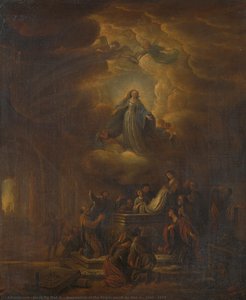
De Wet’s true distinction lay in his ability to transform biblical narratives and historical chronicles into living, breathing dramas. He was far more than a mere illustrator of scripture; he was a storyteller who utilized the canvas to explore the complexities of human psychology and divine intervention. His compositions often feature a dynamic movement that guides the eye through celestial beauty and earthly struggle. A prime example of this is his Assumption of the Virgin, a work that showcases his ability to balance the ethereal with the tangible, presenting the ascension of Mary amidst clouds and angels with an intense emotional resonance.
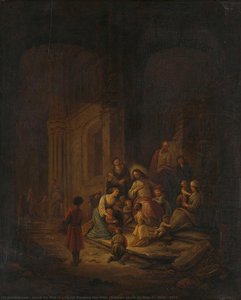
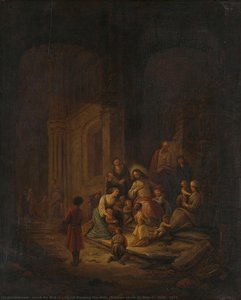
Beyond the sacred, De Wet’s repertoire extended into the realm of landscape and genre scenes, often imbuing them with a sense of atmospheric wonder. Whether depicting a fantastic river landscape or a quiet moment of Christ blessing the children, his brushwork remained dedicated to realistic detail and narrative clarity. His studio was not merely a place of production but a center of learning; his personal notebooks reveal a prolific teacher who mentored at least 34 pupils. Among these notable students were figures such as Paulus Potter and Job Adriaensz Berckheyde, ensuring that his stylistic legacy and technical mastery would ripple through the generations of Dutch painters.
A Legacy Carved in Gold
The historical significance of Jacob De Wet the Elder extends beyond his individual masterpieces to his role as a pillar of the Haarlem art scene. As both a painter and, according to some accounts, an influential art dealer, he was central to the economic and cultural vitality of his city. His life was also marked by familial continuity in art; his son, Jacob De Wet II, followed in his footsteps, eventually finding fame for his monumental series of portraits of Scottish monarchs. This lineage of talent underscores the deep-rooted tradition of craftsmanship that De Wet helped cultivate.
Though he passed away between 1675 and 1691, the impact of his work remains etched in the annals of art history. He represents a vital link in the evolution of Dutch painting, bridging the gap between the intense realism of the early Golden Age and the more decorative, narrative-driven Baroque style. To look upon a De Wet painting is to witness the heartbeat of 17th-century Haarlem—a world where light meets shadow, and where every brushstroke serves to elevate the human experience toward the divine.
Related Articles

Goya's Masterpieces: Explore 25 Iconic Paintings & Art Prints | ArtsDot
Delve into the world of Francisco Goya with ArtsDot. Explore 25 iconic paintings – from 'The Third of May' to his haunting Black Paintings. Discover the stories, techniques & emotions behind these Spanish masterpieces. Find museum-quality art reproductions for your home at ArtsDot.com!

About Us
Discover our story! We bring world-class art into your life through expert curation, personalized creations, and free previews. Trusted by individuals and businesses since 2000.
Jacob Henricus Maris: A Master of Dutch Atmospheric Realism & the Intimate Landscape
Explore the captivating world of Jacob Henricus Maris, a leading figure of the Dutch Hague School. Discover his atmospheric landscapes, signature brushstrokes & lasting influence on 19th-century art. Learn more at ArtsDot.

Baroque Drama: Bringing Opulence & Emotion into Contemporary Interiors
Explore the opulent world of Baroque interior design! Discover key elements, modern applications & how to bring dramatic elegance into your home with 's authentic reproductions.

Baroque Masterpieces: 10 Paintings That Defined an Era |
Journey through the drama & grandeur of Baroque art! Explore 10 masterpieces by Caravaggio, Rembrandt, Rubens & more. Discover stunning oil paintings, rich colors & timeless stories. Find museum-quality reproductions at .