 Preview
 Send
Send Share
Share
 Details

 Download
 Similars
 X-Ray
X-Ray Diaporama
The Conversion of Saint Paul
 Oil On Canvas
- WallArt
- Renaissance
 1544
1544- Renaissance
 193.0 x 276.0 cm
 Read More
Hand Made Oil Reproduction
Hand-painted oil on canvas in your size and frame, made to order by our artists. ( Buy Print Buy Image)




P118B $10

P118H $10

P118W $10

P438Z $10

P508JH $12

P508YH $12

P805H $10

P805Z $10

P919BZ $10

P919G $10

P919XJ $10

P959ZH $10

P968JZ $12

W106C $8

W218G $10

W218JH $8

W218Y $10

W307PJ $10

W316G $10

W316PJ $8

W316Y $10

W398PJ $8

W4111J $10

W500HY $15

W500JH $15

W692G $12

W849H $8

W940BG $15

W953PJ $8




Pick from our preset sizes that match the artwork's original proportions.

You may enter your own dimensions to fit a specific frame or space. If your selected size does not match the original image's proportions, we will either crop the artwork or extend the painting with additional hand-painted elements. A digital mockup will be sent for your approval before production begins.
Please note that the on-screen preview does not reflect the actual cropping or extension. Only the mockup will accurately show the final composition.
While custom sizes are available, we recommend selecting a dimension from the predefined list to preserve the original proportions.
After order, ArtsDot.com team will email client for instructions and provide a mockup preview
Worldwide Delivery () in 3/4 weeks instead of standard 5 weeks. (17 August). No compromise on quality.

Free Worldwide Express Shipping

High-Quality Linen Canvas

Full Shipping Insurance

Customs Tax Refund Guarantee

True Color Matching Guarantee

60-Day Return Policy (Defects Only)

100% Money-Back Guarantee

Bulk Discount Offer
 Glass option is only available in size under 110 CM

The Conversion of Saint Paul
Reproduction Medium
Reproduction Size
-


Total Price
$ 263
Artwork Description
A Divine Encounter in Motion
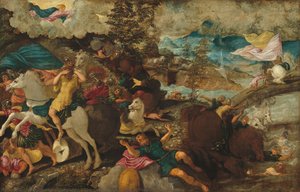
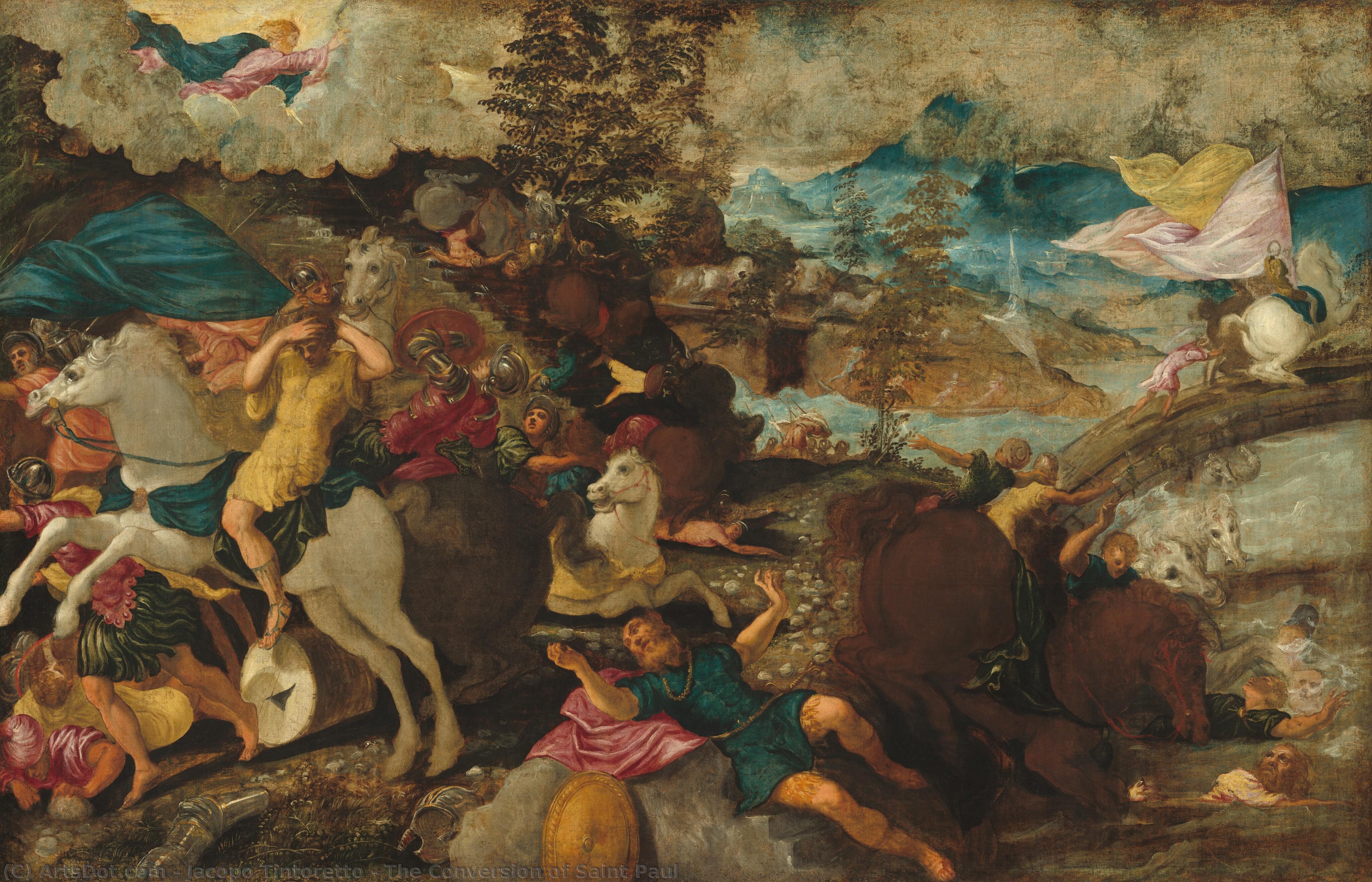
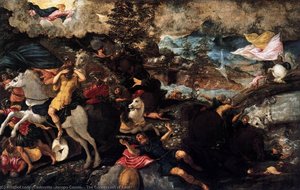
In the grand theater of the Venetian Renaissance, few moments capture the raw, kinetic energy of spiritual transformation quite like Jacopo Tintoretto’s The Conversion of Saint Paul. Painted around 1544, this masterpiece is not merely a depiction of a biblical event; it is a swirling vortex of light, shadow, and human struggle. The canvas erupts with a sense of profound chaos as the world of the earthly and the divine collide. At the heart of this tempest lies Saint Paul, sprawled upon stone steps, his body caught in the sudden, jarring transition from a persecutor of Christians to a chosen apostle. His arms are raised in a gesture of startled vulnerability, while the brilliant teal-blue of his tunic and the warm coral-pink of his cape anchor the composition amidst a sea of tumbling horses and frantic soldiers.
The scene is a masterclass in dynamic composition. Tintoretto, often nicknamed Il Furioso for his vigorous and emotive brushwork, eschews the static, balanced arrangements favored by many of his contemporaries. Instead, he directs the viewer’s eye through a labyrinth of movement. From the rearing white horse on the left, ridden by a man clutching his head in shock, to the soldiers struggling through the riverbanks on the right, every element contributes to a sense of breathless momentum. The landscape itself feels alive, with parchment-white clouds sweeping across the sky and a distant, arched bridge providing a structural counterpoint to the organic disorder below. This is art that breathes, moves, and demands the viewer's full attention.
The Mastery of Venetian Light and Shadow
To behold this work is to witness the pinnacle of Venetian colorism and the dramatic use of chiaroscuro. Tintoretto utilizes light not just to illuminate, but to narrate. A celestial glow descends from the upper left, where a blond, bearded figure—representing the divine presence—stretches across the clouds, gesturing toward the earth. This heavenly light pierces through the atmospheric haze, catching the glint of a gold shield, the silver of a discarded helmet, and the muscular tension of the horses. The interplay between deep, moody shadows and sudden, brilliant highlights creates a sculptural depth that makes the figures appear to leap from the canvas.
For the discerning collector or interior designer, this painting offers an unparalleled emotional resonance. It is a piece that commands presence in any space, bringing with it a sense of historical gravity and intellectual depth. The rich palette—ranging from mustard yellows and emerald greens to deep blues and earthy browns—provides a sophisticated foundation for luxurious decor. Whether placed in a formal gallery setting or as a focal point in a curated study, a high-quality reproduction of this work serves as a window into the soul of the 16th century, inviting contemplation on themes of sudden change, divine intervention, and the enduring power of faith.
Related Artworks

Artist Biography
Jacopo Tintoretto: The Furious Master of Venetian Light
Jacopo Robusti, better known as Tintoretto (from the Italian word *tintore*, meaning dyer, a reference to his father’s profession), emerged in 16th-century Venice as one of the most innovative and influential figures of the Renaissance. Born around 1518, likely late September or early October, his life was a whirlwind of artistic creation, marked by both prodigious talent and a fiercely independent spirit that often clashed with established norms. Unlike many artists of his time who meticulously documented their training, Tintoretto’s early years remain shrouded in some mystery. Tradition holds he apprenticed briefly under Titian, though this is debated; what's undeniable is that he quickly forged his own path, absorbing the lessons of Venetian masters like Giorgione and Giovanni Bellini while simultaneously pushing beyond their conventions with a dynamism all his own. His nickname, *il Furioso* ("the Furious"), speaks to the intensity of his working style – a rapid, almost frenzied approach that produced an astonishing volume of work in a relatively short career, ending with his death on May 31, 1594.A Revolution in Composition and Light
Tintoretto’s genius lay not just in his technical skill but also in his revolutionary approach to composition and the use of light. He rejected the static, balanced arrangements favored by earlier Renaissance painters, opting instead for dramatic diagonals, dynamic movement, and a sense of theatricality that foreshadowed Baroque art. His figures are often caught in moments of intense action, their bodies contorted with emotion, their gestures expansive and expressive. But it was his mastery of light that truly set him apart. Unlike the soft, diffused lighting of Raphael or the carefully controlled chiaroscuro of Caravaggio, Tintoretto employed a bold, almost theatrical use of illumination. Beams of light would slash across canvases, highlighting key figures while plunging others into deep shadow, creating an atmosphere of heightened drama and spiritual intensity. This innovative approach is brilliantly exemplified in works like "The Miracle of Saint Mark," where the saint appears bathed in divine light amidst a swirling vortex of action, or his numerous depictions of “The Last Supper,” each exploring different perspectives and emotional nuances with remarkable freedom. He wasn't afraid to experiment with perspective, often employing dramatic foreshortening and unusual viewpoints to create a sense of immediacy and involvement for the viewer.Major Works and Patronage
Tintoretto’s career flourished under the patronage of Venice’s powerful institutions, particularly the Scuola Grande di San Marco and the Doge's Palace. The Scuola Grande commissions, especially the cycle of paintings depicting the life of Saint Mark, are considered among his greatest achievements, showcasing his ability to combine narrative clarity with breathtaking visual drama. These monumental canvases filled the walls of the *Scuola*, immersing viewers in scenes of miracles, processions, and moments of profound spiritual significance. His work for the Doge's Palace included vast historical paintings that celebrated Venetian power and military triumphs, demonstrating his versatility as an artist capable of tackling both religious and secular subjects with equal skill. Beyond these major commissions, Tintoretto produced countless altarpieces, portraits, and smaller works for private patrons, solidifying his reputation as the leading painter in Venice during a period of intense artistic competition. His son, Domenico Tintoretto, also became a painter, working alongside his father and continuing the family’s legacy after Jacopo's death.Influence and Legacy
Tintoretto’s impact on subsequent generations of artists was profound. He paved the way for the Baroque movement with his dramatic compositions, dynamic figures, and theatrical use of light. Artists like Rubens and Rembrandt were deeply influenced by his innovative approach to painting, adopting his techniques and adapting them to their own styles. His emphasis on emotional intensity and psychological realism also anticipated later developments in art history. While contemporaries sometimes criticized his rapid working style and unconventional methods, today Tintoretto is recognized as a pivotal figure in the transition from Renaissance to Baroque art—a visionary artist who transformed the landscape of Venetian painting and left an indelible mark on Western art history. His ability to infuse religious narratives with such palpable human emotion and dramatic visual power continues to captivate audiences centuries after his death, ensuring his place among the giants of artistic innovation.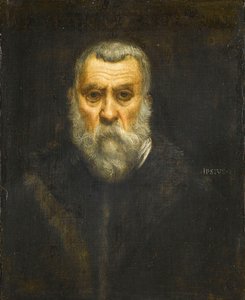
jacopo tintoretto
1518 - 1594
Quick Facts
- Artistic Movement Or Style: Venetian School, Mannerism
- Artists Who Influenced This Artist:
- Titian
- Michelangelo
- Date Of Birth: 1518
- Date Of Death: 1594
- Full Name: Jacopo Tintoretto
- Nationality: Italian
- Notable Artworks:
- Miracle of the Slave
- Last Supper
- Portrait of Procurator Soranzo
Related Articles

White on Canvas: 10 Masterpieces & Timeless Elegance for Your Home Decor
Explore 10 iconic white paintings by Monet, Whistler & Rothko! Discover the stories behind these serene masterpieces and their impact on art history. Find museum-quality reproductions for your home decor at .

Cézanne's Masterpieces: 25 Iconic Artworks to Transform Your Space
Journey through 25 iconic artworks by Paul Cézanne – a master of Impressionism and Post-Impressionism. Explore his landscapes, still lifes, and the stories behind these timeless masterpieces. Discover museum-quality reproductions & curated decor at ArtsDot.com.
Paul Klee's Masterpieces: Explore 25 Iconic Paintings & Prints | ArtsDot
Journey through Paul Klee's 25 most iconic paintings & prints. Explore his abstract style, Bauhaus influence, and vibrant color palettes. Find museum-quality art reproductions & decor ideas at ArtsDot.com. Discover all masterpieces online.

Jacopo Tintoretto's Masterpieces: 25 Paintings That Define Venetian Drama | ArtsDot
Explore 25 breathtaking masterpieces by Jacopo Tintoretto, the Venetian master of drama and light. Discover the stories behind iconic Renaissance paintings & find museum-quality art reproductions to elevate your home decor on ArtsDot.com.
The Equine Muse: A Historical & Artistic Exploration of Horses in Painting
Explore the captivating history of horses in painting! Discover Renaissance masterpieces, Baroque grandeur & expert insights for collecting equestrian art. Learn about symbolism, techniques & lasting value with ArtsDot.