 Preview
 Send
Send Share
Share
 Details

 Download
 Similars
 X-Ray
X-Ray Diaporama
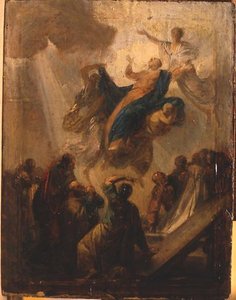
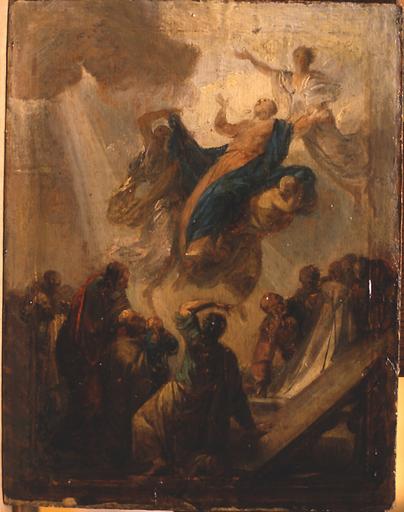
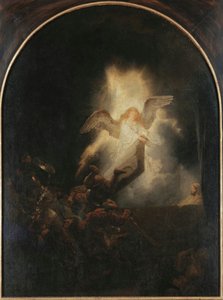
L'ASSOMPTION DE LA VIERGE
 Read More
Hand Made Oil Reproduction
Hand-painted oil on canvas in your size and frame, made to order by our artists. ( Buy Print Buy Image)




































Pick from our preset sizes that match the artwork's original proportions.

You may enter your own dimensions to fit a specific frame or space. If your selected size does not match the original image's proportions, we will either crop the artwork or extend the painting with additional hand-painted elements. A digital mockup will be sent for your approval before production begins.
Please note that the on-screen preview does not reflect the actual cropping or extension. Only the mockup will accurately show the final composition.
While custom sizes are available, we recommend selecting a dimension from the predefined list to preserve the original proportions.
After order, ArtsDot.com team will email client for instructions and provide a mockup preview
Worldwide Delivery () in 3/4 weeks instead of standard 5 weeks. (17 August). No compromise on quality.

Free Worldwide Express Shipping

High-Quality Linen Canvas

Full Shipping Insurance

Customs Tax Refund Guarantee

True Color Matching Guarantee

60-Day Return Policy (Defects Only)

100% Money-Back Guarantee

Bulk Discount Offer
 Glass option is only available in size under 110 CM

L'ASSOMPTION DE LA VIERGE
Reproduction Medium
Reproduction Size
-


Total Price
$ 438
Related Artworks
Artist Biography
The Dramatic Vision of Jean-Charles Nicaise Perrin
In the grand, sweeping tapestry of French Neoclassicism, few artists captured the tension between historical gravity and theatrical emotion as poignantly as Jean-Charles Nicaise Perrin. Born in Paris in 1754, Perrin emerged during an era of profound transformation, a time when the rigid structures of the Ancien Régime were beginning to fracture under the weight of Enlightenment ideals. His life and work serve as a bridge between the classical restraint of the late eighteenth century and the burgeoning romanticism that would soon follow. To look upon a Perrin canvas is to enter a world where history is not merely recorded, but performed with a breathtaking intensity that commands the viewer's gaze.
Perrin’s artistic journey was defined by a relentless pursuit of excellence, characterized by a perseverance that saw him navigate the competitive corridors of the French Academy. Though his path to the prestigious Prix de Rome was marked by several near-misses, it was this very struggle that forged his resilient spirit. His eventual victory in 1780—secured through a stroke of historical fortune involving the disqualification of a rival—granted him the essential passage to Italy. It was in the sun-drenched landscapes and ancient ruins of Rome that Perrin’s style truly began to coalesce, as he immersed himself in the profound legacies of the Old Masters.
A Synthesis of Light and Legend
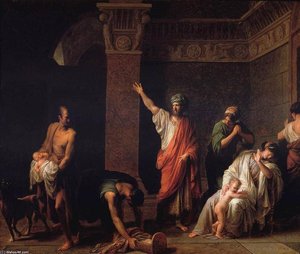
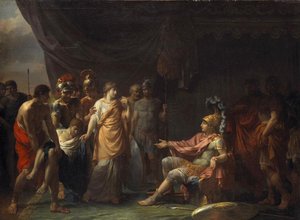
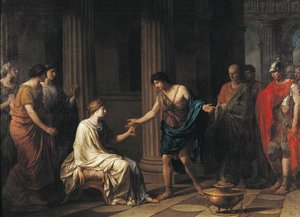
The development of Perrin's technique was deeply rooted in his Roman apprenticeship, where the shadows of Caravaggio and the fluid grace of Guercino left an indelible mark on his brushwork. He mastered the art of chiaroscuro, using dramatic contrasts between light and dark to sculpt figures out of the gloom, lending his biblical and historical scenes a palpable sense of weight and presence. This mastery allowed him to transform static historical moments into living, breathing dramas. His compositions often feature a meticulous attention to detail, where every fold of drapery and every glint of light on armor contributes to a larger narrative of heroism or tragedy.
His subject matter frequently drew from the wellsprings of antiquity and sacred scripture, themes that resonated deeply with the Neoclassical desire to find moral instruction in the past. Whether depicting the profound gravity of a biblical encounter or the political intrigue of ancient legends, Perrin imbued his figures with a psychological depth that transcended mere illustration. His work often possesses a certain theatricality, as if the characters are caught in a pivotal moment of a grand opera, making his paintings not just objects of beauty, but vessels of storytelling.
Legacy and Historical Resonance
As the decades progressed through the Napoleonic era and into the nineteenth century, Perrin’s reputation remained anchored by his ability to marry the formal precision of the French school with an expressive, almost visceral energy. His contributions to the art of printmaking further expanded his reach, allowing his dramatic visions to circulate beyond the walls of elite galleries. While much of his work resides in private collections or specialized museums like the Musée des Beaux-Arts de Valenciennes, his influence persists as a vital link in the evolution of French narrative painting.
Ultimately, the significance of Jean-Charles Nicaise Perrin lies in his ability to capture the soul of an era. He was an artist who understood that history is not just a collection of dates and names, but a series of human emotions—fear, triumph, devotion, and loss. Through his masterful use of light and his dedication to the monumental, he ensured that the echoes of the past would continue to resonate with clarity and power long after his death in 1831.
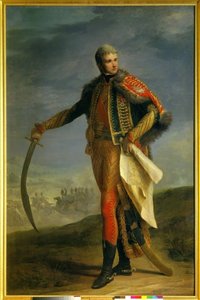
jean charles nicaise perrin
1754 - 1831 , France
Quick Facts
- Artistic Movement Or Style: Neo-classical Painting
- Artists Or Movements Influenced By This Artist: ['Roman School Art']
- Artists Who Influenced This Artist:
- Caravaggio
- Guercino
- Date Of Birth: October 12, 1754
- Date Of Death: September 23, 1831
- Full Name: Jean-Charles Nicaise Perrin
- Nationality: French
- Notable Artworks:
- Mort de Sophonisbe
- Saint Louis en prière
- Alexandre et Timoclée
- Place Of Birth: Paris, France