Preview
 Send
Send Share
Share
 Details

 Download
 Similars
 X-Ray
X-Ray Diaporama
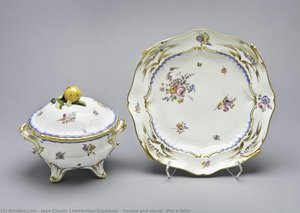
Tureen and stand, (Pot a Oille)
 24.0 x 27.0 cm
 Legion of Honor
 Read More
Hand Made Oil Reproduction
Hand-painted oil on canvas in your size and frame, made to order by our artists. ( Buy Print Buy Image)




































Pick from our preset sizes that match the artwork's original proportions.

You may enter your own dimensions to fit a specific frame or space. If your selected size does not match the original image's proportions, we will either crop the artwork or extend the painting with additional hand-painted elements. A digital mockup will be sent for your approval before production begins.
Please note that the on-screen preview does not reflect the actual cropping or extension. Only the mockup will accurately show the final composition.
While custom sizes are available, we recommend selecting a dimension from the predefined list to preserve the original proportions.
After order, ArtsDot.com team will email client for instructions and provide a mockup preview
Worldwide Delivery () in 3/4 weeks instead of standard 5 weeks. (28 August). No compromise on quality.

Free Worldwide Express Shipping

High-Quality Linen Canvas

Full Shipping Insurance

Customs Tax Refund Guarantee

True Color Matching Guarantee

60-Day Return Policy (Defects Only)

100% Money-Back Guarantee

Bulk Discount Offer
 Glass option is only available in size under 110 CM

Tureen and stand, (Pot a Oille)
Reproduction Medium
Reproduction Size
-


Total Price
$ 263
Related Artworks







Artist Biography
The Alchemist of Rococo Splendor
In the glittering heart of the eighteenth century, few names evoke the delicate opulence of the Rococo era quite like Jean-Claude Chambellan Duplessis. A true polymath of the decorative arts, Duplessis was far more than a mere craftsman; he was an architect of elegance whose hands shaped the very aesthetic of French royalty. Born in Turin, Italy, around 1695, his journey from the traditions of Italian goldsmithing to the pinnacle of Parisian prestige is a testament to a singular, transformative talent. Often referred to as Duplessis père, he possessed a rare ability to bridge the gap between the structural strength of bronze and the ethereal fragility of porcelain, creating a visual language that defined an age of luxury.
His early years were steeped in the rigorous discipline of the Bolognese goldsmithing tradition. Under the watchful eye of his father, Alessandro Ciambellano, he mastered the meticulous precision required to manipulate precious metals. This foundational training instilled in him a profound respect for classical forms and an obsession with detail that would later allow him to breathe life into much more fluid mediums. When he arrived in Paris around 1718, he entered a world of intense intellectual and artistic ferment. Through the vital patronage of influential figures like Marc René de Voyer d'Argenson, Duplessis secured a prestigious residence within the Louvre’s galleries, placing him at the very epicenter of European high culture and providing the fertile ground necessary for his genius to bloom.
A Visionary of Vincennes and Sèvres
The true zenith of Duplessis’ career arrived with his appointment as the artistic director of the Vincennes porcelain manufactory in 1748. It was here that his multidisciplinary expertise converged to revolutionize European ceramics. He did not merely design shapes; he orchestrated an entire sensory experience. As a master of both form and substance, Duplessis supervised the intricate processes of throwing and molding, advised on the subtle nuances of ground colors, and even provided the exquisite gilt bronze stands that would support his porcelain masterpieces. His work at Vincennes—and subsequently at its successor, the legendary Sèvres factory—transformed porcelain from a mere functional material into a medium of high sculptural art.
His creative output was characterized by an extraordinary versatility. While he is perhaps most celebrated for his innovative designs for tea services and vessels, his imagination knew no bounds. He experimented relentlessly with new silhouettes, creating:
- Graceful vases and urns that captured the undulating rhythms of Rococo curves.
- Intricate cups and saucers that balanced weight with a sense of weightless elegance.
- Dynamic figure groups that brought a narrative, sculptural dimension to tabletop settings.
Legacy of the Royal Goldsmith
The historical significance of Jean-Claude Chambellan Duplessis extends far beyond the physical beauty of his creations. In 1758, his appointment as orfèvre du roi—Goldsmith to the King—solidified his status as a premier artist of the French Crown. His work became the standard by which all decorative excellence was measured, influencing generations of designers and craftsmen across Europe. He embodied the spirit of the Enlightenment’s decorative counterpart: a period where scientific precision in material science met an almost poetic devotion to ornament.
Today, his legacy survives in the prestigious collections of the world's greatest museums, from the Getty Museum to the Art Institute of Chicago. When we look upon a piece of Sèvres porcelain or a finely cast bronze mount from the mid-eighteenth century, we are witnessing the enduring breath of Duplessis’ vision. He remains a monumental figure whose life work serves as a shimmering window into the soul of the Rococo, reminding us of a time when art and utility were inextricably entwined in a dance of unparalleled splendor.

jean-claude chambellan duplessis
1699 - 1774 , Italy
Quick Facts
- Artistic Movement Or Style: Rococo
- Artists Who Influenced This Artist: ['None Known']
- Date Of Birth: 1699, Turin, Italy
- Date Of Death: 1774-10-11, Paris, France
- Full Name: Jean Claude Chambellan Duplessis
- Nationality: France
- Notable Artworks:
- Elephant Candelabrum Vase
- Vase à Oreilles
- Ewer and Basin
- Pair of Vases
- Place Of Birth: Turin