 Preview
 Send
Send Share
Share
 Details

 Download
 Similars
 X-Ray
X-Ray Diaporama
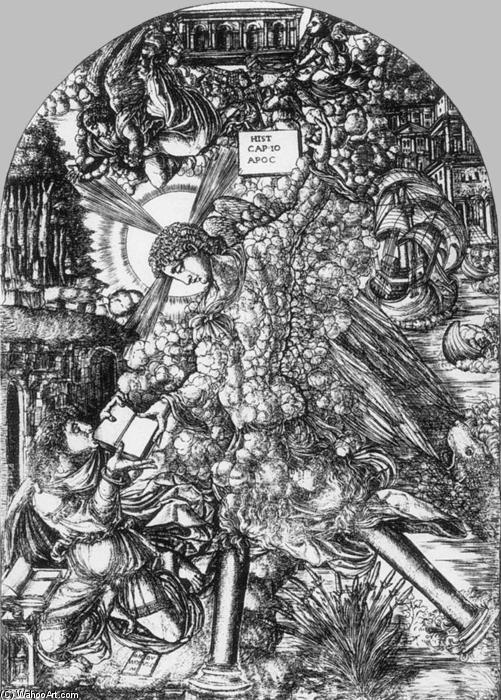
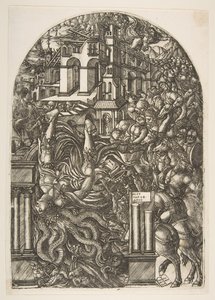
Illustration to the Apocalypse


 Read More
Giclée / Art Print
Museum-quality giclée or canvas print with fast production and flexible finish options. ( Buy Hand Made Painting Buy Image)




































Pick from our preset sizes that match the artwork's original proportions.

You may enter your own dimensions to fit a specific frame or space. If your selected size does not match the original image's proportions, we will either crop the artwork or extend the image with a mirrored or solid-fill edge. A digital mockup will be sent for your approval before production begins.
Please note that the on-screen preview does not reflect the actual cropping or extension. Only the mockup will accurately show the final composition.
While custom sizes are available, we recommend selecting a dimension from the predefined list to preserve the original proportions.
Worldwide Delivery () in 2 weeks instead of standard 4/5 weeks. (24 August)

Free Worldwide Express Shipping

High-Quality Linen Canvas

Full Shipping Insurance

Customs Tax Refund Guarantee

True Color Matching Guarantee

60-Day Return Policy (Defects Only)

100% Money-Back Guarantee

Bulk Discount Offer
 Glass option is only available in size under 110 CM

Illustration to the Apocalypse
Giclée / Art Print
Reproduction Size
-


Total Price
$ 63
Related Artworks
Artist Biography
The Visionary Burin: The Life and Legacy of Jean Duvet
In the annals of the French Renaissance, few names evoke as much mystery and profound spiritual intensity as Jean Duvet. A figure emerging from the shadows of the sixteenth century, Duvet was far more than a mere craftsman; he was a pioneer who bridged the gap between the meticulous traditions of the Middle Ages and the burgeoning expressive freedom of the modern era. Born in Dijon around 1485 to a goldsmith, his early years were steeped in the tactile precision of metalworking. This foundational training under his father provided him with the technical dexterity required to manipulate the burin, yet it was his imaginative spirit that would eventually elevate his work from mere ornamentation to monumental narrative art.
The trajectory of Duvet’s career was profoundly altered by his exposure to the broader European artistic landscape. While much of his early life remains shrouded in biographical obscurity, evidence suggests a transformative journey through Italy around 1519. Immersing himself in the vibrant, often dramatic atmosphere of Florence and Rome, he encountered the sophisticated language of Italian Mannerism. This encounter allowed him to assimilate the refined techniques of masters like Marcantonio Raimondi and the powerful graphic presence of Albrecht Dürer. However, rather than simply imitating these giants, Duvet synthesized their influences into a highly personal style—one that favored rhythmic repetition, shimmering textures, and a certain naïve grandeur that felt entirely his own.
A Symphony of Chaos: The Apocalypse and Symbolic Mastery
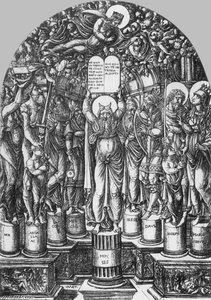
Duvet’s most enduring contribution to the history of art lies in his extraordinary series of engravings, most notably his monumental depictions of the Apocalypse. In these works, the artist transcends the boundaries of realistic representation to explore a realm of symbolic and theological depth. His compositions are famously dense, populated by crowded, often grotesque figures that seem to surge across the plate with an almost frantic energy. He eschewed conventional perspective in favor of a complex, layered spatial configuration that prioritizes emotional impact over anatomical or architectural accuracy.
To gaze upon a Duvet engraving is to enter a visionary landscape where the spiritual and the visceral collide. His mastery of line allowed him to create surfaces that appear to vibrate with life; fine, short strokes generate a luminous effect, while the juxtaposition of massive figures against tiny, delicate details creates a sense of cosmic scale. This technique—often compared by later scholars to the prophetic visions of William Blake—imbues his religious subjects with an intense, subjective feeling. In his famous depictions of Saint John the Evangelist, Duvet often blurred the line between the biblical figure and himself, presenting the artist as a witness to the divine mysteries he so meticulously carved into copper.
Historical Significance and the Dawn of French Printmaking
The historical weight of Jean Duvet’s oeuvre cannot be overstated. As one of the first truly significant French printmakers, he established a precedent for an expressive, uniquely French tradition of engraving that would resonate throughout the sixteenth century. His work represents a fascinating crossroads in art history: it retains the symbolic, often unsettling echoes of the medieval period while embracing the technical sophistication and humanistic inquiries of the Renaissance.
Beyond his technical innovations, Duvet’s legacy is defined by the freedom and immediacy that characterize his plates—a quality that many historians argue has no true equivalent in the broader context of Renaissance printmaking. Through his ability to translate complex theological concepts into a visceral visual language, he paved the way for future generations of artists to explore the depths of the human psyche and the sublime terrors of the divine. Even today, as we navigate an era of digital perfection, the raw, textured, and deeply humanistic engravings of Jean Duvet continue to captivate the soul, reminding us of the power of the hand-carved line to touch the infinite.
jean duvet
1485 - 1561 , France
Quick Facts
- Artistic Movement Or Style: Renaissance printmaking
- Artists Or Movements Influenced By This Artist: ['Albrecht Dürer']
- Artists Who Influenced This Artist:
- William Blake
- Raphael
- Date Of Birth: 1485
- Date Of Death: after 1561
- Full Name: Jean Duvet
- Nationality: French
- Notable Artworks:
- Moses and the Patriarchs
- Musée National Jean-Jacques Henner
- Place Of Birth: Dijon, France