 Send
Send Share
Share
 Details

 Download
 Similars
 Diaporama
Female portrait
 Black and White Photography
- Photo
 1855
1855- 19th Century
 13.0 x 10.0 cm
 George Eastman Museum
 Read More
Hand Made Oil Reproduction
Hand-painted oil on canvas in your size and frame, made to order by our artists. ( Buy Print Buy Image)




































Pick from our preset sizes that match the artwork's original proportions.

You may enter your own dimensions to fit a specific frame or space. If your selected size does not match the original image's proportions, we will either crop the artwork or extend the painting with additional hand-painted elements. A digital mockup will be sent for your approval before production begins.
Please note that the on-screen preview does not reflect the actual cropping or extension. Only the mockup will accurately show the final composition.
While custom sizes are available, we recommend selecting a dimension from the predefined list to preserve the original proportions.
After order, ArtsDot.com team will email client for instructions and provide a mockup preview
Worldwide Delivery () in 3/4 weeks instead of standard 5 weeks. (25 August). No compromise on quality.

Free Worldwide Express Shipping

High-Quality Linen Canvas

Full Shipping Insurance

Customs Tax Refund Guarantee

True Color Matching Guarantee

60-Day Return Policy (Defects Only)

100% Money-Back Guarantee

Bulk Discount Offer
 Glass option is only available in size under 110 CM

Female portrait
Reproduction Medium
Reproduction Size
-


Total Price
$ 263
Artwork Description
A Melancholic Glimpse into the Mid-19th Century
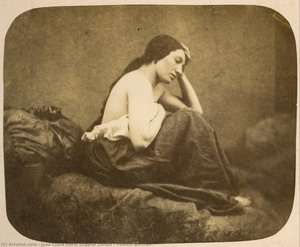
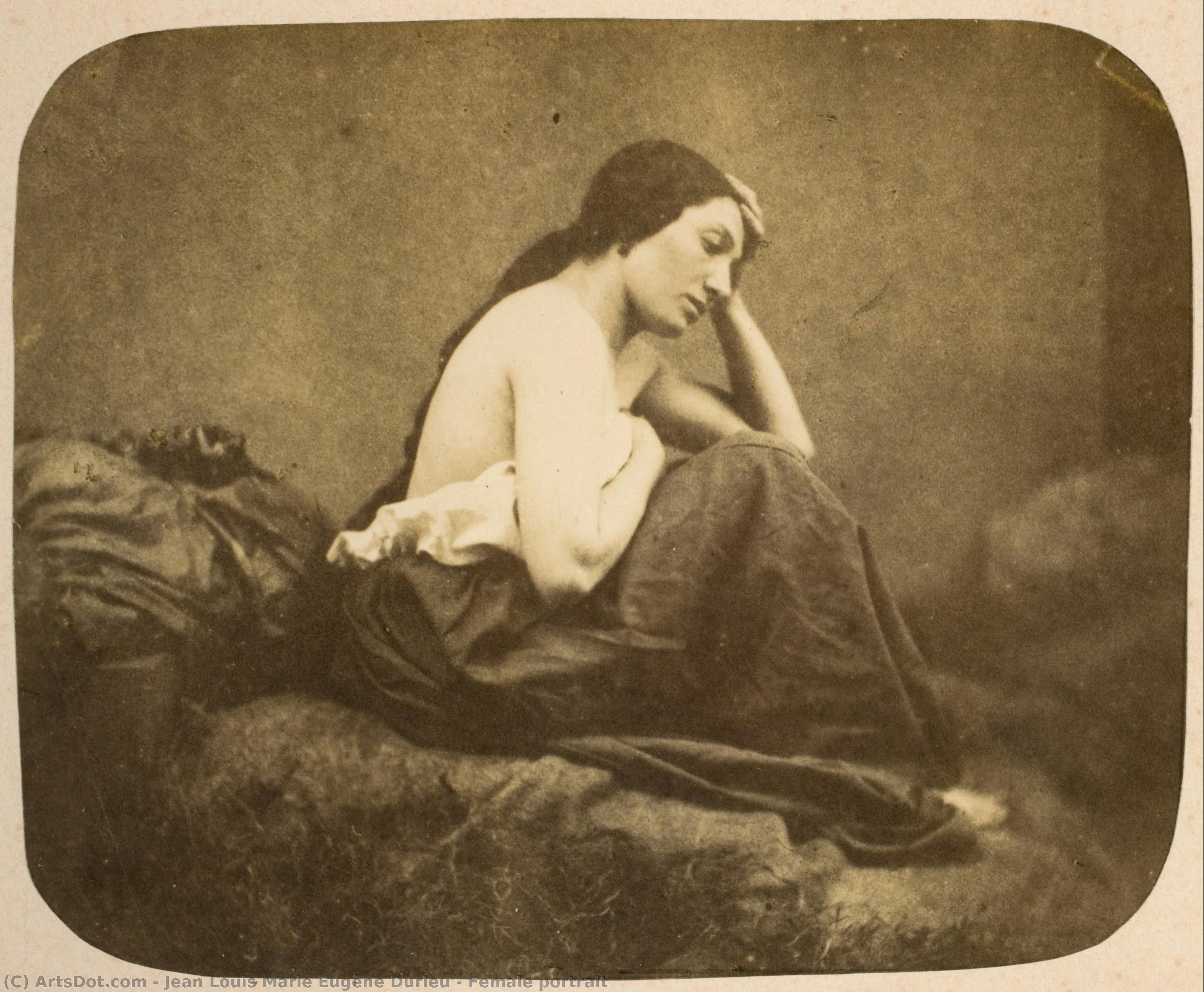
In this evocative black and white photograph from 1855, titled Female Portrait, we are transported to a moment of profound introspection. The image captures a woman seated upon the ground, her posture heavy with the weight of contemplation or perhaps a quiet, lingering sorrow. With her head resting deeply in her hands, she becomes a focal point of human vulnerability, her long hair cascading down her back like a shroud of silk. This piece, captured by the pioneering French photographer Jean Louis Marie Eugène Durieu, transcends mere documentation; it serves as a window into the emotional landscape of the mid-19th century, where the boundaries between photography and the soulful depth of classical painting began to blur.
The composition is masterfully balanced, utilizing the stark contrasts of monochrome to heighten the dramatic tension. While the woman remains the central figure of our empathy, the presence of shadowy figures in the periphery—partially visible onlookers who ground the scene in a social reality—adds a layer of voyeuristic complexity. The subtle appearance of an enigmatic object in the upper corner, reminiscent of a bird, introduces a touch of the surreal, inviting the viewer to wonder if it symbolizes a fleeting thought, a lost freedom, or a silent witness to her solitude.
The Intersection of Photography and Fine Art
To understand the technical and historical significance of this work, one must look toward the legacy of Durieu himself. As an amateur photographer who navigated the upper echelons of French civil service, Durieu brought a sophisticated eye to his photographic experiments. His work is historically significant for its intersection with the great masters of his era; as a contemporary and friend of Eugène Delacroix, many of the subjects he captured through the lens were also immortalized on canvas by the legendary painter. This photograph embodies that very spirit—the way light and shadow are used to sculpt form and emotion in a manner strikingly similar to the Romantic movement in painting.
For the discerning collector or interior designer, this reproduction offers more than just a visual element; it provides a narrative anchor for a room. The 13 x 10 cm scale of the original suggests an intimacy that can be amplified when presented as a high-quality hand-painted reproduction. The monochromatic palette allows it to integrate seamlessly into modern minimalist spaces or classic, dark-toned studies, acting as a conversation piece that evokes the quiet dignity of the past. It is a work that does not shout for attention but rather commands it through its silent, haunting grace.
A Timeless Emotional Resonance
The true power of this portrait lies in its ability to evoke empathy across generations. The subject's pose—a universal gesture of grief or deep thought—resonates with anyone who has experienced the quiet moments of life's transitions. In an era of hyper-saturated digital imagery, there is a profound luxury in the stillness and grain of Durieu’s mid-19th-century technique. It invites the viewer to slow down, to breathe, and to inhabit the silence alongside the subject.
Whether you are seeking to add a sense of historical depth to a gallery wall or looking for a piece that embodies the melancholic beauty of the Romantic era, this Female Portrait stands as a testament to the enduring power of the photographic medium. It is an exquisite choice for those who appreciate art that explores the complexities of the human condition through the delicate interplay of light, shadow, and soul.
Related Artworks
![[ellen Terry At Age Sixteen] — Julia Margaret Cameron, Pre-raphaelite Revival](/media/artworks/images-thumb/2c/7b/2c7b1d541f094c02639b9b8340679602.jpg)
Artist Biography
early life and career
jean louis marie eugène durieu, a french amateur photographer, was born in nîmes, france in 1800. little is known about his early life, but it is evident that he developed an interest in photography at a young age. before pursuing a career in photography, durieu served as a high-ranking civil servant in the french government.photographic contributions
durieu's photographic work primarily focused on nude male and female subjects. his early photographs, which date back to the mid-19th century, were groundbreaking for their time. as a friend of eugène delacroix, many of durieu's models were also painted by delacroix, showcasing the intersection of photography and painting during this period.notable works and legacy
* jean louis marie eugène durieu's photographs can be found in various museums and private collections. although his work is not as widely recognized as some of his contemporaries, his contributions to the development of photography are undeniable. * a few of his notable works include:- photographie (c. 1850s): this early photograph showcases durieu's skill in capturing the human form.
- nude study (c. 1860s): this work demonstrates durieu's ability to balance light and composition.
museums and collections
* musée des beaux-arts bordeaux, france: although not exclusively dedicated to durieu's work, this museum features an impressive collection of 19th-century french art, which might be of interest to those studying durieu's influences. * view more of jean louis marie eugène durieu's work on ArtsDotdeath and legacy
jean louis marie eugène durieu passed away in either geneva or paris in 1874, leaving behind a legacy as one of the pioneers in french photography. his early nude photographs continue to fascinate art enthusiasts and historians alike. recommended reading: * discover more about 19th-century french photography on ArtsDot * learn more about eugène delacroix's work and influence on wikipedia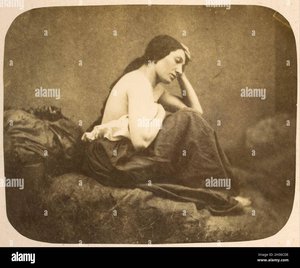
jean louis marie eugène durieu
1800 - 1874 , France
Quick Facts
- Artistic Movement Or Style: 19th Century Art
- Artists Or Movements Influenced By This Artist: ['Later artists on WahooArt']
- Artists Who Influenced This Artist:
- Caspar David Friedrich
- J.M.W. Turner
- John Constable
- Date Of Death: 1874
- Nationality: WahooArt
Related Articles

White on Canvas: 10 Masterpieces & Timeless Elegance for Your Home Decor
Explore 10 iconic white paintings by Monet, Whistler & Rothko! Discover the stories behind these serene masterpieces and their impact on art history. Find museum-quality reproductions for your home decor at .

Dark Masterpieces: 10 Iconic Paintings Dominated by Black Tones |
Explore 10 iconic paintings dominated by black tones, from Rembrandt’s chiaroscuro to Goya's dark expressions. Discover the stories behind these masterpieces & find museum-quality art reproductions for your home at .

Monochrome Visions: Exploring the Aesthetic & Historical Significance of Black & White Photography
Explore the rich history & artistic power of black and white photography. From early techniques to iconic masters like Ansel Adams, discover why monochrome continues to captivate art lovers today. Expert insights for collectors.
Whistler's Masterpieces: Explore 25 Iconic Paintings & Aesthetic Art for Your Home
Journey through 25 iconic James Abbott McNeill Whistler paintings! Explore his masterpieces of Aestheticism, from 'Nocturne in Black and Gold' to captivating portraits. Find museum-quality art reproductions & elevate your home decor with ArtsDot.com. Discover the full collection online.
Mars Black Masterpieces: 10 Iconic Paintings & Timeless Art Decor Ideas
Delve into the power of 'Mars Black' with 10 iconic paintings by masters like Rembrandt & Caravaggio. Explore dramatic chiaroscuro, gothic art, and timeless beauty. Find museum-quality reproductions & elevate your home decor on .