


 Preview
 Send
Send Share
Share
 Details

 Download
 Similars
 X-Ray
X-Ray Diaporama
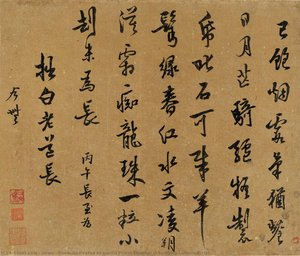
Poem Dedicated to Daoist Priest Zhuobai in Running-cursive Script
 1666
1666 26.0 x 30.0 cm
 Read More
Giclée / Art Print
Museum-quality giclée or canvas print with fast production and flexible finish options. ( Buy Hand Made Painting Buy Image)




































Pick from our preset sizes that match the artwork's original proportions.

You may enter your own dimensions to fit a specific frame or space. If your selected size does not match the original image's proportions, we will either crop the artwork or extend the image with a mirrored or solid-fill edge. A digital mockup will be sent for your approval before production begins.
Please note that the on-screen preview does not reflect the actual cropping or extension. Only the mockup will accurately show the final composition.
While custom sizes are available, we recommend selecting a dimension from the predefined list to preserve the original proportions.
Worldwide Delivery () in 2 weeks instead of standard 4/5 weeks. (30 August)

Free Worldwide Express Shipping

High-Quality Linen Canvas

Full Shipping Insurance

Customs Tax Refund Guarantee

True Color Matching Guarantee

60-Day Return Policy (Defects Only)

100% Money-Back Guarantee

Bulk Discount Offer
 Glass option is only available in size under 110 CM

Poem Dedicated to Daoist Priest Zhuobai in Running-cursive Script
Giclée / Art Print
Reproduction Size
-


Total Price
$ 63
Related Artworks

Artist Biography
The Poet Painter of Lingnan: The Life and Legacy of Jinwu
In the vibrant cultural landscape of 17th-century China, few figures captured the spiritual and rhythmic essence of the era as profoundly as Jinwu. Born Shi Jinwu in 1633 within the Guangdong Province, he emerged not merely as a practitioner of art, but as a master craftsman whose brushstrokes bridged the gap between the earthly and the divine. As a pivotal figure of the Lingnan School, Jinwu lived through a period of immense cultural transformation, contributing to a movement that sought to redefine artistic expression by blending traditional rigor with a newfound, expressive vitality. While the early details of his life remain partially veiled by the mists of history, his impact on Chinese calligraphy and painting remains etched in the enduring elegance of his surviving works.
The foundation of Jinwu’s mastery lay in his rigorous early training, which centered on the disciplined art of running-cursive script. This particular form of calligraphy, characterized by its fluid, interconnected strokes, served as the heartbeat of his creative output. Under the guidance of esteemed masters who revered the traditions of the Song and Yuan dynasties, Jinwu learned to move beyond simple replication, instead embracing a philosophy that prioritized individual interpretation and emotional sincerity. He drew deep inspiration from the Ming Dynasty literati painters, whose emphasis on conveying profound internal truths through subtle visual nuances became a cornerstone of his aesthetic. This training instilled in him a rare ability to imbue even the simplest line with a sense of life and movement.
A Symphony of Script and Spirit
To observe a work by Jinwu is to witness a deliberate reflection of Daoist philosophy. His command over the running-cursive script was so masterful that his calligraphy often created an illusion of perpetual motion, mirroring the natural, unceasing rhythms of the cosmos. This sense of cosmic flow was not merely a technical achievement but a spiritual pursuit; for Jinwu, the movement of the brush was an extension of the Dao itself. His themes frequently drifted toward the sacred, finding profound inspiration in the figures of Daoist priests and Buddhist monks. These subjects allowed him to explore the spiritual fervor of Lingnan society, translating religious devotion into a visual language of grace and meticulous detail.
Beyond his religious iconography, Jinwu’s versatility allowed him to master diverse genres that expanded the emotional range of his oeuvre:
- Serene Landscapes: His landscapes were imbued with a profound tranquility, inviting viewers into meditative states of contemplation.
- Expressive Portraits: Through portraiture, he captured the essence of character, utilizing the subtle nuances learned from the literati tradition.
- Calligraphic Masterpieces: Works such as his Poem Dedicated to Daoist Priest Zhuobai demonstrate his ability to marry poetic sentiment with dynamic, rhythmic inkwork.
The historical significance of Jinwu lies in his ability to harmonize the technical precision of classical Chinese art with a deeply personal, emotive spirit. By weaving together the elegance of calligraphy with the spiritual depth of Daoist and Buddhist themes, he helped solidify the identity of the Lingnan School. His legacy remains a testament to the power of art to serve as a vessel for both cultural heritage and individual transcendence, ensuring that his name continues to resonate within the annals of Chinese art history.
Jinwu
1633 - 1681 , China
Quick Facts
- Artistic Movement Or Style: Running-cursive script calligraphy
- Artists Or Movements Influenced By This Artist:
- Shen Xiang
- Xu Kun
- Artists Who Influenced This Artist: ['Song Dynasty painters']
- Date Of Birth: 1633
- Date Of Death: 1681
- Full Name: Jinwu
- Nationality: Chinese
- Notable Artworks: ['Poem Dedicated to Daoist Priest Zhuobai in Running-cursive Script']
- Place Of Birth: China

