Preview
 Send
Send Share
Share
 Details

 Download
 Similars
 X-Ray
X-Ray Diaporama
February
 Oil
Oil- WallArt
- Baroque
 1642
1642- Early Modern
 149.0 x 123.0 cm
 Staatsgalerie Stuttgart
 Read More
Hand Made Oil Reproduction
Hand-painted oil on canvas in your size and frame, made to order by our artists. ( Buy Print Buy Image)




P118B $10

P118H $10

P118W $10

P438Z $10

P508JH $12

P508YH $12

P805H $10

P805Z $10

P919BZ $10

P919G $10

P919XJ $10

P959ZH $10

P968JZ $12

W106C $8

W218G $10

W218JH $8

W218Y $10

W307PJ $10

W316G $10

W316PJ $8

W316Y $10

W398PJ $8

W4111J $10

W500HY $15

W500JH $15

W692G $12

W849H $8

W940BG $15

W953PJ $8




Pick from our preset sizes that match the artwork's original proportions.

You may enter your own dimensions to fit a specific frame or space. If your selected size does not match the original image's proportions, we will either crop the artwork or extend the painting with additional hand-painted elements. A digital mockup will be sent for your approval before production begins.
Please note that the on-screen preview does not reflect the actual cropping or extension. Only the mockup will accurately show the final composition.
While custom sizes are available, we recommend selecting a dimension from the predefined list to preserve the original proportions.
After order, ArtsDot.com team will email client for instructions and provide a mockup preview
Worldwide Delivery () in 3/4 weeks instead of standard 5 weeks. (17 August). No compromise on quality.

Free Worldwide Express Shipping

High-Quality Linen Canvas

Full Shipping Insurance

Customs Tax Refund Guarantee

True Color Matching Guarantee

60-Day Return Policy (Defects Only)

100% Money-Back Guarantee

Bulk Discount Offer
 Glass option is only available in size under 110 CM

February
Reproduction Medium
Reproduction Size
-


Total Price
$ 263
Artwork Description
A Vivacious Encounter in Baroque Splendor
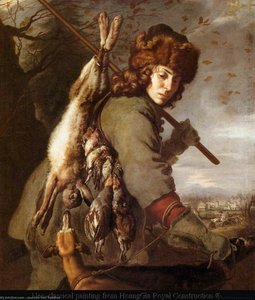
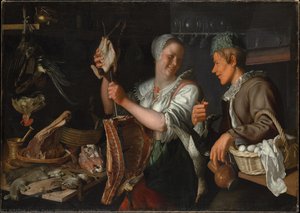
In the evocative masterpiece February, painted in 1642, Joachim von Sandrart invites us into a world of bustling vitality and intricate social drama. At the heart of this grand composition stands a bearded man, his presence commanding yet strangely intimate, clad in a striking red shirt that serves as a warm, pulsating anchor for the eye. As he holds a plate, perhaps offering sustenance or participating in a ritual of hospitality, a delicate bird perches upon his shoulder, its gaze fixed upon him in a moment of quiet connection. This central duo acts as a focal point of tenderness amidst a much larger, more chaotic tapestry of life. The scene is far from solitary; the background breathes with the movement of various figures, some lost in deep conversation and others observing the man with curious intensity, creating a sense of a lively, communal gathering that feels both timeless and immediate.
The technique employed by Sandrart showcases the profound mastery characteristic of the German Baroque period. Through a sophisticated use of light and shadow, often referred to as chiaroscuro, the artist breathes life into the textures of the scene—from the soft plumage of the birds scattered throughout the composition to the heavy, tactile quality of the man's garments. The painter’s ability to layer depth is remarkable; while the central figures possess a sharp, sculptural clarity, the background figures dissolve into a more atmospheric, painterly haze, pulling the viewer deeper into the social landscape. This careful manipulation of focus ensures that while the eye wanders through the crowd, it is always drawn back to the emotional core of the man and his avian companion.
Symbolism and the Rhythm of the Seasons
Beyond its surface-level charm, February carries a weight of symbolic meaning that resonates with the seasonal themes often explored in seventeenth-century allegorical art. The title itself suggests a period of transition—a time when the cold of winter begins to yield to the subtle stirrings of spring. The presence of birds, creatures often associated with the return of warmth and life, serves as a poignant metaphor for this seasonal shift. The interaction between the man and the bird can be interpreted as a harmony between humanity and the natural world, a theme that would have been deeply resonant to a contemporary audience navigating the complexities of their own environment. The plate he holds may further symbolize the bounty of the earth or the necessity of preparation during the waning months of winter.
For the discerning collector or interior designer, this artwork offers much more than mere decoration; it provides a window into a sophisticated historical consciousness. The painting’s ability to evoke a sense of "lively sociality" makes it an extraordinary piece for creating atmosphere in a room. Whether placed in a grand library or a curated dining space, the work introduces a narrative depth that sparks conversation. A high-quality reproduction of this piece allows one to bring the warmth, the drama, and the historical prestige of Sandrart’s vision into a modern setting, offering an enduring sense of elegance and a profound connection to the golden age of Baroque storytelling.
Related Artworks
Artist Biography
A Life Bridging Art and History: The World of Joachim von Sandrart
Joachim von Sandrart, a name perhaps less instantly recognizable than those of his Baroque contemporaries, occupies a unique and vital position in the history of 17th-century art. Born in Frankfurt am Main in 1606 to a family with roots in Mons, he was not merely a painter but a pivotal figure who straddled the worlds of artistic creation and historical documentation. His life unfolded as an adventurous journey across Europe, absorbing diverse influences that shaped both his artistic style and his enduring legacy as an art historian. Sandrart’s early exposure to the world of art came through familial connections; he received initial instruction from Johann Theodor de Bry’s son and associates of Matthäus Merian, laying a foundation for his future pursuits. However, it was a youthful ambition for mastery in engraving that propelled him towards Prague at the age of fifteen, where he became a pupil of Aegidius Sadeler, a prominent member of a renowned family of engravers. It was Sadeler who astutely recognized Sandrart’s potential and encouraged his exploration of painting, setting him on a path that would lead to Utrecht and an apprenticeship under Gerrit van Honthorst.From Caravaggisti Shadows to Italian Light
Utrecht in 1625 proved to be a formative experience for Sandrart. Van Honthorst was a leading figure within the Utrecht *Caravaggisti* movement, and it was here that Sandrart began to absorb the dramatic use of light and shadow—the *tenebrism*—that characterized this style. A defining moment arrived in 1627 when Peter Paul Rubens visited Honthorst seeking collaborators for his monumental Marie de' Medici cycle. Sandrart accompanied Honthorst on this venture, gaining invaluable experience working alongside one of the Baroque period’s most celebrated masters. This collaboration extended to London, where they created copies of Holbein portraits for Henry Howard, 22nd Earl of Arundel. This early exposure to Rubens’ dynamism and Honthorst's dramatic realism would profoundly influence Sandrart’s own artistic development. However, the young artist was driven by an insatiable curiosity that propelled him further afield. He embarked on a grand tour of Italy in 1627, sailing from London to Venice where he found acceptance into the esteemed *Bentvueghels* brotherhood—a society of predominantly Dutch and Flemish artists who embraced a spirit of artistic freedom and often adopted satirical nicknames. His journey continued through Bologna, Florence, and Rome, each city offering new artistic stimuli and opportunities for growth. He established himself as a portrait painter during this period, skillfully capturing the likenesses of his sitters while simultaneously honing his skills in genre scenes. Naples and Malta also beckoned, providing inspiration from literary sights and further commissions that allowed him to refine his technique.Amsterdam’s Embrace and Artistic Recognition
By 1637, political unrest and the looming threat of plague prompted Sandrart and his wife to seek refuge in Amsterdam. This relocation marked a significant chapter in his career. He flourished as both a painter of genre scenes and portraits, quickly gaining recognition within the vibrant artistic community of the Dutch Golden Age. The pinnacle of his success during this period arrived with a prestigious commission from the Bicker Company of the Amsterdam *Schutterij* (militia). He was tasked with creating a large commemorative piece celebrating the state visit of Maria de' Medici in 1638. This painting, now housed within the Rijksmuseum, is a masterful depiction of the *Schutterij* members posed around a bust of the visiting queen, accompanied by a poem penned by the renowned Dutch poet Joost van den Vondel. The commission not only showcased Sandrart’s artistic prowess but also symbolized Amsterdam's formal recognition on the European stage through its connection with France. It solidified his reputation as a leading painter and a respected member of the city’s cultural elite.From Painter to Historian: The Legacy of the *Teutsche Academie*
In 1645, Sandrart returned to Frankfurt following an inheritance, rebuilding the family homestead before its unfortunate destruction by fire. He subsequently relocated to Augsburg, where he continued to paint for the Bavarian Electors. However, a shift in his focus occurred after the death of his wife in 1672. Settling in Nuremberg, and later marrying Hester Barbara Bloemaart, daughter of a magistrate, Sandrart dedicated himself to a monumental undertaking: the writing of art history. This endeavor culminated in the publication of the *Teutsche Academie der edlen Bau-, Bild- und Mahlerey-Künste* between 1675 and 1680. Inspired by Karel van Mander’s *Schilder-boeck* and Giorgio Vasari's biographies, Sandrart compiled a comprehensive collection of biographical sketches of Dutch and German artists. The *Teutsche Academie* became an invaluable resource for understanding the artistic landscape of the time, offering insights into the lives, techniques, and influences of numerous painters, sculptors, and architects. While not without its inaccuracies—notably his misattribution regarding Hendrick ter Brugghen—the work remains a vital primary source for scholars studying 17th-century art. Sandrart’s dedication to documenting the contributions of his contemporaries ensured that their achievements would not be forgotten, cementing his place as an important figure in the history of art and establishing him as one of the earliest systematic art historians of the German-speaking world. He died in Nuremberg in 1688, leaving behind a legacy that extends far beyond his paintings—a legacy rooted in his commitment to preserving and celebrating the artistic heritage of his time.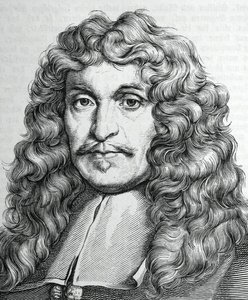
Joachim von Sandrart
1606 - 1688 , Germany
Quick Facts
- Artistic Movement Or Style: Baroque
- Artists Or Movements Influenced By This Artist:
- Arnold Houbraken
- Dutch & German art history
- Artists Who Influenced This Artist:
- Gerrit van Honthorst
- Rubens
- Aegidius Sadeler
- Date Of Birth: 1606
- Date Of Death: 1688
- Full Name: Joachim von Sandrart
- Nationality: German
- Notable Artworks:
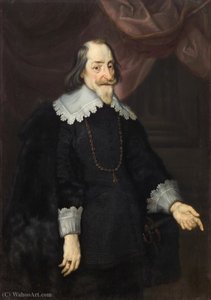
- Herzog Maximilian I
- Officers and Civic Guardsmen
- Pieter Corneliszoon Hooft
- Place Of Birth: Frankfurt, Germany
Related Articles

Crimson Threads of Narrative: Exploring Symbolism & Representation in Artworks Featuring the Red Dress
Explore the rich symbolism of the red dress in art history! From ancient power displays to iconic portraits like Cézanne’s 'Madame Cezanne', discover the cultural and artistic significance behind this captivating color. Expert analysis & insights.
Feathered Visions: A Historical & Artistic Exploration of Birds in Painting
Explore the rich history of birds in painting! Discover symbolism, artistic movements & master artists like Audubon. High-quality reproductions available at ArtsDot.
Mark Rothko's Masterpieces: 25 Paintings That Define Abstract Expressionism | ArtsDot
Explore 25 iconic Mark Rothko paintings that define Abstract Expressionism. Discover the stories, colors & emotions behind these masterpieces. Find museum-quality art reproductions and curated decor ideas at ArtsDot.com.
René Magritte's Masterpieces: 25 Surrealist Paintings for Art Lovers | ArtsDot
Explore 25 iconic René Magritte paintings & delve into the world of surrealism. Discover the stories behind 'The Son of Man', 'Golconda' & more. Find museum-quality art reproductions and elevate your home decor with ArtsDot.com.
Henri Matisse's Masterpieces: Explore 25 Iconic Paintings & Art Decor Ideas
Journey through Henri Matisse's 25 most iconic paintings! Explore Fauvism, vibrant colors & the stories behind masterpieces like 'The Dance'. Find museum-quality art reproductions and curated decor ideas to elevate your space. Discover all masterpieces on ArtsDot.com.