

 Preview
 Buy Print
 Send
Send Share
Share


 Download
 Similars
 X-Ray
X-Ray Diaporama
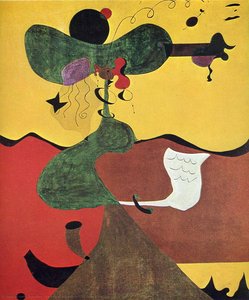
Portrait of Mrs Mills in 1750 (after Constable)

Joan Miró (1893 – 1983)
Explore Joan Miró's vibrant world! Discover Surrealist & abstract masterpieces, Catalan symbolism, & playful forms. A pioneer of modern art – view works at ArtsDot!
A Surrealist Echo: Joan Miró’s Reimagining of Constable
Joan Miró's “Portrait of Mrs. Mills in 1750 (after Constable)” isn’t merely a reproduction; it’s an audacious dialogue between two artistic titans – the meticulous realism of Thomas Gainsborough’s protégé, George Engleheart, and the vibrant, dreamlike world of Joan Miró himself. Completed in 1929 during his Parisian period, this painting transcends simple imitation, transforming Constable's original portrait into a swirling vortex of color, symbolism, and unsettling juxtapositions. The work immediately captivates with its bold palette – deep greens, fiery reds, and earthy browns collide against lighter washes, creating an immediate sense of dynamism and emotional intensity. It’s a far cry from the restrained elegance of the source material, yet undeniably rooted in it.
Deconstructing the Portrait: Gunpowder and Birdsong
Miró’s genius lies in his deliberate dismantling of the original portrait. The central figure, a woman with long, flowing hair – often interpreted as a mermaid or even a bird-like creature – is presented not as a dignified lady but as an active participant in a scene brimming with unexpected elements. Most strikingly, she holds a pistol, a jarring detail that injects a potent dose of tension and ambiguity into the composition. This isn’t simply a decorative accessory; it speaks to themes of power, vulnerability, and perhaps even defiance. Adding to this surreal atmosphere are several other carefully placed details: a soaring bird above, perched atop a mountainous structure, and two additional guns strategically positioned within the frame. These elements aren't haphazard additions but deliberate symbols, inviting viewers to contemplate the underlying narrative.
- The Pistol: Represents agency, protection, or even aggression – challenging the traditional image of a passive subject in portraiture.
- The Birds: Often associated with freedom and spirituality, their presence suggests a connection between the earthly realm and something beyond.
- The Mountain Structure: Could symbolize ambition, aspiration, or perhaps an insurmountable obstacle.
Miró’s Catalan Roots & Surrealist Influence
Born in Barcelona in 1893, Miró's artistic vision was deeply intertwined with his Catalan heritage. The organic forms and vibrant colors of his work are reminiscent of the architectural wonders of Antoni Gaudí, whose influence is subtly felt throughout his oeuvre. However, Miró’s style evolved beyond mere homage, embracing the principles of Surrealism – a movement he engaged with intensely during this period. His paintings aren't intended to depict reality directly but rather to evoke emotions and subconscious associations through abstract shapes, symbolic imagery, and unexpected combinations. The deliberate distortion of form and space reflects a desire to break free from conventional representation and tap into the realm of dreams and intuition.
A Legacy of Dreamlike Abstraction
“Portrait of Mrs. Mills in 1750 (after Constable)” stands as a testament to Miró’s unique artistic voice – a synthesis of meticulous observation, symbolic depth, and unrestrained imagination. It's a painting that rewards repeated viewing, revealing new layers of meaning with each encounter. Reproductions offer an accessible way to experience this captivating work, bringing its dreamlike atmosphere and potent symbolism into any space. ArtsDot’s hand-painted reproductions capture the essence of Miró’s vision, ensuring that this extraordinary portrait continues to resonate with audiences for generations to come.
About this artwork
- Title: Portrait of Mrs Mills in 1750 (after Constable)
- Artist: Joan Miró
- Format: Portrait
- Copyright status: Under copyright
- Movement: Surrealist Expression
- Medium type: WallArt
- Main color: Yellow
- Purpose: Statement
- Keywords: 1929 , color , surrealism
- Color hue: Green Spectrum
Quick Facts
- Movement: Surrealism
- Notable elements: Whimsical forms, guns
- Subject or theme: Female portraiture
- Dimensions: 116.7 x 89.6 cm
- Artist: Joan Miró
- Influences:
- Constable
- Gaudí
- Year: 1929
QR Code


