

 Preview
 Send
Send Share
Share
 Details

 Download
 Similars
 X-Ray
X-Ray Diaporama
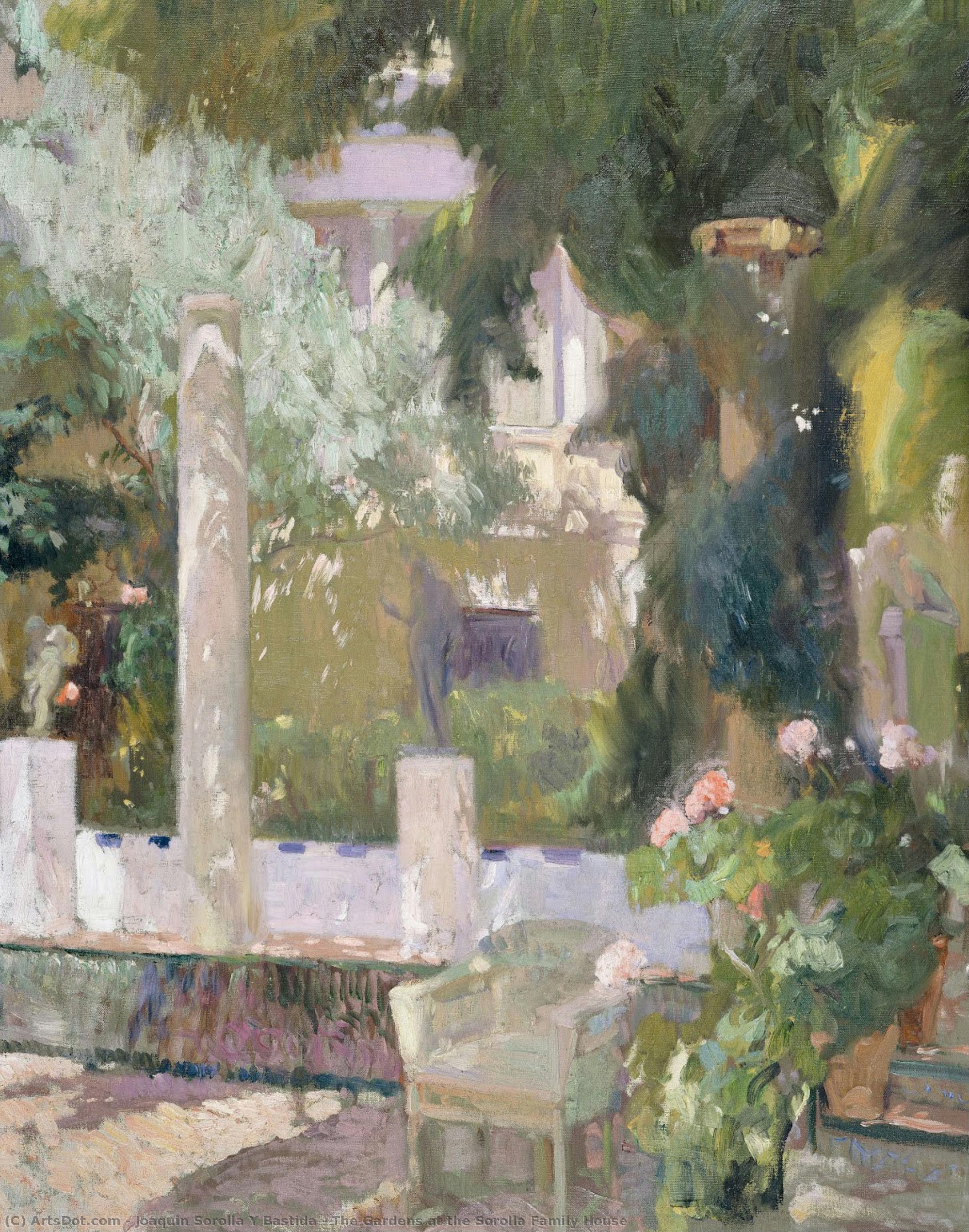
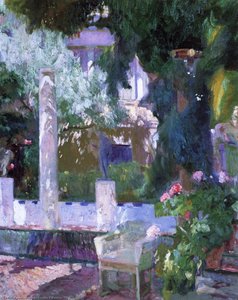
The Gardens at the Sorolla Family House


 Read More
Purchase a high-resolution, enhanced digital image, far superior to the online preview.
Each file is meticulously prepared by our in-house specialists using advanced tools and expert manual retouching. We ensure every image has exceptional clarity, precise color accuracy, and fine detail.
The final file is delivered via email within 72 hours, optimized for immediate use in professional, editorial, and print environments. This is the same quality trusted by top-tier design studios, publishers, and galleries.
Digital Image
Download a high-resolution file for personal display, printing, and creative projects. ( Buy Print Buy Hand Made Painting)
Included in Every Digital Image Order
Expert Digital Delivery, Guaranteed
When you choose ArtsDot.com, you're not just getting an image - you're receiving a professionally enhanced digital artwork, crafted with precision and backed by a satisfaction guarantee. Here's everything that comes with your order, automatically:

Fast Email Delivery
Your high-resolution digital image file will be emailed to you within 72 hours of ordering - ready for immediate use.

AI-Enhanced Digital File
Your artwork is professionally optimized using advanced AI tools and manual editing, ensuring maximum detail, clarity, and color accuracy.

Free Lifetime Re-Delivery
Accidentally deleted or lost your file? No worries - we'll resend it to you anytime, free of charge.

No Import Fees - Ever
Enjoy your artwork instantly with zero customs, duties, or delivery fees - digital downloads are always tax-free.

Color Accuracy Guarantee
We ensure your digital image reflects the original colors as closely as possible using professional tools and color management.

60-Day Satisfaction Guarantee
If you're not satisfied with your digital image, we'll revise it or refund 100% within 60 days - no questions asked.

100% Money-Back Guarantee
Not satisfied? Get a full refund within 60 days of receiving your digital file - no questions asked.

Bulk Order Discounts
Buy 3 images, save 10% - Buy 5, save 15% - Buy 10+, save 20%. Great for creative projects, galleries, and agencies.
A Symphony of Light and Tranquility: Exploring Joaquín Sorolla’s “The Gardens at the Sorolla Family House”
Joaquín Sorolla y Bastida (1863 – 1923), a luminary of Spanish Impressionism, possessed an unparalleled ability to capture the ephemeral beauty of sunlight filtering through foliage—a skill brilliantly demonstrated in his monumental canvas, "The Gardens at the Sorolla Family House." Painted between 1916 and 1920 during his residency in Madrid, this artwork transcends mere depiction; it embodies a profound meditation on memory, serenity, and the enduring allure of nature’s embrace. Sorolla's oeuvre is defined by an unwavering devotion to capturing the immediacy of experience—the fleeting dance of light upon textured surfaces—a stylistic hallmark that distinguishes him from many of his contemporaries.Technical Mastery: Impressionistic Brushstrokes and Color Harmony
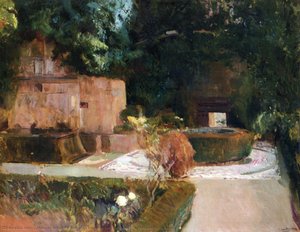
Sorolla’s technique was revolutionary for its time, prioritizing spontaneity and tonal variation over meticulous detail. He employed loose, visible brushstrokes – a characteristic trait of Impressionism – to build up layers of pigment onto the canvas with remarkable speed. These strokes weren't intended to create photographic realism but rather to convey the sensation of light itself; Sorolla meticulously observed how sunlight transformed the colors of the garden plants and skillfully translated these observations into vibrant hues. The palette is dominated by greens—ranging from pale jade to deep emerald—interspersed with splashes of ochre, lemon yellow, and terracotta red, creating a harmonious blend that evokes warmth and vibrancy. Careful attention was paid to capturing the subtle gradations of color, resulting in an illusionistic depth that draws the viewer into the scene.Historical Context: Sorolla’s Madrid Retreat
Sorolla's decision to relocate to Madrid in 1916 represented a significant shift from his celebrated coastal landscapes—particularly his iconic depictions of Albufera Lagoon near Valencia. This move coincided with a period of personal reflection and artistic experimentation, fueled by the desire to reconnect with his roots amidst the bustling city life. The Sorolla Museum, established posthumously in Madrid, houses an impressive collection of his paintings and drawings, offering visitors a glimpse into his evolving artistic vision. “The Gardens at the Sorolla Family House” reflects this newfound focus on domestic tranquility—a deliberate contrast to the dynamic energy of his earlier works. It speaks to Sorolla’s fascination with capturing not just what he saw but also how he *felt* – conveying an atmosphere of peaceful contemplation and nostalgic longing.Symbolism: The Chair as Focal Point
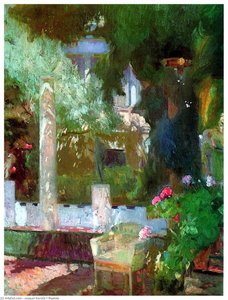
The inclusion of a wicker chair in the composition is particularly noteworthy. This seemingly simple element serves as a powerful symbol—representing Sorolla himself, engaged in his artistic practice. More importantly, it anchors the viewer’s gaze within the garden space, emphasizing its role as a locus of creativity and contemplation. The chair's position suggests stillness and introspection, mirroring the mood conveyed by the overall painting. It invites viewers to consider the artist’s presence within this idyllic setting—a subtle reminder that art is born from observation and imbued with emotion.Emotional Resonance: Capturing the Essence of Beauty
Ultimately, “The Gardens at the Sorolla Family House” succeeds in transporting us back to a moment of serene beauty. The painting radiates warmth and optimism—a testament to Sorolla’s masterful ability to distill complex emotions into visual form. It's more than just a depiction of a garden; it’s an embodiment of joie de vivre—a celebration of the simple pleasures of life and the transformative power of art. Like all great artworks, this piece lingers in the memory long after viewing, prompting contemplation on themes of nostalgia, peace, and the enduring legacy of artistic genius.Related Artworks
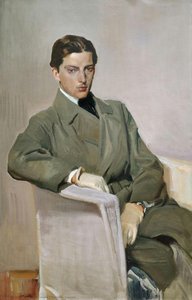
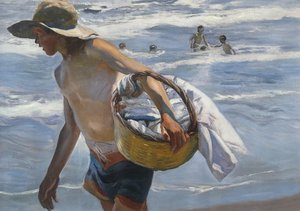
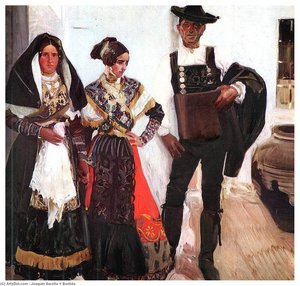
Artist Biography
A Life Bathed in Light: The World of Joaquín Sorolla
Joaquín Sorolla y Bastida, a name synonymous with the radiant light and vibrant energy of Spain, was more than just a painter; he was a chronicler of his nation’s soul. Born in Valencia in 1863, Sorolla's early life was marked by tragedy. Orphaned at the tender age of two following a cholera epidemic that claimed both parents, young Joaquín and his sister were raised by their maternal aunt and uncle. This early experience with loss perhaps instilled within him a profound appreciation for the fleeting beauty of life – a sentiment that would permeate his art. Though hardship shadowed his beginnings, it did not dim the spark of artistic talent that quickly became apparent. He received initial instruction in Valencia, demonstrating an aptitude that led to studies under established artists like Cayetano Capuz and José Benlliure, eventually culminating in a four-year grant to study in Rome. It was there, amidst the classical grandeur of Italy, that Sorolla began to forge his unique artistic path, absorbing influences while simultaneously developing a style distinctly his own.From Historical Narratives to Sun-Drenched Realism
Sorolla’s early work reflected the prevailing academic trends of the time – large-scale historical and mythological scenes. However, a pivotal shift occurred as he returned to Spain and began to truly observe the world around him. He found himself captivated by the everyday lives of his countrymen, particularly those along the Valencian coast. The intense Mediterranean sunlight, the shimmering sea, and the vibrant energy of the people became his primary subjects. This transition wasn’t immediate; Sorolla continued to explore social realism with works like Sad Inheritance (1899), a powerful depiction of children afflicted by polio bathing in the sea – a painting that garnered significant acclaim but also revealed a darker, more compassionate side to his artistic vision. Sad Inheritance, exhibited at the Universal Exhibition in Paris, brought him widespread recognition and cemented his position as a leading figure in Spanish art. Yet, it was his increasingly focused exploration of light and color, inspired by Impressionism though never fully embracing its tenets, that would define his legacy. He wasn’t merely *depicting* light; he was attempting to *capture* its very essence, the way it danced on water, illuminated skin, and transformed ordinary moments into scenes of extraordinary beauty.Master of Luminism: A Unique Artistic Voice
Sorolla's technique became instantly recognizable – a bravura display of brushwork, characterized by loose, energetic strokes that conveyed movement and atmosphere. He worked *en plein air* whenever possible, directly confronting the challenges of capturing fleeting light conditions. This dedication to painting outdoors resulted in canvases brimming with life and immediacy. His beach scenes, perhaps his most iconic works, are not simply picturesque representations of leisure; they are studies in luminosity, reflections, and the joyful interaction between people and their environment. Paintings like Children on the Seashore and Sewing the Sail exemplify this mastery – figures bathed in golden light, rendered with a remarkable sense of spontaneity and vitality. He wasn’t interested in meticulous detail; rather, he sought to convey the *impression* of reality, prioritizing atmosphere and emotion over precise representation. This approach earned him comparisons to Impressionists like Monet and Renoir, but Sorolla's work possessed a unique Spanish character – a warmth, intensity, and emotional depth that set it apart.Legacy and Enduring Influence
By the early 20th century, Joaquín Sorolla was internationally renowned. He exhibited widely throughout Europe and the United States, receiving numerous accolades and commissions. His most ambitious undertaking, Vision of Spain, a series of fourteen monumental murals commissioned by the Hispanic Society of America, remains a testament to his artistic vision and technical skill. Though he suffered a stroke in 1920 that curtailed his painting activity, Sorolla’s influence continued to grow after his death in 1923. His work inspired generations of artists, not only in Spain but around the world. Today, his paintings are held in major museums globally, including the Museo Sorolla in Madrid – a former home transformed into a dedicated space for showcasing his art. Sorolla’s legacy extends beyond his technical brilliance; he captured a specific moment in Spanish history and culture, immortalizing the beauty of its landscapes and the spirit of its people. He remains a master of light, color, and emotion—a painter whose work continues to resonate with audiences today, reminding us of the power of art to illuminate our world.Key Achievements & Recognition
- 1892: Gold medal at the National Exhibition in Madrid for Another Marguerite.
- 1894: Acclaimed for The Return from Fishing: Hauling the Boat, acquired by the Musée du Luxembourg.
- 1899: Grand Prix and medal of honor at the Universal Exhibition in Paris for Sad Inheritance.
- 1900-1923: Extensive exhibitions throughout Europe and the United States, establishing international recognition.
- 1912-1928: Commissioned to create Vision of Spain for the Hispanic Society of America (completed posthumously).
- Present Day: Works held in major museums worldwide, including the Museo Sorolla in Madrid.
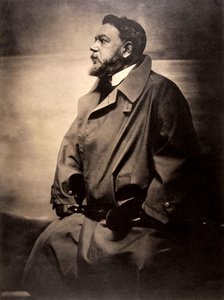
Joaquín Sorolla y Bastida
1863 - 1923 , Spain
Quick Facts
- Artistic Movement Or Style: Realism, Luminism, Impressionism
- Artists Who Influenced This Artist:
- Francisco Pradilla
- Jules Bastien-Lepage
- Adolph von Menzel
- Date Of Birth: February 27, 1863
- Date Of Death: August 10, 1923
- Full Name: Joaquín Sorolla y Bastida
- Nationality: Spanish
- Notable Artworks:
- Italian Girl with Flowers
- Bathing Time
- White Slave Trade
- Typical Sorianos
- Children on the Seashore
- Sewing the Sail
- Place Of Birth: Valencia, Spain

