 Preview
 Send
Send Share
Share
 Details

 Download
 Similars
 X-Ray
X-Ray Diaporama
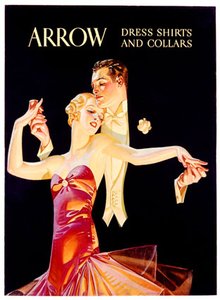
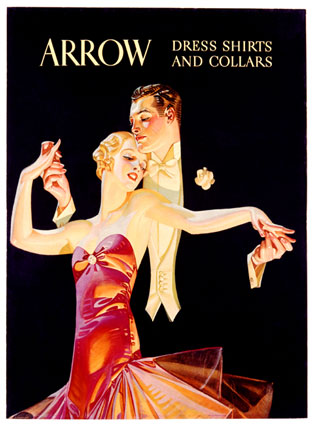
arrow shirts
 Read More
Hand Made Oil Reproduction
Hand-painted oil on canvas in your size and frame, made to order by our artists. ( Buy Print Buy Image)




































Pick from our preset sizes that match the artwork's original proportions.

You may enter your own dimensions to fit a specific frame or space. If your selected size does not match the original image's proportions, we will either crop the artwork or extend the painting with additional hand-painted elements. A digital mockup will be sent for your approval before production begins.
Please note that the on-screen preview does not reflect the actual cropping or extension. Only the mockup will accurately show the final composition.
While custom sizes are available, we recommend selecting a dimension from the predefined list to preserve the original proportions.
After order, ArtsDot.com team will email client for instructions and provide a mockup preview
Worldwide Delivery () in 3/4 weeks instead of standard 5 weeks. (22 August). No compromise on quality.

Free Worldwide Express Shipping

High-Quality Linen Canvas

Full Shipping Insurance

Customs Tax Refund Guarantee

True Color Matching Guarantee

60-Day Return Policy (Defects Only)

100% Money-Back Guarantee

Bulk Discount Offer
 Glass option is only available in size under 110 CM

arrow shirts
Reproduction Medium
Reproduction Size
-


Total Price
$ 263
Related Artworks









Artist Biography
The Grace of the Rococo: The Life and Legacy of Johann Josef Christian
In the heart of 18th-century Germany, a period defined by the swirling elegance of the Rococo movement, the name Johann Josef Christian emerged as a symbol of refined artistry and decorative mastery. Born in 1706 in the quiet town of Riedlingen, Christian would grow to become much more than a mere craftsman; he was a visionary who could breathe life into stone and pigment alike. While historical records from his early years remain somewhat veiled in the mists of time, his formative training under the guidance of Johann Georg Baumgartner in Stuttgart provided him with a formidable foundation. This apprenticeship allowed him to absorb the essential disciplines of oil painting, sculptural modeling, and stucco work, creating a versatile toolkit that would later allow him to navigate the complex demands of both fine art and architectural ornamentation.
As his career unfolded, Christian became an indispensable figure within the cultural fabric of the German states, particularly through his deep connections to the Württemberg royal court. His ability to translate the opulence of aristocratic life into tangible art made him a favorite among the nobility and high-ranking clergy. Whether he was capturing the psychological depth of a sitter in a portrait or carving the divine presence of an angel from marble, his work always maintained a sense of delicate movement and ornamental splendor. His mastery extended beyond the canvas into the very bones of the era's most magnificent structures, where his skill as a sculptor and stuccodore helped define the breathtaking interiors of the Swabian Baroque road.
A Symphony of Form and Texture
The true essence of Christian’s genius lies in his seamless ability to blend different artistic mediums into a unified aesthetic experience. In his paintings, one finds the quintessential hallmarks of the Rococo style: a preference for pastel palettes, asymmetrical compositions, and an almost tactile approach to texture. He possessed a remarkable talent for rendering the heavy sheen of silk, the intricate lace of a collar, and the soft glow of skin, all while maintaining an atmosphere of light and airy grace. His genre scenes and portraits do not merely document faces and fashions; they capture the very spirit of an era characterized by social ritual and aesthetic indulgence.
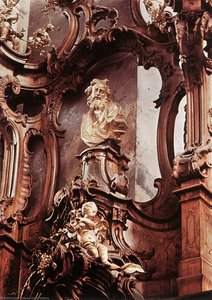
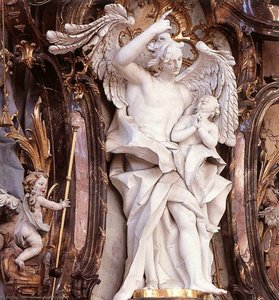
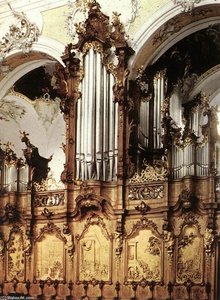
However, it is perhaps in his three-dimensional works where his expressive dynamism truly shines. Christian’s sculptures, such as his celebrated "Angel" from approximately 1760, demonstrate a profound command over emotion and religious symbolism. In these pieces, the cold rigidity of marble or wood is transformed into something fluid and emotive. His contributions to the choir stalls of the great monastic churches, including those at Zwiefalten and Ottobeuren, serve as monumental testaments to his ability to integrate sculpture with architecture. Through these works, he achieved a sense of theatricality that invited the viewer into a sacred, immersive space, where every carved leaf and sculpted figure contributed to a larger narrative of divine beauty.
Historical Significance and Enduring Impression
Though the tides of art history eventually shifted toward the more rigid structures of Neoclassicism, the impact of Johann Josef Christian remains etched in the architectural and artistic heritage of Germany. He represents a pinnacle of the Rococo period—a time when art was not merely observed but lived within. His legacy is found in the way he bridged the gap between the decorative and the profound, proving that ornamentation could carry as much emotional weight as a grand historical epic.
Today, we look back at his body of work to understand the sophisticated social hierarchies and the aesthetic aspirations of the 18th century. His life's work offers us a window into a world of:
- Technical Versatility: The rare ability to master painting, sculpture, and stucco decoration simultaneously.
- Cultural Connection: A profound influence on the visual identity of the Württemberg court and Southern German ecclesiastical art.
- Aesthetic Refinement: The perfection of the Rococo language through delicate brushwork and expressive, dynamic forms.
Johann Josef Christian passed away in his birthplace of Riedlingen in 1777, leaving behind a world that had been made more beautiful by his touch. His ability to capture both the fleeting elegance of a social gathering and the eternal grace of a celestial being ensures that his name continues to resonate within the halls of European art history.
johann josef christian
1706 - 1777 , Germany
Quick Facts
- Artistic Movement Or Style: Rococo
- Date Of Birth: 1706
- Full Name: Johann Josef Christian
- Nationality: German
- Notable Artworks:
- Angel
- Arrow Shirts
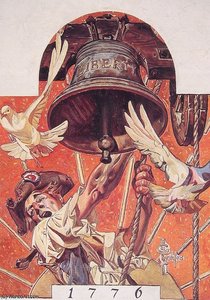
- Patriot and Liberty Bell
- Place Of Birth: Riedlingen, Germany