 Preview
 Send
Send Share
Share
 Details

 Download
 Similars
 X-Ray
X-Ray Diaporama
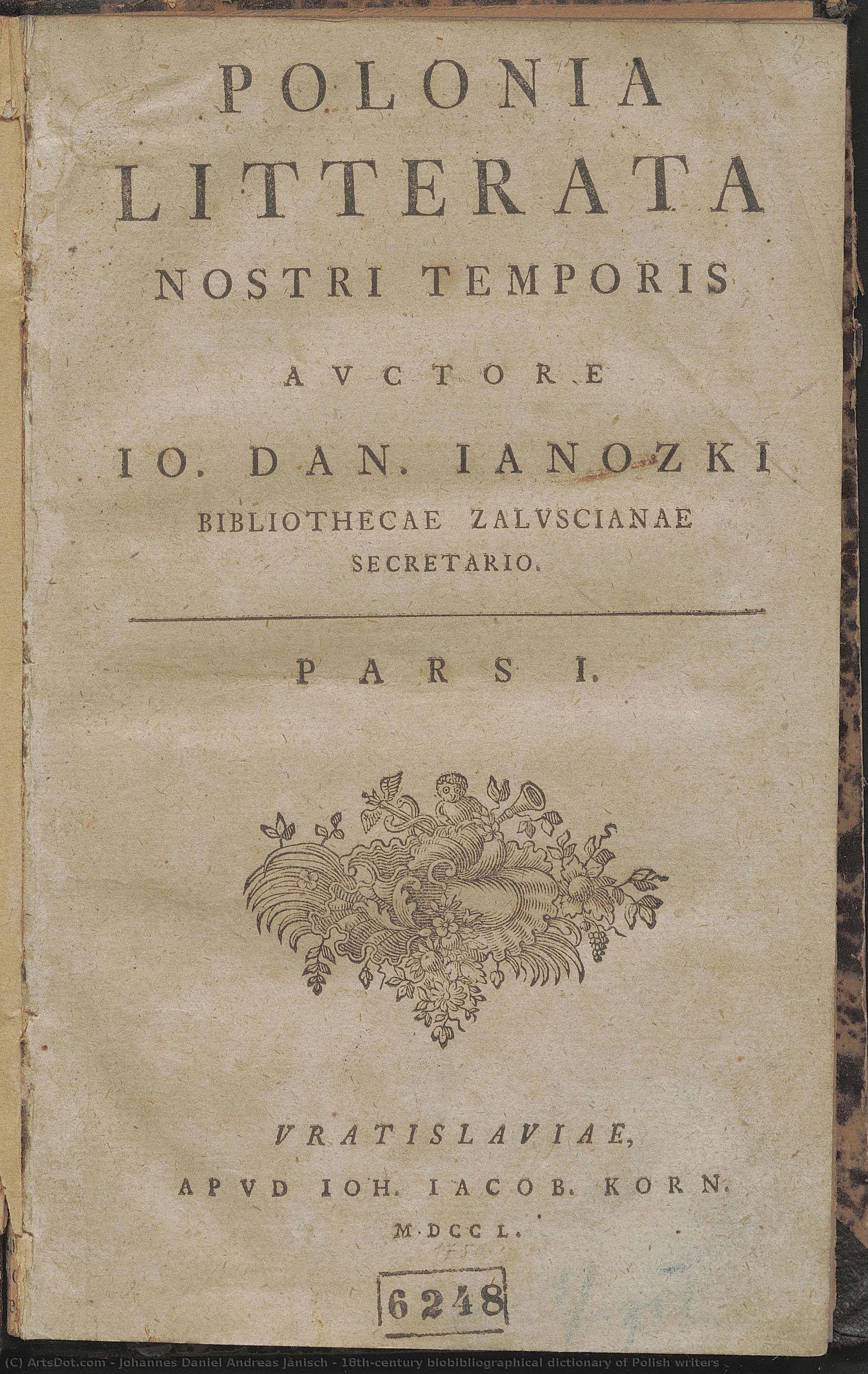
18th-century biobibliographical dictionary of Polish writers


 Read More
Hand Made Oil Reproduction
Hand-painted oil on canvas in your size and frame, made to order by our artists. ( Buy Print Buy Image)




































Pick from our preset sizes that match the artwork's original proportions.

You may enter your own dimensions to fit a specific frame or space. If your selected size does not match the original image's proportions, we will either crop the artwork or extend the painting with additional hand-painted elements. A digital mockup will be sent for your approval before production begins.
Please note that the on-screen preview does not reflect the actual cropping or extension. Only the mockup will accurately show the final composition.
While custom sizes are available, we recommend selecting a dimension from the predefined list to preserve the original proportions.
After order, ArtsDot.com team will email client for instructions and provide a mockup preview
Worldwide Delivery () in 3/4 weeks instead of standard 5 weeks. (30 August). No compromise on quality.

Free Worldwide Express Shipping

High-Quality Linen Canvas

Full Shipping Insurance

Customs Tax Refund Guarantee

True Color Matching Guarantee

60-Day Return Policy (Defects Only)

100% Money-Back Guarantee

Bulk Discount Offer
 Glass option is only available in size under 110 CM

18th-century biobibliographical dictionary of Polish writers
Reproduction Medium
Reproduction Size
-


Total Price
$ 263
Related Artworks









Artist Biography
The Architect of Memory: The Life and Legacy of Johannes Daniel Andreas Jänisch
In the vibrant, intellectual currents of Enlightenment Poland, few figures navigated the delicate intersection of literature and preservation as masterfully as Johannes Daniel Andreas Jänisch. Born in 1720 in the town of Międzychod, a place where German cultural traditions and Polish landscapes met, Jänisch’s early life was shaped by a profound sense of meticulousness. The son of a tailor and wood merchant, his upbringing provided a pragmatic foundation that would later serve him well in the painstaking labor of bibliographical scholarship. His journey from a small Polish town to the prestigious halls of European academia is a testament to the transformative power of education during the 18th century.
Jänisch’s intellectual awakening began in earnest at the Kreuzschule in Dresden, where he immersed himself in the classical studies and humanist ideals that defined his era. This period of study exposed him to the radical philosophies of thinkers like Voltaire and Rousseau, instilling in him a lifelong passion for the written word. His academic trajectory continued at the renowned Landesschule Pforta, an institution that acted as a crucible for great minds. It was here that Jänisch encountered literary luminaries such as Johann Elias Schlegel and Friedrich Gottlieb Klopstock. These encounters were not merely academic; they were deeply personal, shaping his aesthetic sensibilities and fueling a desire to document the vast, often unmapped, landscape of Polish literature.
A Custodian of the Written Word
The turning point in Jänisch’s career arrived through a serendipitous connection with Gottfried Enoch Jonisch, a respected bibliophile who recognized the young scholar's extraordinary potential. Through Jonisch’s recommendation, Jänisch secured the prestigious position of librarian and secretary at the library of Andrzej Stanisław Załuski in Warsaw. This institution was the beating heart of Polish intellectual life, and serving as its custodian allowed Jänisch to delve into the very soul of the nation's literary heritage. His time at the Załuski library was more than a job; it was an immersion into a world of rare manuscripts, forgotten histories, and the enduring power of the printed page.
His most significant contribution to the annals of history remains his monumental work, “Polonia litterata nostri temporis”. This ambitious biobibliographical dictionary sought to map the lives and works of Polish authors living during the reign of Augustus III. Through this project, Jänisch did more than list names; he constructed a narrative of a nation's intellectual vitality. His work represents the very beginnings of modern Polish bibliography, providing a structured, scholarly framework that allowed future generations to understand the breadth of their own literary tradition. Though the full scope of his vision—originally intended to span four parts—was only partially realized in print, the volumes that did emerge remain cornerstones of historical scholarship.
Historical Significance and Enduring Influence
The legacy of Johannes Daniel Andreas Jänisch extends far beyond the dusty shelves of the libraries he once managed. He was a pioneer who bridged the gap between the scattered knowledge of the past and the organized scholarship of the future. By applying rigorous analytical skills to the collection of biographical data, he helped establish a standard for bibliographical accuracy that would influence historians for centuries. His life reflects the broader Enlightenment movement: a period characterized by an unquenchable thirst for knowledge, the systematic categorization of the world, and a profound respect for the continuity of human thought.
Today, Jänisch is remembered not merely as a librarian, but as a vital architect of Polish cultural identity. His ability to weave together the threads of individual lives into a cohesive national bibliography ensured that the voices of his contemporaries would not be lost to the passage of time. In the grand tapestry of 18th-century history, Jänisch stands as a guardian of memory, a man who understood that to preserve a culture, one must first learn to read, organize, and honor its stories.
johannes daniel andreas jänisch
1720 - 1786 , Poland
Quick Facts
- Artistic Movement Or Style: Enlightenment
- Artists Or Movements Influenced By This Artist: ['Modern Polish Bibliography']
- Artists Who Influenced This Artist:
- Johann Elias Schlegel
- Friedrich Gottlieb Klopstock
- Date Of Birth: Międzychod, Poland (1720)
- Date Of Death: 1786
- Full Name: Johannes Daniel Andreas Jänisch
- Nationality: Polish
- Notable Artworks: ['Biobibliographical Dictionary']
- Place Of Birth: Poland