 Preview
 Send
Send Share
Share
 Details

 Download
 Similars
 X-Ray
X-Ray Diaporama
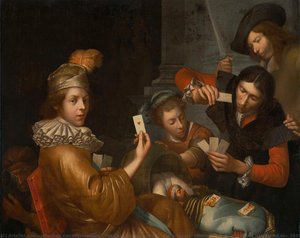
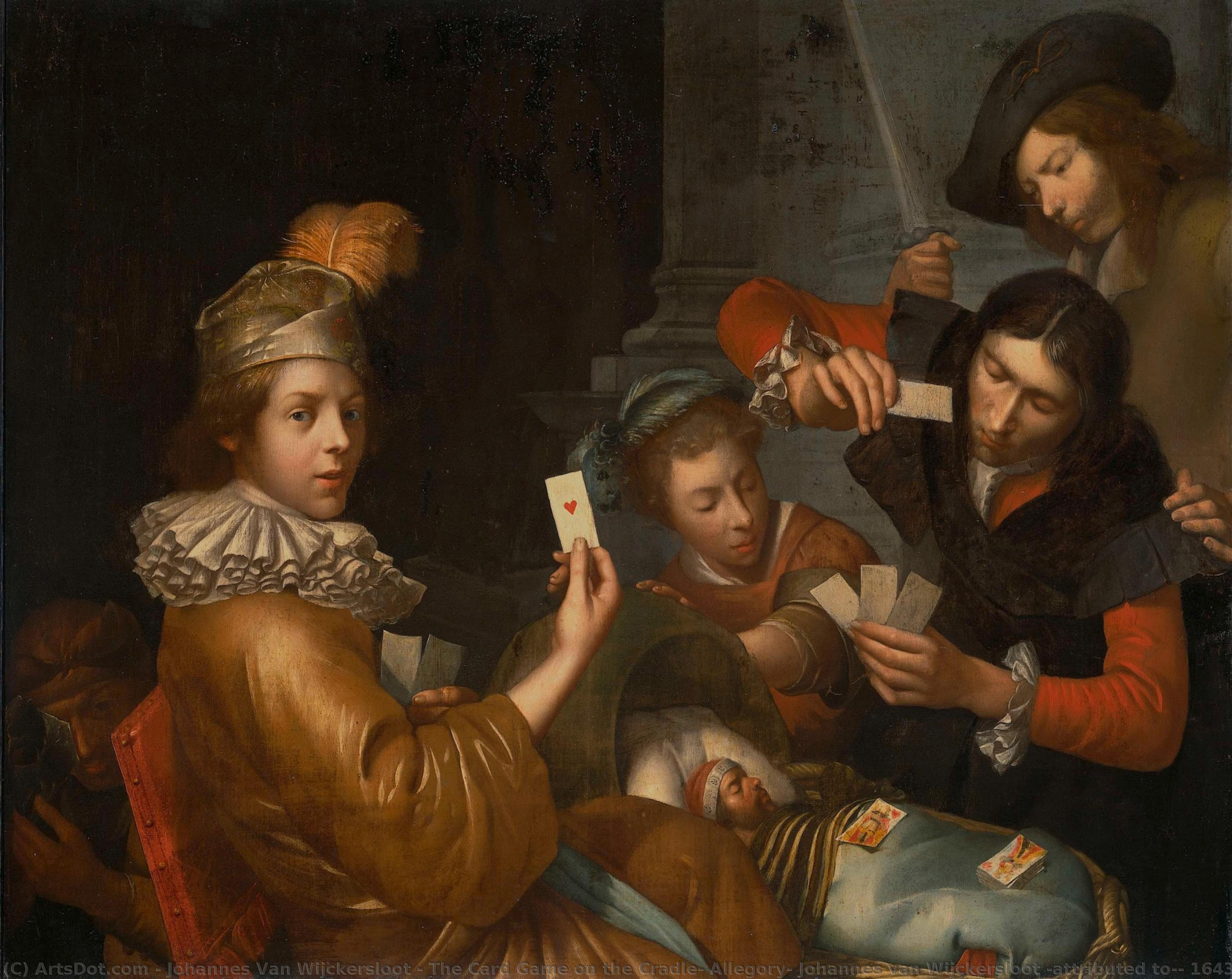
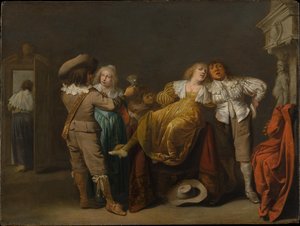
The Card Game on the Cradle: Allegory, Johannes van Wijckersloot (attributed to), 1643 - 1683
 1683
1683 98.0 x 121.0 cm
 Read More
Hand Made Oil Reproduction
Hand-painted oil on canvas in your size and frame, made to order by our artists. ( Buy Print Buy Image)




































Pick from our preset sizes that match the artwork's original proportions.

You may enter your own dimensions to fit a specific frame or space. If your selected size does not match the original image's proportions, we will either crop the artwork or extend the painting with additional hand-painted elements. A digital mockup will be sent for your approval before production begins.
Please note that the on-screen preview does not reflect the actual cropping or extension. Only the mockup will accurately show the final composition.
While custom sizes are available, we recommend selecting a dimension from the predefined list to preserve the original proportions.
After order, ArtsDot.com team will email client for instructions and provide a mockup preview
Worldwide Delivery () in 3/4 weeks instead of standard 5 weeks. (5 September). No compromise on quality.

Free Worldwide Express Shipping

High-Quality Linen Canvas

Full Shipping Insurance

Customs Tax Refund Guarantee

True Color Matching Guarantee

60-Day Return Policy (Defects Only)

100% Money-Back Guarantee

Bulk Discount Offer
 Glass option is only available in size under 110 CM

The Card Game on the Cradle: Allegory, Johannes van Wijckersloot (attributed to), 1643 - 1683
Reproduction Medium
Reproduction Size
-


Total Price
$ 263
Related Artworks








Artist Biography
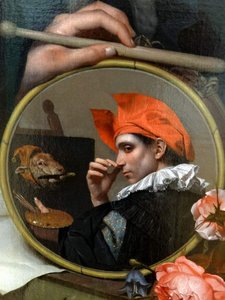
The Silent Master of Utrecht: The Life of Johannes van Wijckersloot
In the golden twilight of the Dutch Golden Age, a period defined by unparalleled mercantile prosperity and artistic explosion, there lived a painter whose brush captured the very heartbeat of a nation in turmoil. Johannes van Wijckersloot, born in the vibrant city of Utrecht around 1625 or 1630, remains a figure of profound mystery and enduring significance. While the biographical details of his early years are largely obscured by the mists of time, the traces of his presence in the guild records suggest a man deeply embedded in the artistic fabric of his era. It is believed that he honed his craft within the prestigious drawing academy newly established in Utrecht, an institution that would have provided him with the essential vocabulary of light, shadow, and form that later defined his mature style.
His ascent within the Utrecht Guild of Saint Luke was not merely a matter of survival but a testament to his growing mastery. By 1658, Wijckersloot had achieved the esteemed rank of headman, a position of leadership that signaled both his technical excellence and his respected standing among his peers. This period of his life represents a transition from a diligent student of the Utrecht school to a sophisticated creator capable of navigating the complex demands of both portraiture and high-concept allegory. His work began to reflect a unique duality: the ability to render the physical world with startling realism while simultaneously imbuing it with layers of philosophical and political meaning.
Symbolism and the Weight of History
To look upon a Wijckersloot painting is to engage in a silent dialogue with history. He was a master of the allegorical mode, a genre that allowed him to transform contemporary political crises into timeless visual metaphors. Perhaps his most hauntingly beautiful achievement is his 1672 allegory concerning the Rampjaar, or the "Disaster Year." In this work, he captures the vulnerability of the Dutch Republic during the French invasion with heartbreaking precision. Through the depiction of a peaceful Garden of Holland, where a defeated lion lies amidst broken swords and scattered arrows, he communicated the collective trauma of a nation under siege.
The power of his compositions lies in their intricate symbolic language:
- The Dutch Lion: A symbol of national strength, rendered here in a state of profound vulnerability to mirror the political instability of 1672.
- The French Rooster: An evocative antagonist used to represent the encroaching threat of foreign invasion.
- The Broken Sword and Scattered Arrows: Visual cues that speak to the collapse of defenses and the fragility of peace.
Beyond these grand political statements, Wijckersloot possessed a remarkable sensitivity for portraiture. He did not merely record faces; he sought to capture the psychological essence of his subjects. His ability to manipulate light to reveal the subtle nuances of human expression allowed him to create portraits that felt alive, breathing with the quiet dignity or the hidden anxieties of the Dutch citizenry.
A Legacy Carved in Color and Light
As his career progressed, Wijckersloot’s reach expanded beyond the borders of Utrecht. His move to Amsterdam in 1684 marked the final chapter of a life dedicated to the pursuit of artistic truth. Though he passed away in 1687, the impact of his meticulous brushwork and his ability to weave complex narratives into single frames left an indelible mark on the Dutch tradition. He belonged to that rare class of artists who could serve both the intimate needs of the portraitist and the grander ambitions of the historian.
The historical significance of Johannes van Wijckersloot lies in his role as a visual chronicler of the Dutch soul. In an age where politics, religion, and commerce were inextricably linked, his paintings served as mirrors to the societal shifts of the 17th century. Through his mastery of color and his profound understanding of allegory, he ensured that the triumphs and tragedies of the Dutch Golden Age would not merely be remembered in text, but felt through the evocative power of art.
Johannes van Wijckersloot
1687 , Netherlands
Quick Facts
- Artistic Movement Or Style: Golden Age Painting
- Artists Or Movements Influenced By This Artist: ['']
- Artists Who Influenced This Artist: ['']
- Date Of Death: 1687
- Full Name: Johannes van Wijckersloot
- Nationality: Dutch
- Notable Artworks:
- Allegory on the Rampjaar
- The Card Game on the Cradle
- Place Of Birth: Utrecht, Netherlands