 Preview
 Send
Send Share
Share
 Details

 Download
 Similars
 X-Ray
X-Ray Diaporama
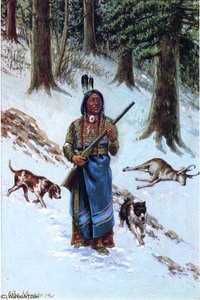
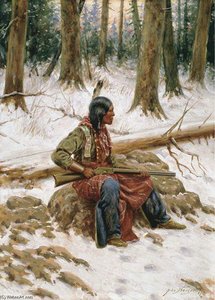
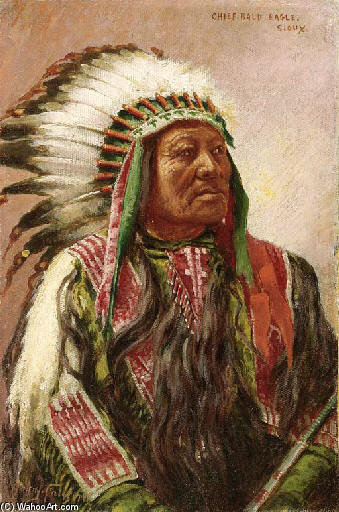
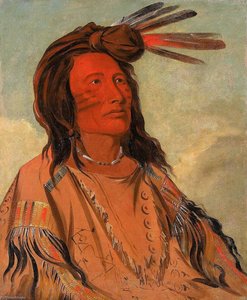
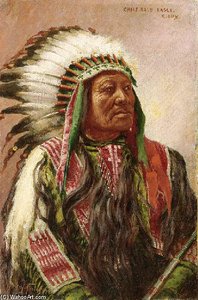
Chief Bald Eagle, Sioux
 Read More
Hand Made Oil Reproduction
Hand-painted oil on canvas in your size and frame, made to order by our artists. ( Buy Print Buy Image)




































Pick from our preset sizes that match the artwork's original proportions.

You may enter your own dimensions to fit a specific frame or space. If your selected size does not match the original image's proportions, we will either crop the artwork or extend the painting with additional hand-painted elements. A digital mockup will be sent for your approval before production begins.
Please note that the on-screen preview does not reflect the actual cropping or extension. Only the mockup will accurately show the final composition.
While custom sizes are available, we recommend selecting a dimension from the predefined list to preserve the original proportions.
After order, ArtsDot.com team will email client for instructions and provide a mockup preview
Worldwide Delivery () in 3/4 weeks instead of standard 5 weeks. (18 August). No compromise on quality.

Free Worldwide Express Shipping

High-Quality Linen Canvas

Full Shipping Insurance

Customs Tax Refund Guarantee

True Color Matching Guarantee

60-Day Return Policy (Defects Only)

100% Money-Back Guarantee

Bulk Discount Offer
 Glass option is only available in size under 110 CM

Chief Bald Eagle, Sioux
Reproduction Medium
Reproduction Size
-


Total Price
$ 263
Related Artworks


Artist Biography
The Soul of the Southwest: The Life and Legacy of John Hauser
In the vast, sun-drenched expanse of the American West, where the horizon meets the rugged silhouettes of the mesas, there exists a profound sense of history etched into the very earth. It was this enduring spirit that John Hauser sought to immortalize through his brush. Born in 1859 in Cincinnati, Ohio, to German immigrant parents, Hauser’s journey began far from the arid landscapes of the Southwest. His early years were shaped by the disciplined atmosphere of the Queen City, where he received a foundational education at the Ohio Mechanics' Institute and later studied under Thomas Satterwhite Noble. Yet, even in his youth, there was an unmistakable pull toward a larger world, a curiosity that would eventually lead him across the Atlantic to the prestigious Royal Academy of Fine Arts in Munich.
This European immersion proved to be a transformative chapter in Hauser’s artistic evolution. Immersed in the rigorous traditions of German academic realism, he honed a technique characterized by meticulous observation and an almost scientific precision. It was during this period that his first significant work, “Lord Baltimore,” emerged—a portrait of a legendary Indian scout that signaled his lifelong fascination with Native American subjects. This early success bridged the gap between his European training and his burgeoning interest in the American frontier, blending the sophisticated light and shadow of the Munich school with the raw, untamed narratives of the West.
A Deepened Connection: Beyond the Canvas
While many artists of his era approached the American West as transient visitors or romanticized observers, Hauser sought a much more intimate communion with the cultures he depicted. His expeditions to Arizona and New Mexico in the 1890s were not merely for the purpose of sketching landscapes; they were quests for authenticity. Traveling alongside contemporaries like Joseph Henry Sharp, Hauser ventured into the heart of tribal territories, including the Pine Ridge Reservation. This dedication to truth went beyond mere artistic study; it became a lived experience. In a remarkable testament to his respect and integration into the communities he painted, Hauser and his wife were eventually adopted by the Lakota Sioux tribe, becoming members of their nation.
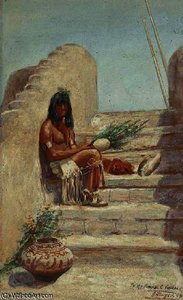
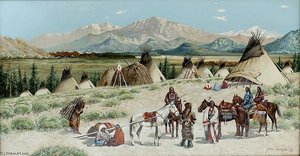
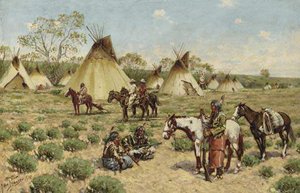
This profound cultural bond fundamentally altered the texture of his work. The portraits he produced were not merely ethnographic studies but soulful encounters. He possessed a rare ability to capture the dignity, the quiet strength, and the nuanced humanity of Native American individuals. Whether depicting the movement of a scout or the stillness of a village elder, Hauser’s brushwork conveyed a deep-seated reverence. His paintings often functioned as windows into a way of life that was rapidly changing under the pressures of westward expansion, preserving the essence of a pre-reservation era through a lens of both realism and romanticism.
Mastery of Light and Landscape
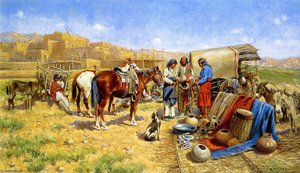
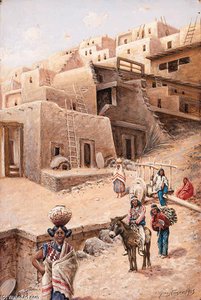
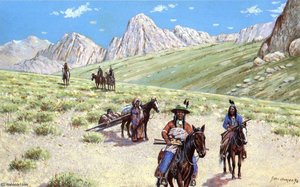
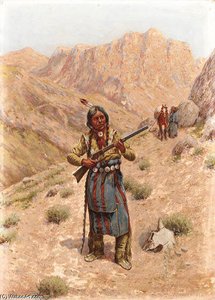
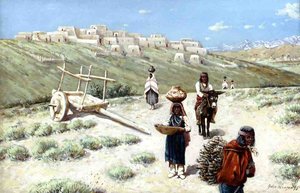
Hauser’s technical mastery extended seamlessly from his portraiture to his sweeping depictions of the Southwestern landscape. He had an extraordinary gift for rendering the unique atmospheric conditions of the desert—the way the midday sun flattens the terrain into brilliant, heat-soaked planes, or how the twilight brings long, violet shadows across the canyon floors. His works, such as “Near Laguna Pueblo” and “Mountain Desert Trail,” demonstrate a sophisticated command over color and composition.
The artist’s legacy is defined by several key artistic achievements:
- Authentic Portraiture: He moved beyond the caricatures common in 19th-century Western art to provide deeply respectful and anatomically precise portraits of Native American leaders and families.
- Landscape Integration: His ability to weave human figures into vast, sweeping vistas created a sense of narrative continuity between the people and their ancestral lands.
- Academic Precision: By applying the rigorous standards of the Munich Academy to American subjects, he elevated Western frontier art to a level of high-art sophistication.
Today, John Hauser is remembered not just as a painter of scenes, but as a chronicler of a vanishing world. His work remains a vital historical record, capturing the intersection of tradition and transition. Through his eyes, we see the American West not as a lawless frontier, but as a complex, beautiful, and deeply human landscape, forever preserved in the amber of his masterful oil paintings.
John Hauser
1859 - 1913 , United States of America
Quick Facts
- Artistic Movement Or Style: Romanticism
- Artists Or Movements Influenced By This Artist: ['Romanticism']
- Artists Who Influenced This Artist: ['Thomas Satterwhite Noble']
- Date Of Birth: Cincinnati, United States of America (1859)
- Date Of Death: 1913
- Full Name: John Hauser
- Nationality: American
- Notable Artworks:
- Near Laguna Pueblo
- Mountain Desert Trail
- Successful Hunt
- Place Of Birth: Cincinnati, Ohio