 Preview
 Send
Send Share
Share
 Details

 Download
 Similars
 X-Ray
X-Ray Diaporama
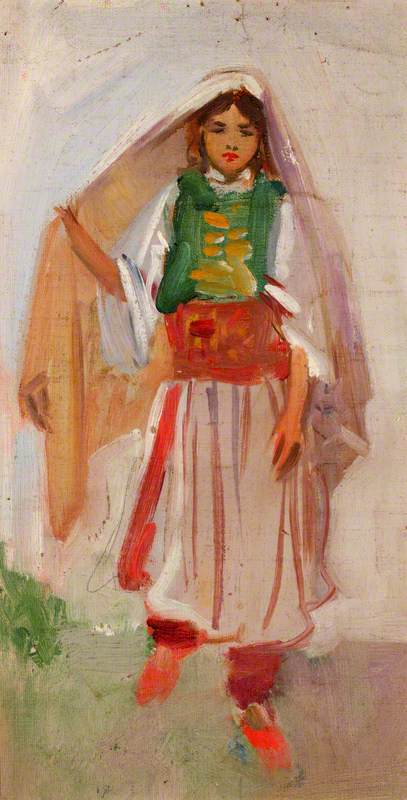
Arab Girl Holding Her Head Veil
 32.0 x 23.0 cm
 Read More
Giclée / Art Print
Museum-quality giclée or canvas print with fast production and flexible finish options. ( Buy Hand Made Painting Buy Image)




































Pick from our preset sizes that match the artwork's original proportions.

You may enter your own dimensions to fit a specific frame or space. If your selected size does not match the original image's proportions, we will either crop the artwork or extend the image with a mirrored or solid-fill edge. A digital mockup will be sent for your approval before production begins.
Please note that the on-screen preview does not reflect the actual cropping or extension. Only the mockup will accurately show the final composition.
While custom sizes are available, we recommend selecting a dimension from the predefined list to preserve the original proportions.
Worldwide Delivery () in 2 weeks instead of standard 4/5 weeks. (24 August)

Free Worldwide Express Shipping

High-Quality Linen Canvas

Full Shipping Insurance

Customs Tax Refund Guarantee

True Color Matching Guarantee

60-Day Return Policy (Defects Only)

100% Money-Back Guarantee

Bulk Discount Offer
 Glass option is only available in size under 110 CM

Arab Girl Holding Her Head Veil
Giclée / Art Print
Reproduction Size
-


Total Price
$ 63
Related Artworks


Artist Biography
John J Alsop: A Pioneer of Bedouin Portraiture
John J Alsop (born circa 1879, died unknown) stands as a singular figure in the annals of British art history – specifically recognized for his groundbreaking contributions to documenting and celebrating Bedouin culture. While overshadowed by contemporaries like Harvey Reeves and John Reed, Alsop’s meticulous observation and artistic skill cemented his place as one of the earliest practitioners of portraiture focused on nomadic peoples.
Born in England, Alsop's early life remains sparsely documented. However, he joined the British Red Cross during World War I, dedicating himself to humanitarian service and actively engaging in fieldwork across Egypt and Syria. It was during this period that his artistic endeavors truly flourished, driven by a profound desire to capture the essence of Bedouin existence – their traditions, rituals, and daily routines.
- Early Influences: Alsop’s artistic sensibilities were undoubtedly shaped by the Victorian aesthetic, characterized by detailed realism and an appreciation for naturalistic color palettes. The influence of artists like Frederic Leighton and William Holman Hunt can be discerned in his compositional choices and stylistic refinements.
- Methodology & Technique: Unlike many artists of his time who favored idealized representations, Alsop adopted a rigorously scientific approach to portraiture. He meticulously documented subjects’ features, clothing, and surroundings using watercolors and pencil sketches – techniques he considered paramount for conveying accuracy and capturing the subtleties of Bedouin life.
- Notable Works: Among his most celebrated paintings are portraits of Bedouin chiefs and families, notably “Sheikh Khalil” (1920), which exemplifies Alsop’s masterful blending of observation and artistic expression. His drawings offer invaluable insights into Bedouin social structures and customs.
- The Significance of Bedouin Portraiture: Alsop's work represents a pivotal moment in ethnographic art – demonstrating the potential for visual media to illuminate cultures beyond Western Europe. He challenged prevailing notions about representation, prioritizing truthful depiction over stylistic embellishment and establishing a precedent for documenting marginalized communities.
- Legacy & Recognition: Although Alsop’s artistic output remained relatively modest compared to other artists of his era, his pioneering approach to Bedouin portraiture continues to inspire scholars and artists alike. Recent exhibitions have revived interest in his oeuvre, reaffirming his enduring contribution to the history of art and anthropology.
Exploring Alsop's Artistic Style
Alsop’s distinctive style can be characterized by several key elements. Firstly, he favored a subdued color scheme—primarily muted reds, browns, and ochres—reflecting the arid landscapes inhabited by Bedouin communities. Secondly, his compositions were often asymmetrical, mirroring the dynamism of nomadic life.
He skillfully employed watercolor techniques to achieve luminous effects and capture the atmospheric qualities of desert environments. Furthermore, Alsop’s meticulous pencil sketches provided a foundational layer of detail—recording precise anatomical measurements and capturing nuanced expressions – ensuring that every aspect of his subjects was faithfully rendered.
His artistic vision transcended mere technical proficiency; it embodied a deep empathy for Bedouin culture and a commitment to preserving its traditions. Alsop’s work stands as a testament to the transformative power of art—demonstrating how visual representations can foster understanding and appreciation across cultural boundaries.
Quick Facts
- Artistic Movement Or Style: Victorian Art Style
- Artists Or Movements Influenced By This Artist: ['John Alsop Drawings']
- Artists Who Influenced This Artist: ['Harvey Reeves']
- Date Of Death: Living
- Full Name: John J Alsop
- Nationality: British
- Notable Artworks: ['Bedouin Arab Portraits']