 Preview
 Send
Send Share
Share
 Details

 Download
 Similars
 X-Ray
X-Ray Diaporama
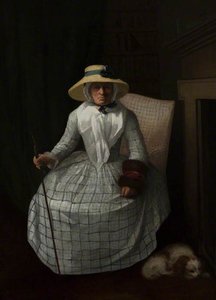
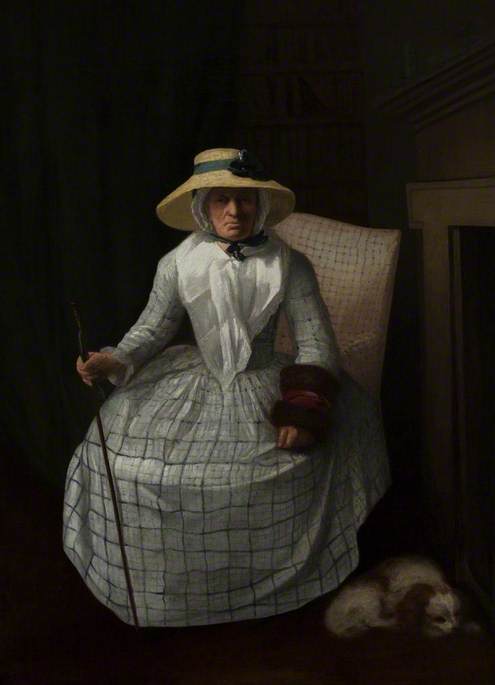
Mrs Jeffrey, née Mary Wilkes (1728–1808)
 1794
1794 123.0 x 87.0 cm
 Victoria Art Gallery
 Read More
Giclée / Art Print
Museum-quality giclée or canvas print with fast production and flexible finish options. ( Buy Hand Made Painting Buy Image)




































Pick from our preset sizes that match the artwork's original proportions.

You may enter your own dimensions to fit a specific frame or space. If your selected size does not match the original image's proportions, we will either crop the artwork or extend the image with a mirrored or solid-fill edge. A digital mockup will be sent for your approval before production begins.
Please note that the on-screen preview does not reflect the actual cropping or extension. Only the mockup will accurately show the final composition.
While custom sizes are available, we recommend selecting a dimension from the predefined list to preserve the original proportions.
Worldwide Delivery () in 2 weeks instead of standard 4/5 weeks. (26 August)

Free Worldwide Express Shipping

High-Quality Linen Canvas

Full Shipping Insurance

Customs Tax Refund Guarantee

True Color Matching Guarantee

60-Day Return Policy (Defects Only)

100% Money-Back Guarantee

Bulk Discount Offer
 Glass option is only available in size under 110 CM

Mrs Jeffrey, née Mary Wilkes (1728–1808)
Giclée / Art Print
Reproduction Size
-


Total Price
$ 63
Related Artworks









Artist Biography
The Enigmatic Brush of the Georgian Era
In the vibrant, social tapestry of late 18th-century England, few figures capture the essence of the era’s shifting social dynamics as subtly as John Sanders. Born around 1750, Sanders emerged during a period of profound transformation, where the elegance of the Georgian era met the burgeoning energy of the Regency period. While much of his early life remains shrouded in the mists of history, his artistic presence was undeniably felt within the prestigious circles of Bath society and the bustling art markets of London. He was not merely a painter of faces, but a chronicler of an age defined by intellectual discourse, aristocratic grace, and the rise of a new, aspirational middle class.
Sanders’ journey into the heart of British portraiture was marked by a unique spirit of collaboration. Rather than seeking the solitary path of the lone genius, he found great success as part of a formidable artistic trio alongside William Tatham and Thomas Bailey. This partnership was a masterclass in creative synergy and business acumen. Within this studio system, Sanders played a specialized and vital role; while others might focus on the grand architecture of a scene or the heavy drapery of a gown, Sanders possessed a remarkable gift for capturing the most human elements of a portrait—the delicate nuances of faces and the expressive grace of hands. This division of labor allowed the trio to meet the soaring demand for portraiture, providing the growing merchant and professional classes with exquisite keepsakes that mirrored their own rising status.
Mastery of Detail and the Spirit of Bath
The artistry of John Sanders is best understood through his meticulous devotion to observation. His style was deeply rooted in the neoclassical traditions of his time, drawing silent inspiration from the refined aesthetics of masters like Benjamin West and Angelica Kauffmann. This influence manifested in a technique that prioritized clarity, precision, and a sophisticated use of light. When viewing his work, one is struck by an almost tactile quality; he had an uncanny ability to render the shimmering texture of silk, the soft weight of velvet, and the subtle warmth of human skin with profound accuracy.
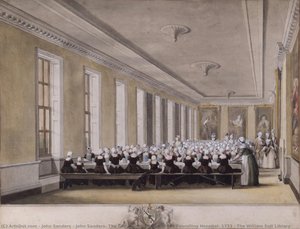
Nowhere is his ability to convey atmosphere more evident than in his celebrated works that depict the social institutions of his day. His painting “The Girls’ Dining Room”, currently held at The Holburne Museum in Bath, serves as a breathtaking window into the past. In this monumental piece, Sanders does not merely document a room; he captures a moment of lived experience. Through subtle tonal variations and a masterful command of composition, he breathes life into the setting, allowing the viewer to feel the quiet dignity and the social rhythms of the Foundling Hospital. His work transcends simple likeness, reaching toward a psychological depth that invites the observer to contemplate the emotions and the very soul of his subjects.
A Legacy Written in Portraiture
Though Sanders may not occupy the same singular spotlight as contemporaries like Gainsborough or Reynolds, his historical significance lies in his role as a vital architect of the British visual identity during a period of immense social change. Through his collaborative studio, he helped democratize the art of portraiture, making the prestige of fine painting accessible to a wider segment of society beyond the highest aristocracy. His work represents the aesthetic heartbeat of the Regency middle class—a group characterized by their industriousness and their desire for cultural refinement.
The enduring legacy of John Sanders is found in the quiet strength of his craftsmanship and his ability to freeze the elegance of a vanishing world. His contributions to the history of British art include:
- The Refinement of Collaborative Portraiture: Revolutionizing the studio system to meet the demands of a growing clientele through specialized skill sets.
- Documentation of Bath Society: Providing an invaluable visual record of the social customs, fashion, and architectural splendor of Georgian England.
- Technical Precision: Advancing the standard of detail in facial rendering and textural representation within the English portrait tradition.
- Cultural Preservation: Creating works that continue to serve as essential historical touchstones for understanding the social evolution of the 18th and 19th centuries.

john sanders
1750 - 1825
Quick Facts
- Artistic Movement Or Style: Bath Society Art
- Date Of Death: 1825
- Full Name: John Sanders
- Nationality: English
- Notable Artworks: ['The Girls’ Dining Room']
- Place Of Birth: England