 Preview
 Send
Send Share
Share
 Details

 Download
 Similars
 X-Ray
X-Ray Diaporama
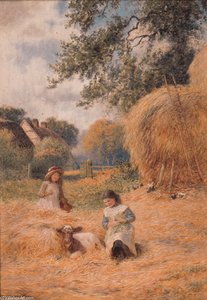
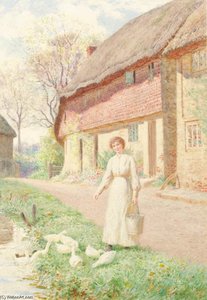
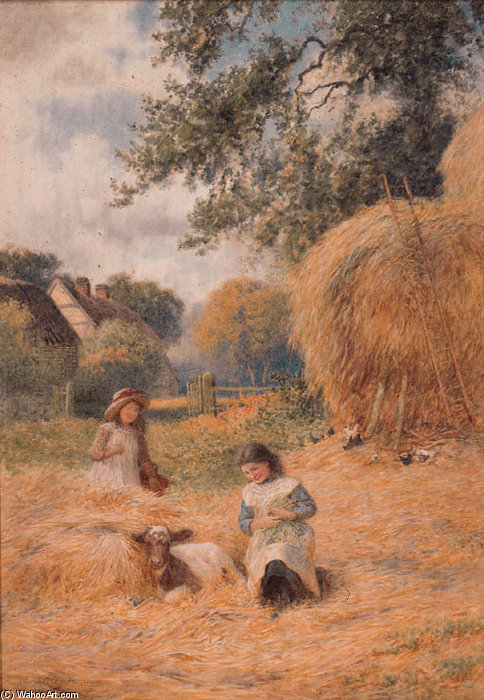
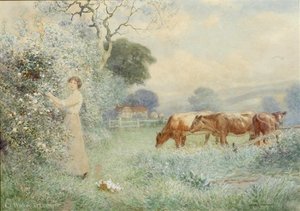
Feeding The Calf; And Gathering Blossom
 Read More
Giclée / Art Print
Museum-quality giclée or canvas print with fast production and flexible finish options. ( Buy Hand Made Painting Buy Image)




































Pick from our preset sizes that match the artwork's original proportions.

You may enter your own dimensions to fit a specific frame or space. If your selected size does not match the original image's proportions, we will either crop the artwork or extend the image with a mirrored or solid-fill edge. A digital mockup will be sent for your approval before production begins.
Please note that the on-screen preview does not reflect the actual cropping or extension. Only the mockup will accurately show the final composition.
While custom sizes are available, we recommend selecting a dimension from the predefined list to preserve the original proportions.
Worldwide Delivery () in 2 weeks instead of standard 4/5 weeks. (18 August)

Free Worldwide Express Shipping

High-Quality Linen Canvas

Full Shipping Insurance

Customs Tax Refund Guarantee

True Color Matching Guarantee

60-Day Return Policy (Defects Only)

100% Money-Back Guarantee

Bulk Discount Offer
 Glass option is only available in size under 110 CM

Feeding The Calf; And Gathering Blossom
Giclée / Art Print
Reproduction Size
-


Total Price
$ 63
Related Artworks
Artist Biography
The Quiet Majesty of Joseph Kirkpatrick
In the soft, dappled light of the late Victorian and Edwardian eras, few artists captured the serene pulse of the British landscape with as much tender precision as Joseph Kirkpatrick. Born in Liverpool in 1872, Kirkpatrick emerged from the industrial heart of England to become a painter of profound tranquility. His work serves as a window into a bygone world, where the rhythmic simplicity of rural life and the dignified permanence of architectural landmarks were celebrated with an almost devotional care. To wander through his canvases is to experience a sense of stillness, a respite from the encroaching noise of the modern age, found in the delicate petals of a primrose or the weathered stone of a country church.
Kirkpatrick’s artistic journey was rooted in the rigorous traditions of British art education. Studying at the Liverpool School of Art, he immersed himself in the dual influences of Academic precision and the burgeoning luminosity of Impressionism. This foundation allowed him to master a technique that balanced the objective truth of realism with a poetic, atmospheric sensibility. He was particularly adept at using a glazing technique—layering thin, translucent washes of pigment over underpaintings—to create a sense of inner light. This method gave his depictions of gardens and woodlands a breathing, organic quality, where shadows felt deep and sunlight seemed to filter through the very air itself.
A Legacy of Detail and Devotion
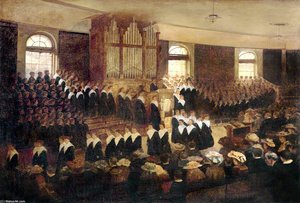
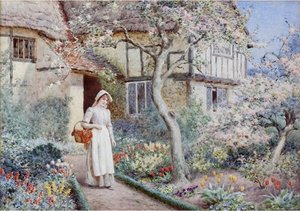
The breadth of Kirkpatrick’s oeuvre reveals an artist deeply enamored with both the natural world and the human structures that inhabit it. He possessed a remarkable ability to render textures, from the soft, velvety surface of a newborn calf to the intricate, cold masonry of St Mary’s Church in Birkenhead or the historic Blue Coat School. His paintings often focused on the intersection of human endeavor and natural beauty, portraying humble farming figures with an earthy, grounded quality that echoed the nineteenth-century French genre painters. Whether it was a woodland scene of women gathering primroses or the vibrant, seasonal promise of flowering trees, his subjects were always treated with a profound respect for their inherent dignity.
Throughout his career, Kirkpatrick achieved significant recognition within the prestigious circles of the British art establishment. His dedication to his craft led to regular exhibitions at the Royal Academy between 1898 and 1928, a testament to his standing among his contemporaries. His works found homes in esteemed collections, including the Walker Art Gallery in Liverpool, ensuring that his vision of a peaceful, idealized England would endure. As he moved from the bustling energy of London to the more pastoral setting of Arundel, Sussex, in 1916, his art continued to reflect a deep-seated reverence for the landscapes that shaped the British identity.
The enduring significance of Joseph Kirkpatrick lies in his ability to capture the ephemeral moments of beauty and make them permanent. His paintings are more than mere records of scenery; they are emotional landscapes that evoke nostalgia and peace. Through his meticulous brushwork and sensitive use of light, he preserved the essence of a vanishing era, leaving behind a body of work that continues to resonate with anyone seeking the quiet splendor of the natural world.
joseph kirkpatrick
1872 - 1930 , United Kingdom
Quick Facts
- Artistic Movement Or Style: Victorian Landscapes
- Date Of Birth: Liverpool, United Kingdom (1872)
- Date Of Death: 1930
- Full Name: Joseph Kirkpatrick
- Nationality: British
- Notable Artworks:
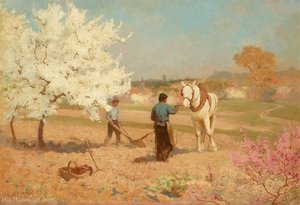
- Flowering Trees
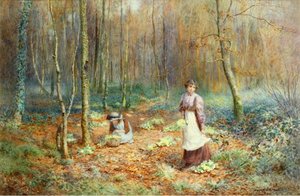
- Woodland scene, with young woman and child gathering primroses
- Place Of Birth: Liverpool