 Preview
 Send
Send Share
Share
 Details

 Download
 Similars
 X-Ray
X-Ray Diaporama
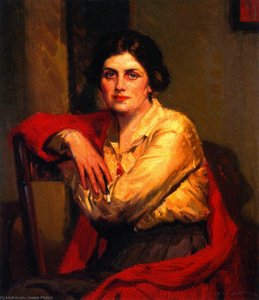
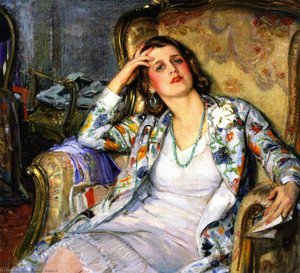
Portrait of Ruth Renick (also known as Jade Necklace)


 Read More
Hand Made Oil Reproduction
Hand-painted oil on canvas in your size and frame, made to order by our artists. ( Buy Print Buy Image)




P118B $10

P118H $10

P118W $10

P438Z $10

P508JH $12

P508YH $12

P805H $10

P805Z $10

P919BZ $10

P919G $10

P919XJ $10

P959ZH $10

P968JZ $12

W106C $8

W218G $10

W218JH $8

W218Y $10

W307PJ $10

W316G $10

W316PJ $8

W316Y $10

W398PJ $8

W4111J $10

W500HY $15

W500JH $15

W692G $12

W849H $8

W940BG $15

W953PJ $8




Pick from our preset sizes that match the artwork's original proportions.

You may enter your own dimensions to fit a specific frame or space. If your selected size does not match the original image's proportions, we will either crop the artwork or extend the painting with additional hand-painted elements. A digital mockup will be sent for your approval before production begins.
Please note that the on-screen preview does not reflect the actual cropping or extension. Only the mockup will accurately show the final composition.
While custom sizes are available, we recommend selecting a dimension from the predefined list to preserve the original proportions.
After order, ArtsDot.com team will email client for instructions and provide a mockup preview
Worldwide Delivery () in 3/4 weeks instead of standard 5 weeks. (25 August). No compromise on quality.

Free Worldwide Express Shipping

High-Quality Linen Canvas

Full Shipping Insurance

Customs Tax Refund Guarantee

True Color Matching Guarantee

60-Day Return Policy (Defects Only)

100% Money-Back Guarantee

Bulk Discount Offer
 Glass option is only available in size under 110 CM

Portrait of Ruth Renick (also known as Jade Necklace)
Reproduction Medium
Reproduction Size
-


Total Price
$ 263
Artwork Description
An Intimate Encounter with Melancholy: The Portrait of Ruth Renick
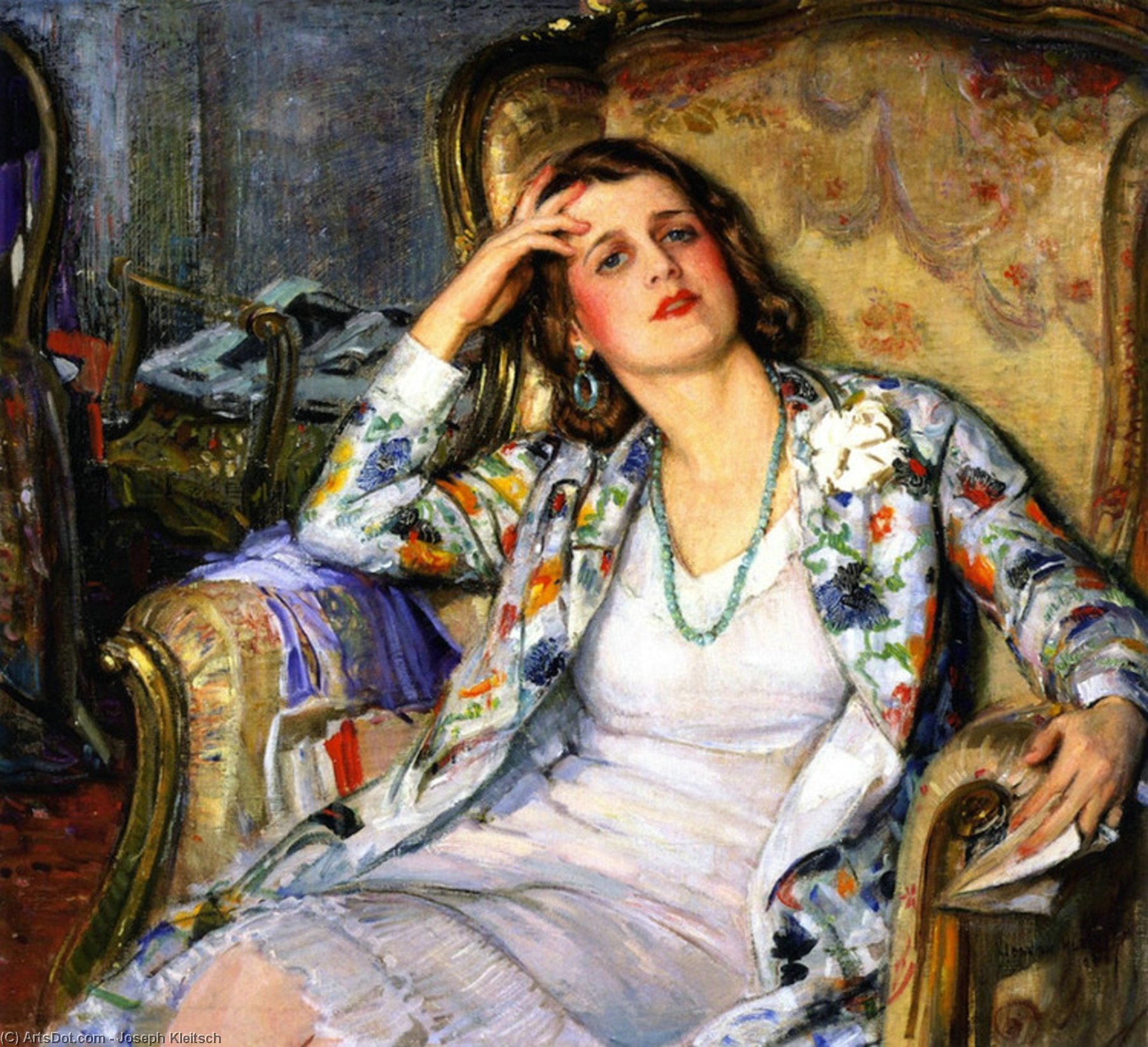
In the quiet, evocative depths of Joseph Kleitsch’s 1928 masterpiece, Portrait of Ruth Renick—often cherished by collectors as Jade Necklace—we find ourselves invited into a moment of profound psychological intimacy. This oil on canvas is far more than a mere likeness; it is a window into a soul caught in a state of quiet contemplation and perhaps a touch of existential unrest. The subject, seated with her hands delicately yet heavily pressed against her face, serves as the emotional anchor of the composition. Her expression, which oscillates between deep introspection and a palpable sense of distress, commands the viewer's attention, pulling us into her private world of thought and feeling.
The painting’s brilliance lies in its ability to balance the heavy weight of human emotion with the exquisite refinement of material beauty. The striking jade necklace draped around her neck acts as a luminous focal point, its verdant hue providing a sophisticated contrast to the softer tones of her attire. This piece of jewelry is not merely an ornament; it symbolizes a layer of elegance and social grace that persists even amidst her visible discomfort. Through this interplay of luxury and vulnerability, Kleitsch achieves a masterful tension that keeps the eye moving across the canvas, searching for meaning within the subject's silent gaze.
Mastery of Light and Impressionistic Depth
As a pioneer of California Impressionism, Joseph Kleitsch brought a sophisticated European sensibility to his work, a legacy of his formative years in Budapest, Munich, and Paris. In this portrait, we see his technical prowess through a nuanced color palette and a deliberate approach to light. The background, though deceptively simple, is far from empty; the presence of two chairs receding into the distance creates a subtle sense of dimensionality and spatial depth. This arrangement prevents the composition from feeling static, instead suggesting a lived-in environment that surrounds the subject in a quiet, domestic stillness.
The technique employed here showcases Kleitsch’s ability to manipulate texture and light to convey atmosphere. The way the light catches the edges of the white dress and illuminates the smooth surface of the jade creates a tactile quality that is highly sought after by art enthusiasts. For interior designers and collectors, this painting offers a unique versatility; its somber yet elegant mood makes it a profound statement piece for a study, a library, or a sophisticated living space. It possesses that rare, transformative quality where a single work of art can alter the entire emotional temperature of a room.
A Timeless Legacy for the Discerning Collector
Owning a reproduction of such a significant work allows one to bring the historical weight and emotional resonance of the early 20th century into a modern setting. Kleitsch’s ability to capture the human form with both precision and poetic depth ensures that this portrait remains relevant across generations. It is a piece that invites conversation, prompting viewers to reflect on their own moments of introspection and the beauty found in vulnerability.
For those looking to curate a collection defined by depth, history, and technical excellence, the Portrait of Ruth Renick stands as an essential inspiration. Whether viewed as a study in Impressionistic light or a profound psychological portrait, it remains a testament to Kleitsch's enduring mastery and a captivating addition to any curated gallery of fine art.
Related Artworks



Artist Biography
The Luminous Legacy of Joseph Kleitsch
In the golden annals of California Impressionism, few names resonate with as much rhythmic vitality as Joseph Kleitsch. A pioneer who breathed life into the coastal landscapes of Southern California, Kleitsch possessed a rare ability to translate the ephemeral dance of light and atmosphere onto canvas. Born in 1885 amidst the multicultural tapestry of Balassagyártya, Hungary, his early years were steeped in a European tradition that would later serve as the foundation for his American mastery. His artistic soul was forged in the prestigious studios of Budapest, Munich, and Paris, where he absorbed the profound lessons of the Impressionist masters. This rigorous formal training provided him with a sophisticated understanding of color theory and composition, yet it was his eventual migration to the United States in 1912 that would truly ignite his creative spirit.
Upon arriving in America, Kleitsch found himself drawn to the burgeoning artistic pulse of Chicago before ultimately finding his true sanctuary in the sun-drenched landscapes of Laguna Beach. It was here, amidst the salt spray and eucalyptus groves, that his style reached its zenith. Influenced deeply by the works of Claude Monet and Pierre-Auguste Renoir, Kleitsch embraced the practice of plein air painting, seeking to capture the fleeting moments of nature with an immediacy that felt almost musical. His brushwork was never merely descriptive; it was emotive. As noted by contemporary critics, he approached the canvas with the spontaneous abandon of a gypsy violinist, using thick, textured strokes to build layers of light that seemed to vibrate within the frame.
A Master of Color and Atmosphere
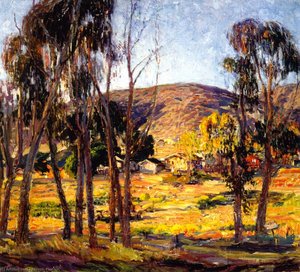
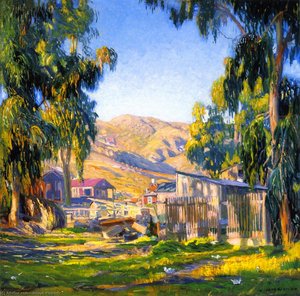
The essence of Kleitsch’s work lies in his unparalleled command over color. He did not merely paint landscapes; he painted the very feeling of warmth and humidity. His palette was a celebration of the California sun, characterized by luminous hues that could transform a simple grove of trees into a shimmering vision of gold and emerald. In masterpieces such as "Houses among the Eucalypti," one can witness his ability to nestle architectural forms within nature using vibrant oil textures that invite the viewer into a tranquil, sunlit world. His technique eschewed the rigid constraints of meticulous detail, opting instead for a soft-focus brilliance that prioritized the mood and the atmospheric weight of the scene.
Beyond the coastal vistas of California, Kleitsch’s travels allowed him to revisit the landscapes of his European heritage through a new, Americanized lens. His 1927 painting, "Giverny, France," serves as a poignant bridge between his formative years and his mature style, utilizing warm colors and soft light to evoke a sense of timelessness. Whether he was capturing the historic grandeur of Mission San Juan Capistrano or the quiet charm of a French village, his work remained anchored in a singular pursuit: the capture of light's transient beauty.
Historical Significance and Artistic Spirit
The historical importance of Joseph Kleitsch extends far beyond his individual canvases. He was a foundational figure in the Laguna Beach art colony, helping to establish the region as a premier destination for American Impressionism. His ability to synthesize European academic rigor with the rugged, bright reality of the California coast helped define a unique regional aesthetic that continues to inspire collectors and artists today. His life, though tragically short, ended in 1931, leaving behind a body of work that serves as a window into a vanished era of coastal serenity.
To study the works of Kleitsch is to experience a profound sense of nostalgia and wonder. His legacy is preserved through:
- The mastery of plein air techniques that captured the authentic light of the Pacific coast.
- A revolutionary approach to color that moved away from realism toward emotional expressionism.
- The establishment of a regional identity for California Impressionism, making Laguna Beach a legendary artistic landmark.
Through his vibrant portraits and sweeping landscapes, Kleitsch remains a timeless figure, reminding us that art is not merely about what we see, but how the light makes us feel.
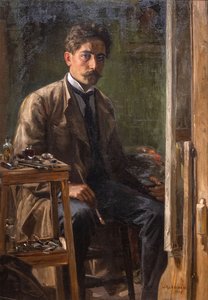
Joseph Kleitsch
1885 - 1931 , Hungary
Quick Facts
- Artistic Movement Or Style: California Impressionism
- Artists Or Movements Influenced By This Artist: ['']
- Artists Who Influenced This Artist: ['']
- Date Of Birth: June 6, 1882
- Date Of Death: November 16, 1931
- Full Name: Joseph Kleitsch
- Nationality: Hungarian-American
- Notable Artworks:
- Orientale
- Children of Capistrano
- Rocky Cliffs, Laguna
- Place Of Birth: Balassagyártya, Hungary
Related Articles
White on Canvas: 10 Masterpieces & Timeless Elegance for Your Home Decor
Explore 10 iconic white paintings by Monet, Whistler & Rothko! Discover the stories behind these serene masterpieces and their impact on art history. Find museum-quality reproductions for your home decor at .
The Subtleties of White: Exploring Absence, Light & Symbolism in Art History
Explore the profound symbolism & history of white in art! From ancient purity to modern abstraction, discover how artists have used absence & light. Expert insights from ArtsDot.

Crimson Threads of Narrative: Exploring Symbolism & Representation in Artworks Featuring the Red Dress
Explore the rich symbolism of the red dress in art history! From ancient power displays to iconic portraits like Cézanne’s 'Madame Cezanne', discover the cultural and artistic significance behind this captivating color. Expert analysis & insights.

Monochrome Visions: Exploring the Aesthetic & Historical Significance of Black & White Photography
Explore the rich history & artistic power of black and white photography. From early techniques to iconic masters like Ansel Adams, discover why monochrome continues to captivate art lovers today. Expert insights for collectors.

Azure Visions: Exploring Representations of the Blue Dress in Western Art History
Explore the rich history of the blue dress in Western art! Discover its symbolism, from Renaissance masterpieces to modern interpretations by artists like Martin & Schiele. Uncover cultural meanings and artistic techniques.