 Preview
 Send
Send Share
Share
 Details

 Download
 Similars
 X-Ray
X-Ray Diaporama
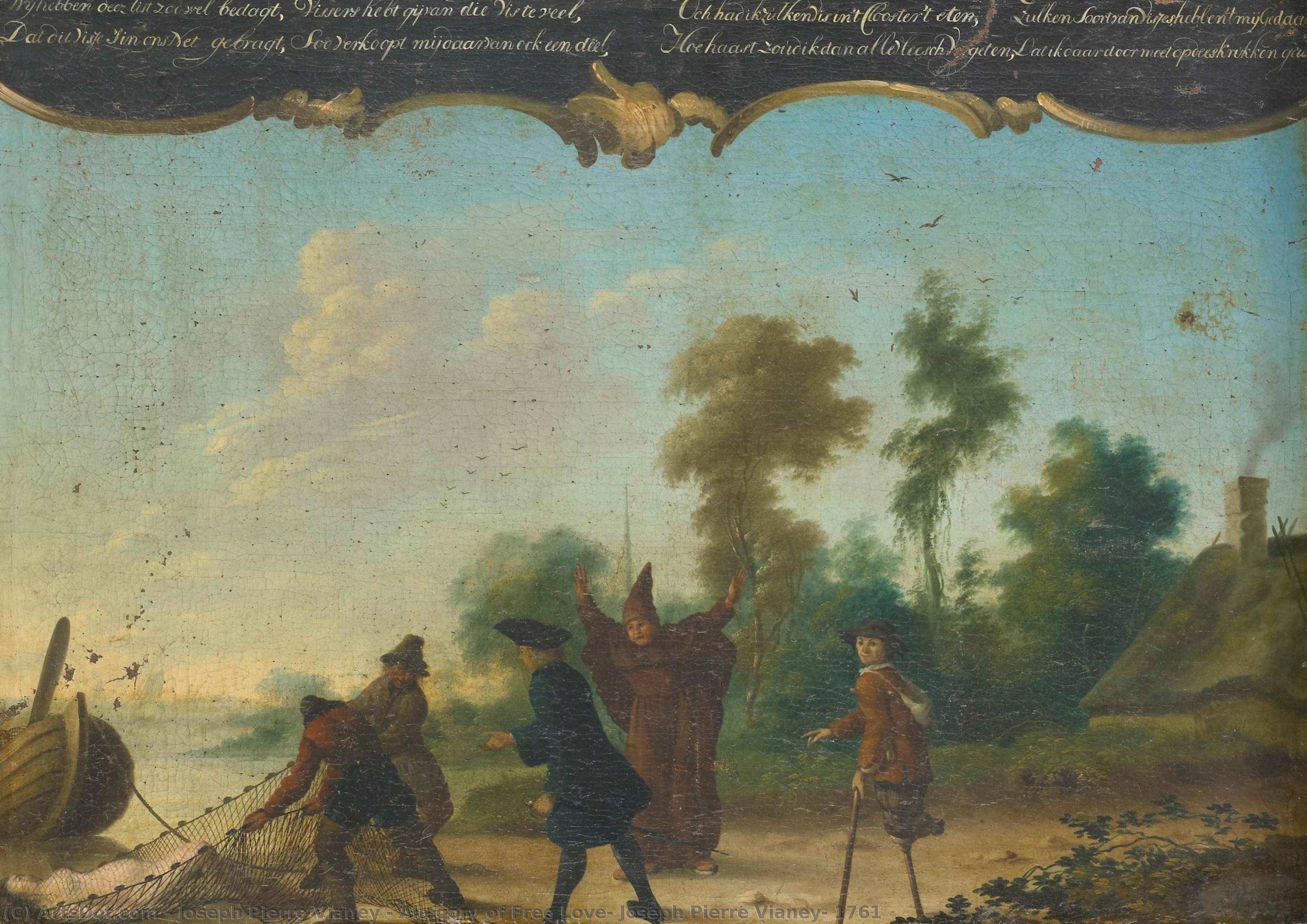
Allegory of Free Love, Joseph Pierre Vianey, 1761
 1761
1761 59.0 x 82.0 cm
 Read More
Giclée / Art Print
Museum-quality giclée or canvas print with fast production and flexible finish options. ( Buy Hand Made Painting Buy Image)




































Pick from our preset sizes that match the artwork's original proportions.

You may enter your own dimensions to fit a specific frame or space. If your selected size does not match the original image's proportions, we will either crop the artwork or extend the image with a mirrored or solid-fill edge. A digital mockup will be sent for your approval before production begins.
Please note that the on-screen preview does not reflect the actual cropping or extension. Only the mockup will accurately show the final composition.
While custom sizes are available, we recommend selecting a dimension from the predefined list to preserve the original proportions.
Worldwide Delivery () in 2 weeks instead of standard 4/5 weeks. (4 September)

Free Worldwide Express Shipping

High-Quality Linen Canvas

Full Shipping Insurance

Customs Tax Refund Guarantee

True Color Matching Guarantee

60-Day Return Policy (Defects Only)

100% Money-Back Guarantee

Bulk Discount Offer
 Glass option is only available in size under 110 CM

Allegory of Free Love, Joseph Pierre Vianey, 1761
Giclée / Art Print
Reproduction Size
-


Total Price
$ 63
Related Artworks









Artist Biography
The Brief, Luminous Life of Joseph Pierre Vianey
In the vibrant artistic landscape of mid-18th century Nantes, a city defined by its maritime spirit and the burgeoning intellectual currents of the Enlightenment, the name Joseph Pierre Vianey emerges as a poignant symbol of fleeting brilliance. Born in 1731, Vianly was part of a generation of French painters who sought to navigate the delicate balance between the structured elegance of the Georgian era and the emerging emotional depths of Romanticism. Though his life was tragically truncated by his death in 1765 at the tender age of thirty-four, the impact of his short career remains etched in the annals of art history through works that challenge the boundaries of conventional portraiture and landscape.
Vianey’s artistic journey was deeply rooted in a family tradition of visual artistry, providing him with an early foundation that allowed his innate talents to flourish. While much of his formative biography remains shrouded in the mists of time, scholars often point to the profound influence of the celebrated Flemish master Jean-Baptiste Oudry. Under such tutelage, Vianey likely absorbed the meticulous precision required for botanical accuracy and the sophisticated grace found in aristocratic portraiture. This lineage is evident in his ability to marry technical mastery with a sense of atmospheric wonder, creating works that feel both grounded in reality and elevated by imagination.
A Mastery of Light, Landscape, and Symbolism
The aesthetic language of Vianey is one of subtle nuance and profound contemplation. He possessed a rare ability to capture the ephemeral qualities of the natural world, utilizing muted palettes to evoke the soft, shifting light of the French countryside. His landscapes are rarely mere topographical records; instead, they are idealized pastoral scenes—rolling hills and wildflower-strewn meadows that serve as stages for deeper philosophical inquiries. In these canvases, Vianey utilized the Georgian fascination with tranquility and moral virtue to explore themes of innocence and spiritual aspiration.
Beyond the serene beauty of his landscapes, Vianey’s true genius lay in his use of symbolism to convey complex human narratives. He moved beyond simple representation to imbue his subjects with allegorical weight, a technique that allowed him to touch upon the social and moral tensions of his era. His brushwork often balanced the delicate textures of nature—the softness of a petal or the translucency of light—with a structured composition that guided the viewer toward a deeper, more meditative experience.
The Legacy of Allegory
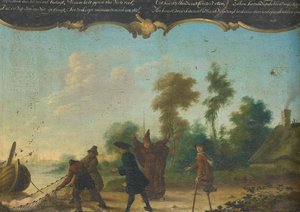
Perhaps the most significant milestone in Vianey’s career was the completion of his monumental work, “Allegory of Free Love,” in 1761. This ambitious piece, which continues to reside within the prestigious Pickford’s House Museum, stands as a testament to his daring spirit. In a departure from the formal constraints of contemporary portraiture, Vianey utilized a complex narrative involving a gentleman, a monk, and a beggar, all interacting with fishermen who have discovered a nude female figure caught in their nets. This work serves as a profound exploration of social strata and human connection, using the visceral imagery of the net and the entwined vines to discuss themes of fate and desire.
The historical significance of Joseph Pierre Vianey lies in his role as a bridge between eras. He captured the refined, structured beauty of the 18th century while simultaneously planting the seeds for the more emotive, symbolic explorations that would define later movements. Though his time on the canvas was brief, his ability to weave together the elegance of Nantes' maritime heritage with the profound allegories of the human condition ensures that his name remains a vital chapter in the story of French art.
joseph pierre vianey
1731 - 1765 , France
Quick Facts
- Artistic Movement Or Style: Georgian Painting
- Date Of Birth: 1731-12-09
- Date Of Death: 1765
- Full Name: Joseph Pierre Vianey
- Nationality: French
- Notable Artworks: ['Allegory of Free Love']
- Place Of Birth: Nantes, France