 Preview
 Send
Send Share
Share
 Details

 Download
 Similars
 X-Ray
X-Ray Diaporama
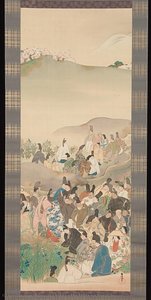
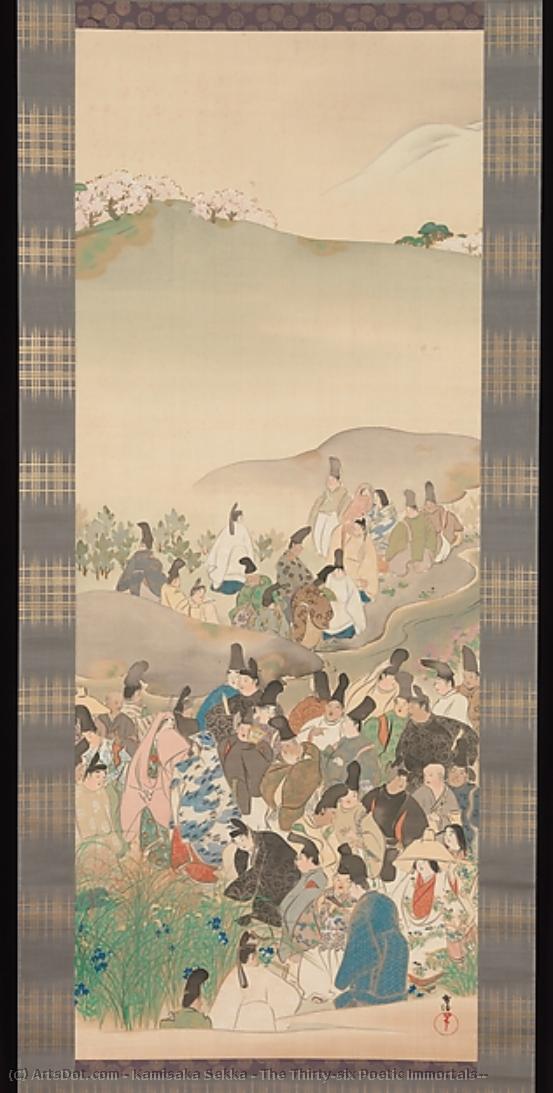
The Thirty-six Poetic Immortals
 1910
1910 129.0 x 51.0 cm
 Read More
Hand Made Oil Reproduction
Hand-painted oil on canvas in your size and frame, made to order by our artists. ( Buy Print Buy Image)




































Pick from our preset sizes that match the artwork's original proportions.

You may enter your own dimensions to fit a specific frame or space. If your selected size does not match the original image's proportions, we will either crop the artwork or extend the painting with additional hand-painted elements. A digital mockup will be sent for your approval before production begins.
Please note that the on-screen preview does not reflect the actual cropping or extension. Only the mockup will accurately show the final composition.
While custom sizes are available, we recommend selecting a dimension from the predefined list to preserve the original proportions.
After order, ArtsDot.com team will email client for instructions and provide a mockup preview
Worldwide Delivery () in 3/4 weeks instead of standard 5 weeks. (22 August). No compromise on quality.

Free Worldwide Express Shipping

High-Quality Linen Canvas

Full Shipping Insurance

Customs Tax Refund Guarantee

True Color Matching Guarantee

60-Day Return Policy (Defects Only)

100% Money-Back Guarantee

Bulk Discount Offer
 Glass option is only available in size under 110 CM

The Thirty-six Poetic Immortals
Reproduction Medium
Reproduction Size
-


Total Price
$ 538
Artwork Description
Related Artworks









Artist Biography
The Last Great Champion of Rinpa: The Life of Kamisaka Sekka
In the heart of Kyoto, a city where the echoes of ancient traditions meet the whispers of modernity, the life of Kamisaka Sekka (1866–1942) unfolded as a masterful bridge between two eras. Born into a samurai family, Sekka’s early years were steeped in the disciplined elegance of Japanese heritage. From a young age, his prodigious talent for design and painting became evident, leading him toward a formal education that would anchor him within the Rinpa school. This prestigious aesthetic movement, known for its decorative brilliance and stylized naturalism, became the foundation upon which he built his illustrious career. As one of the final great proponents of this tradition, Sekka did not merely preserve the Rinpa legacy; he breathed new, contemporary life into it.
Sekka’s artistic evolution was profoundly shaped by a courageous spirit of exploration. While many of his contemporaries remained tethered to the past, Sekka looked toward the horizon. In 1901, sponsored by the Japanese government, he embarked on a transformative journey to Glasgow. This expedition allowed him to witness firsthand the burgeoning influence of Art Nouveau and the Western fascination with Japonism. He did not travel as a student seeking to imitate Western art, but rather as an observer seeking a dialogue. He studied how Japanese motifs could resonate with European sensibilities, investigating which elements of his own culture might find new meaning in a globalized artistic landscape.
A Synthesis of East and West
Upon his return to Kyoto, Sekka’s work began to exhibit a breathtaking synthesis of styles. He accepted a professorship at the newly established Kyoto Municipal School of and Crafts, where he could mentor a new generation while continuing his own radical experiments. His mastery of traditional techniques remained unshakeable; he continued to employ tarashikomi—the signature Rinpa method of dropping wet pigment into still-wet paint to create beautiful, mottled effects—to render landscapes and figures with ethereal grace. Yet, the infusion of Western influence brought a newfound vibrancy to his palette.
The hallmark of Sekka’s mature style is a captivating tension between meticulous detail and bold, modern abstraction. His compositions often feature:
- Vibrant Color Swaths: Large, saturated areas of color that seem to pulse with energy.
- Graphic Patterning: Images that hover on the threshold between representational painting and decorative pattern, giving his work a strikingly three-dimensional quality.
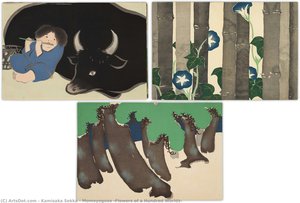
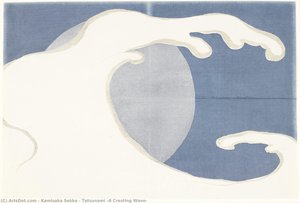
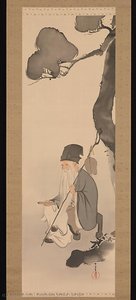
- Symbolic Naturalism: The use of traditional motifs, such as bamboo grass, waves, and legendary figures like Jurōjin, reimagined through a lens of modern design.
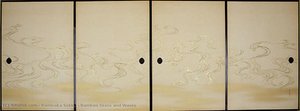
In works such as his celebrated sliding-door panels depicting Bamboo Grass and Waves, one can see the full realization of his vision. The delicate sasa leaves and rhythmic waves evoke the ancient Tanabata Festival, yet the execution possesses a graphic clarity that feels remarkably modern. He transformed the traditional subject matter of the Japanese literary canon into something that felt immediate and fresh.
Legacy and Historical Significance
The significance of Kamisaka Sekka lies in his ability to navigate the turbulent waters of cultural change without losing his artistic soul. At a time when Japan was rapidly Westernizing, Sekka ensured that the aesthetic principles of the Rinpa school were not lost to history but were instead integrated into the modern consciousness. His versatility extended far beyond the canvas; his expertise in lacquerware and various other crafts demonstrated a holistic understanding of Japanese artistry, treating every medium as an opportunity for design excellence.
Today, Sekka is remembered not just as a painter, but as a visionary designer who understood that true innovation requires a deep respect for one's roots. His work remains a testament to the power of cultural exchange, proving that when tradition meets modernity, the result can be an enduring and luminous beauty that transcends borders and generations.
Kamisaka Sekka
1866 - 1942 , Japan
Quick Facts
- Artistic Movement Or Style: Rinpa School; Japonism
- Artists Or Movements Influenced By This Artist: ['Art Nouveau']
- Artists Who Influenced This Artist:
- Hiroshige
- Utagawa Hiroshi
- Date Of Birth: 1866
- Full Name: Kamisaka Sekka
- Nationality: Japanese
- Notable Artworks:
- Bamboo Grass and Waves
- The Thirty-six Poetic Immortals
- Jurōjin
- Place Of Birth: Kyoto, Japan