

 Preview
 Send
Send Share
Share
 Details

 Download
 Similars
 X-Ray
X-Ray Diaporama
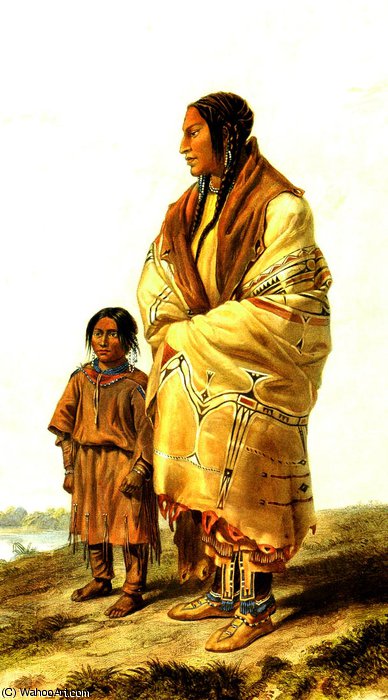
Dacota Woman and Assiniboin Girl


 Read More
Purchase a high-resolution, enhanced digital image, far superior to the online preview.
Each file is meticulously prepared by our in-house specialists using advanced tools and expert manual retouching. We ensure every image has exceptional clarity, precise color accuracy, and fine detail.
The final file is delivered via email within 72 hours, optimized for immediate use in professional, editorial, and print environments. This is the same quality trusted by top-tier design studios, publishers, and galleries.
Digital Image
Download a high-resolution file for personal display, printing, and creative projects. ( Buy Print Buy Hand Made Painting)
Included in Every Digital Image Order
Expert Digital Delivery, Guaranteed
When you choose ArtsDot.com, you're not just getting an image - you're receiving a professionally enhanced digital artwork, crafted with precision and backed by a satisfaction guarantee. Here's everything that comes with your order, automatically:

Fast Email Delivery
Your high-resolution digital image file will be emailed to you within 72 hours of ordering - ready for immediate use.

AI-Enhanced Digital File
Your artwork is professionally optimized using advanced AI tools and manual editing, ensuring maximum detail, clarity, and color accuracy.

Free Lifetime Re-Delivery
Accidentally deleted or lost your file? No worries - we'll resend it to you anytime, free of charge.

No Import Fees - Ever
Enjoy your artwork instantly with zero customs, duties, or delivery fees - digital downloads are always tax-free.

Color Accuracy Guarantee
We ensure your digital image reflects the original colors as closely as possible using professional tools and color management.

60-Day Satisfaction Guarantee
If you're not satisfied with your digital image, we'll revise it or refund 100% within 60 days - no questions asked.

100% Money-Back Guarantee
Not satisfied? Get a full refund within 60 days of receiving your digital file - no questions asked.

Bulk Order Discounts
Buy 3 images, save 10% - Buy 5, save 15% - Buy 10+, save 20%. Great for creative projects, galleries, and agencies.
A Glimpse into 19th-Century Dakota Life: "Dacota Woman and Assiniboin Girl"
Karl Bodmer's "Dacota Woman and Assiniboin Girl," created in 1833, offers a poignant window into the lives of Native Americans during an era of significant cultural change. This captivating artwork isn’t merely a portrait; it’s a meticulously observed record of Dakota culture, rendered with remarkable detail and sensitivity. The painting depicts a woman, likely a member of the Dakota tribe, standing alongside a young girl, presumably her daughter or a close relative. Their presence is dignified and serene, conveying a sense of quiet strength and resilience.
Style & Technique: Romantic Realism
Bodmer’s artistic style can be characterized as Romantic Realism. While rooted in the Romantic movement's appreciation for natural beauty and cultural diversity, his approach is grounded in meticulous observation and a commitment to accurate representation. He employed watercolor on paper, a medium that allowed him to capture the subtle nuances of light and shadow with remarkable precision. The lithograph reproduction process further enhances the detail, allowing viewers to appreciate the texture of clothing, the intricate patterns of beadwork, and the expressive features of the subjects.
Historical Context & Bodmer's Expedition
This artwork is inextricably linked to Karl Bodmer’s participation in Prince Maximilian zu Wied-Neuwied’s North American expedition (1832-1839). The prince, a keen naturalist and ethnographer, commissioned Bodmer to document the cultures of the Indigenous peoples inhabiting the Missouri River region. Unlike many artists of his time who depicted Native Americans through a lens of exoticism or romanticized stereotypes, Bodmer strived for authenticity. He lived among the Dakota people, learning their customs and traditions firsthand, which informed his artistic representations. The painting serves as a valuable historical document, providing insights into Dakota life during a period of increasing contact with European-American settlers.
Symbolism & Emotional Impact
Beyond its documentary value, "Dacota Woman and Assiniboin Girl" resonates on an emotional level. The woman's gaze, directed slightly off-canvas, suggests a quiet contemplation – perhaps reflecting on the changes occurring around her or conveying a sense of enduring strength in the face of adversity. The presence of the young girl symbolizes hope for the future, while also hinting at the challenges faced by Indigenous communities as their traditional ways of life were threatened. The composition itself—the two figures standing side-by-side—evokes a feeling of connection and familial bonds. The earthy tones and naturalistic depiction create a sense of intimacy, drawing the viewer into this moment in time.
A Timeless Masterpiece
“Dacota Woman and Assiniboin Girl” remains a powerful testament to Karl Bodmer’s artistic skill and his commitment to portraying Native American cultures with respect and accuracy. Whether you are an art enthusiast, collector, or interior designer seeking a piece that combines historical significance with aesthetic beauty, this artwork offers a captivating glimpse into the past and a profound reflection on the human spirit.
Related Artworks
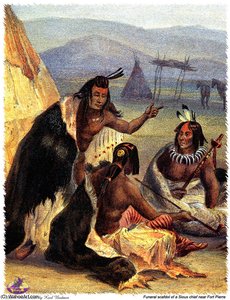
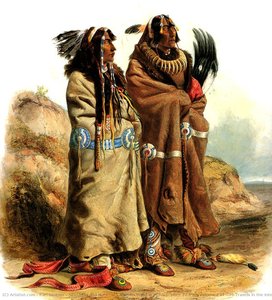
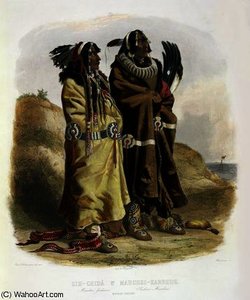
Artist Biography
A Swiss Eye on the American West: The Life and Art of Karl Bodmer
Born in Zurich, Switzerland, in 1809, Johann Carl Bodmer – known to art history as Karl Bodmer – embarked on a path that would uniquely intertwine European Romanticism with the vanishing world of the North American frontier. His early life remains somewhat shrouded in mystery, yet it’s clear his artistic inclinations were nurtured from a young age through tutelage under his uncle, Johann Jakob Meier, a respected engraver. This foundational training instilled in Bodmer a meticulous attention to detail and a mastery of draftsmanship that would become hallmarks of his style. Initially gaining recognition for picturesque views of the Rhine and Moselle valleys, etched and published for the burgeoning tourist market, Bodmer’s talent soon caught the eye of Prince Maximilian zu Wied-Neuwied, a German aristocrat with a passion for natural history and ethnography. This encounter would irrevocably alter the course of Bodmer's career, propelling him into an adventure that would immortalize both himself and the cultures he encountered.Journey to the Missouri: Documenting a Vanishing World
In 1832, Bodmer joined Prince Maximilian on a daring expedition up the Missouri River, a journey undertaken with the ambitious goal of documenting the Native American tribes and landscapes of the American West. This was not merely an artistic commission; it was a scientific endeavor, and Bodmer’s role extended beyond that of a mere illustrator. He became a visual chronicler, tasked with capturing the essence of a world rapidly changing under the pressures of westward expansion. For two years, Bodmer meticulously recorded his observations in over 400 drawings and watercolors, depicting everything from sweeping landscapes to intimate portraits of individuals belonging to tribes such as the Mandan, Hidatsa, Sioux, and Blackfeet. His work stands apart for its remarkable accuracy and sensitivity; he didn’t simply portray these people as exotic subjects but sought to understand and represent their cultures with respect and dignity. The harsh realities of frontier life – disease, conflict, and cultural disruption – are subtly present in his depictions, lending a poignant weight to his artistic record. Päsesick-Kaskutäu, a delicate watercolor capturing the likeness of a young Hidatsa man, exemplifies Bodmer’s ability to convey both physical detail and psychological depth.Artistic Style and Influences: Romanticism Meets Ethnography
Bodmer's artistic style is deeply rooted in the Romantic tradition, characterized by an emphasis on emotion, individualism, and a reverence for nature. However, his work transcends mere aesthetic beauty; it’s infused with a keen ethnographic sensibility. He wasn’t simply painting landscapes or portraits—he was creating visual documents of cultures facing imminent transformation. His compositions often feature carefully observed details of clothing, tools, and ceremonial objects, providing invaluable insights into the material culture of these tribes. The influence of earlier landscape painters like Caspar David Friedrich is evident in his dramatic skies and evocative use of light and shadow, while his portraiture reveals a sensitivity to human expression reminiscent of artists such as Jean-Auguste-Dominique Ingres. The combination of Romantic aesthetics with ethnographic precision makes Bodmer’s work truly unique. He skillfully balanced artistic license with scientific accuracy, creating images that are both visually compelling and historically significant.Legacy and Rediscovery: A Lasting Impact
Despite the immense effort invested in the expedition and the subsequent publication of Prince Maximilian's *Travels in the Interior of North America*, illustrated with Bodmer’s aquatints, the work initially received a lukewarm reception. The book was expensive and failed to gain widespread popularity, leading to financial hardship for both men. Bodmer eventually settled in Barbizon, France, joining the ranks of artists associated with the Barbizon school, known for their plein air painting and realistic depictions of rural life. While he continued to paint and exhibit his work, his contributions to American history were largely overlooked for many years. It wasn’t until the 20th century that Bodmer's art began to receive the recognition it deserved. Today, his paintings and watercolors are celebrated as invaluable historical documents and masterpieces of Romantic art. Museums around the world, including the Joslyn Art Museum in Omaha and collections in Switzerland, proudly display his work, ensuring that his legacy endures.- His images provide a crucial visual record of Native American cultures before they were irrevocably altered by colonization.
- Bodmer’s meticulous attention to detail and artistic skill continue to inspire artists and scholars alike.
- He stands as a testament to the power of art to document, preserve, and illuminate the human experience.
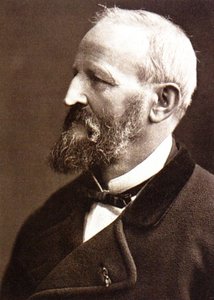
Karl Bodmer
1809 - 1893 , Switzerland
Quick Facts
- Artistic Movement Or Style: Romanticism
- Date Of Birth: 1809
- Date Of Death: 1893
- Full Name: Karl Bodmer
- Nationality: Swiss
- Notable Artworks:
- Päsesick-Kaskutäu
- Island of Schwanau
- Teiresias foretells…
- Place Of Birth: Zurich, Switzerland

