 Preview
 Send
Send Share
Share
 Details

 Download
 Similars
 X-Ray
X-Ray Diaporama
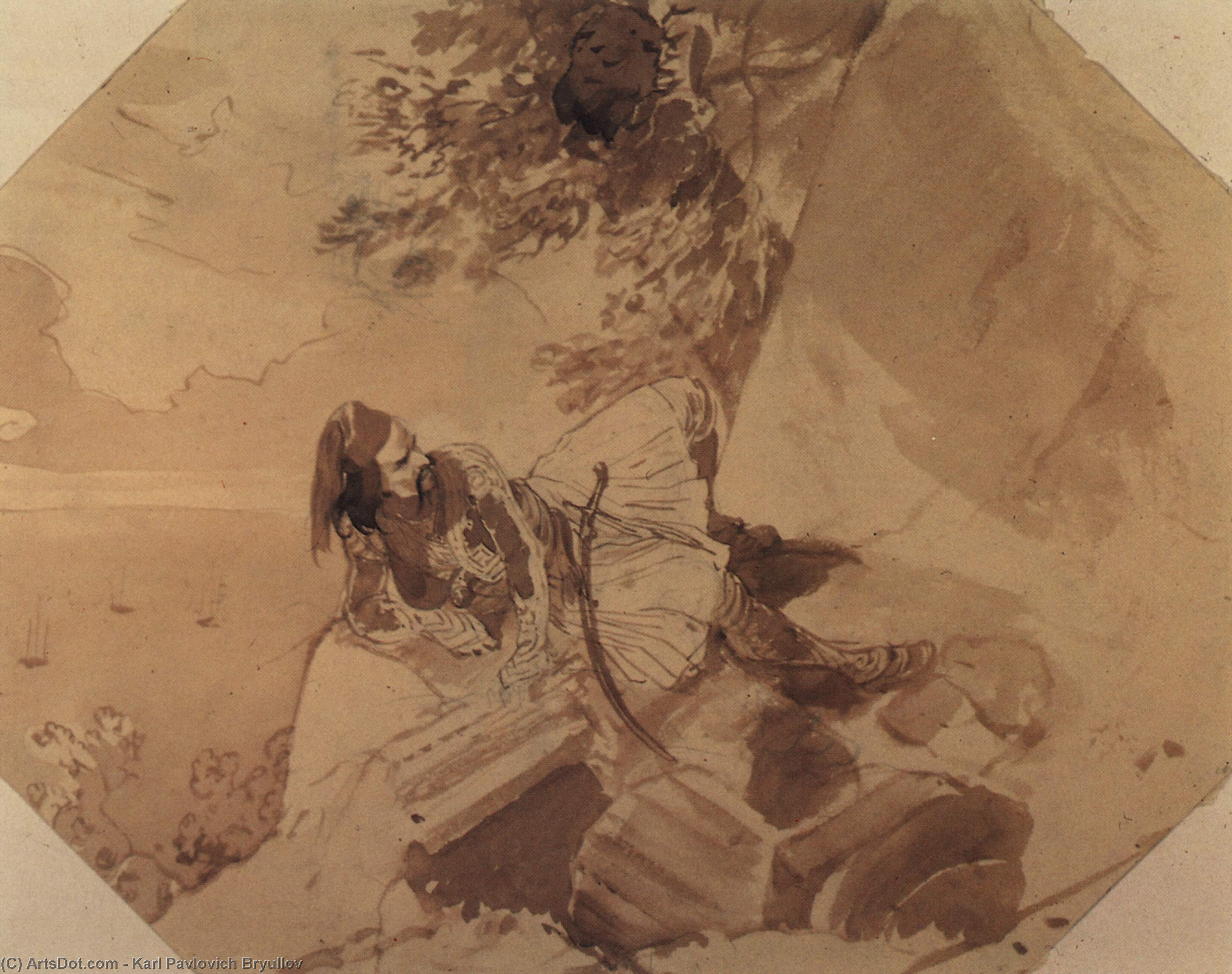
Greek lying on a rock


 Read More
Hand Made Oil Reproduction
Hand-painted oil on canvas in your size and frame, made to order by our artists. ( Buy Print Buy Image)




P118B $10

P118H $10

P118W $10

P438Z $10

P508JH $12

P508YH $12

P805H $10

P805Z $10

P919BZ $10

P919G $10

P919XJ $10

P959ZH $10

P968JZ $12

W106C $8

W218G $10

W218JH $8

W218Y $10

W307PJ $10

W316G $10

W316PJ $8

W316Y $10

W398PJ $8

W4111J $10

W500HY $15

W500JH $15

W692G $12

W849H $8

W940BG $15

W953PJ $8




Pick from our preset sizes that match the artwork's original proportions.

You may enter your own dimensions to fit a specific frame or space. If your selected size does not match the original image's proportions, we will either crop the artwork or extend the painting with additional hand-painted elements. A digital mockup will be sent for your approval before production begins.
Please note that the on-screen preview does not reflect the actual cropping or extension. Only the mockup will accurately show the final composition.
While custom sizes are available, we recommend selecting a dimension from the predefined list to preserve the original proportions.
After order, ArtsDot.com team will email client for instructions and provide a mockup preview
Worldwide Delivery () in 3/4 weeks instead of standard 5 weeks. (22 August). No compromise on quality.

Free Worldwide Express Shipping

High-Quality Linen Canvas

Full Shipping Insurance

Customs Tax Refund Guarantee

True Color Matching Guarantee

60-Day Return Policy (Defects Only)

100% Money-Back Guarantee

Bulk Discount Offer
 Glass option is only available in size under 110 CM

Greek lying on a rock
Reproduction Medium
Reproduction Size
-


Total Price
$ 263
Artwork Description
A Moment of Romantic Solitude
In the quietude of 1835, Karl Pavlovich Bryullov captured a scene that transcends mere portraiture, inviting the viewer into a profound state of introspection. Greek Lying on a Rock is not simply a depiction of a man at rest; it is an evocative window into the Romantic era's obsession with the individual spirit and its relationship with the untamed natural world. The subject, draped in a luminous white shirt that catches the soft light, rests his head upon his hand in a classic pose of melancholic contemplation. Nearby, the subtle presence of a sword hints at a narrative of fallen heroism or perhaps a weary warrior finding temporary respite from the struggles of life. This delicate balance between strength and vulnerability creates an immediate emotional resonance, making the piece a captivating centerpiece for any collection focused on human emotion.
The technical mastery displayed in this work reflects Bryullov’s deep reverence for the Italian Renaissance masters. One can sense the ghostly influence of Caravaggio in the way light dances across the man's skin and the rugged texture of the stone, creating a dramatic interplay of shadow and brilliance. The artist employs a sophisticated brushwork that brings a tactile quality to the scene—from the coarse surface of the rock to the ethereal softness of the sky. Above the reclining figure, two birds drift through the heavens, serving as subtle symbols of freedom and the fleeting nature of time, contrasting beautifully with the heavy, grounded presence of the man and his earthly burdens.
A Masterpiece for the Modern Interior
For the discerning collector or interior designer, this reproduction offers more than just aesthetic beauty; it provides a focal point of historical depth and narrative complexity. The composition, characterized by its balanced use of natural elements like the distant tree and the expansive sky, lends a sense of tranquility and grandeur to any room. Whether placed in a sun-drenched study or a sophisticated gallery-style living space, the painting’s muted yet rich palette complements both classical and contemporary decor. It serves as an intellectual conversation piece, prompting guests to ponder the identity of the Greek figure and the stories hidden within his silent gaze.
Investing in a high-quality hand-painted reproduction of this Bryullov masterpiece allows one to bring the soul of 19th-century Russian Romanticism into the modern home. The artwork’s ability to evoke a sense of peace, combined with its underlying tension, makes it an ideal choice for creating an atmosphere of refined elegance and thoughtful reflection. It is a timeless tribute to the enduring power of art to capture the most intimate moments of the human experience.
Related Artworks

Artist Biography
Karl Pavlovich Bryullov: A Life in Romanticism
Early Life and Training
Karl Pavlovich Bryullov (born Karl Briullo) was born on December 23, 1799, in Saint Petersburg, Russia. His father, Pavel Ivanovich Briullo, was an academician, woodcarver, and engraver of Huguenot descent, who instilled in young Karl a love for the arts. Bryullov’s artistic journey began under his father's guidance before he formally enrolled at the Imperial School for the Arts in St. Petersburg in 1809.
Artistic Development and Influences
Though educated within a classical framework, Bryullov never fully embraced its rigid constraints. He felt a strong pull towards Italy from an early age, and his artistic development was significantly shaped by Italian Renaissance masters. His work demonstrates influences from artists like Raphael, Michelangelo, and Caravaggio, particularly in their dramatic use of light and shadow and mastery of anatomical detail.
- He distinguished himself as a promising student, showcasing imaginative talent during his education.
- After completing his studies, he moved to Rome in 1821, where he spent over a decade honing his skills.
Major Achievements and Notable Works
Bryullov’s breakthrough came with “The Last Day of Pompeii” (1830-1833), a monumental historical painting that catapulted him to international fame. The work, depicting the chaotic eruption of Mount Vesuvius, was lauded for its dramatic composition, emotional intensity, and technical brilliance. It garnered immense praise from contemporaries like Pushkin and Gogol.
- “The Taking of the Life of a Tsar” (1827) – An early work demonstrating his skill in historical narrative.
- “The Defense of the Sepulchre” (1846) - Showcasing Bryullov’s ability to balance emotion and historical accuracy.
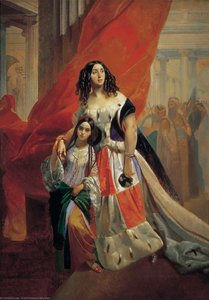
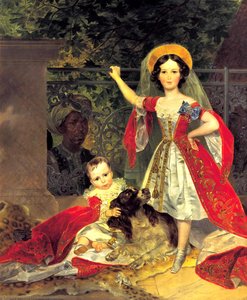
- "Princess Yuliya Pavlovna Samoilova Leaving a Ball with Adopted Daughter Amacilia Pacini" (1832) – A stunning example of his portraiture skills.
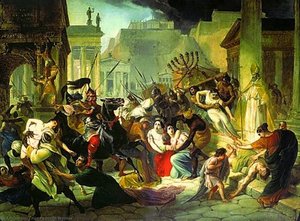
- “Genserich's Invasion of Rome” (1835) - Another dramatic historical scene displaying Baroque influence.
Career and Later Life
Following the success of “The Last Day of Pompeii,” Bryullov returned to Russia in triumph, securing a prestigious position at the Imperial Academy of Arts in 1836. He served as a professor there until 1848, influencing a generation of Russian artists.
- He developed a distinctive portrait style blending neoclassical simplicity with romantic sensibilities.
- His health began to decline while working on the plafond of St Isaac's Cathedral.
- In 1849, seeking improved health, he left Russia for Madeira and eventually settled near Rome, Italy.
Historical Significance and Legacy
Karl Pavlovich Bryullov is considered a pivotal figure in Russian Romanticism. His work marked a shift towards greater emotional expression and dramatic storytelling within Russian art. He bridged the gap between Neoclassical formality and the burgeoning Romantic movement, influencing subsequent generations of artists, including Gavriil Gorelov.
Bryullov’s legacy extends beyond his paintings; he was a respected teacher and a champion of artistic innovation. His contributions solidified his place as one of the greatest visual artists in Russian history, leaving an enduring mark on the nation's cultural heritage. He died on June 23, 1852, near Rome and is buried at the Cimitero Acattolico.
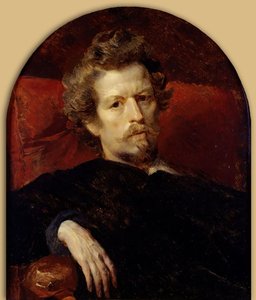
karl pavlovich bryullov
1799 - 1852 , Russia
Quick Facts
- Birth_Date: 1799-12-23
- Birth_Place: Saint Petersburg, Russia
- Death_Date: 1852-06-23
- Movement: Romanticism
- Name: Karl Pavlovich Bryullov
- Nationality: Russian
- Notable_Works:
- The Last Day of Pompeii
- The Taking of the Life of a Tsar
- The Defense of the Sepulchre
Related Articles
Neo-Classicism's Greatest Hits: 10 Masterpieces for Your Home |
Journey through Neo-Classicism's finest! Explore 10 iconic masterpieces by David, Ingres & Canova. Discover art history, techniques & timeless beauty – perfect for inspiring your home decor. Find museum-quality reproductions at
The Enduring Legacy of Classicism: Principles, Evolution & Influence in Western Art
Explore the enduring legacy of Classicism in Western art! Discover its historical context, key principles, iconic masterpieces & lasting influence. Learn about Renaissance and Neoclassical movements with ArtsDot.
Karl Bryullov: Romanticism's Dramatic Vision & Shaping Russian Historical Painting
Explore the dramatic world of Karl Bryullov, a pivotal figure in Russian Romanticism. Discover his masterpieces like 'The Last Day of Pompeii' and learn about his lasting influence on 19th-century art history.
Timeless Resonance: Exploring Classic Vibe in Art – A Historical & Aesthetic Analysis
Explore the rich history & enduring aesthetic of Classicism art! Discover key movements, iconic artists like Raphael & David, and its lasting influence on Western art. Deepen your appreciation today.
Dramatic Art: 10 Masterpieces That Stir the Soul |
Explore 10 dramatic artworks by masters like Rembrandt & Munch that stir deep emotion. Discover art history, techniques & find museum-quality reproductions for your home at . Explore the full collection online.