 Preview
 Send
Send Share
Share
 Details

 Download
 Similars
 X-Ray
X-Ray Diaporama
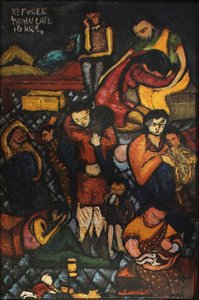
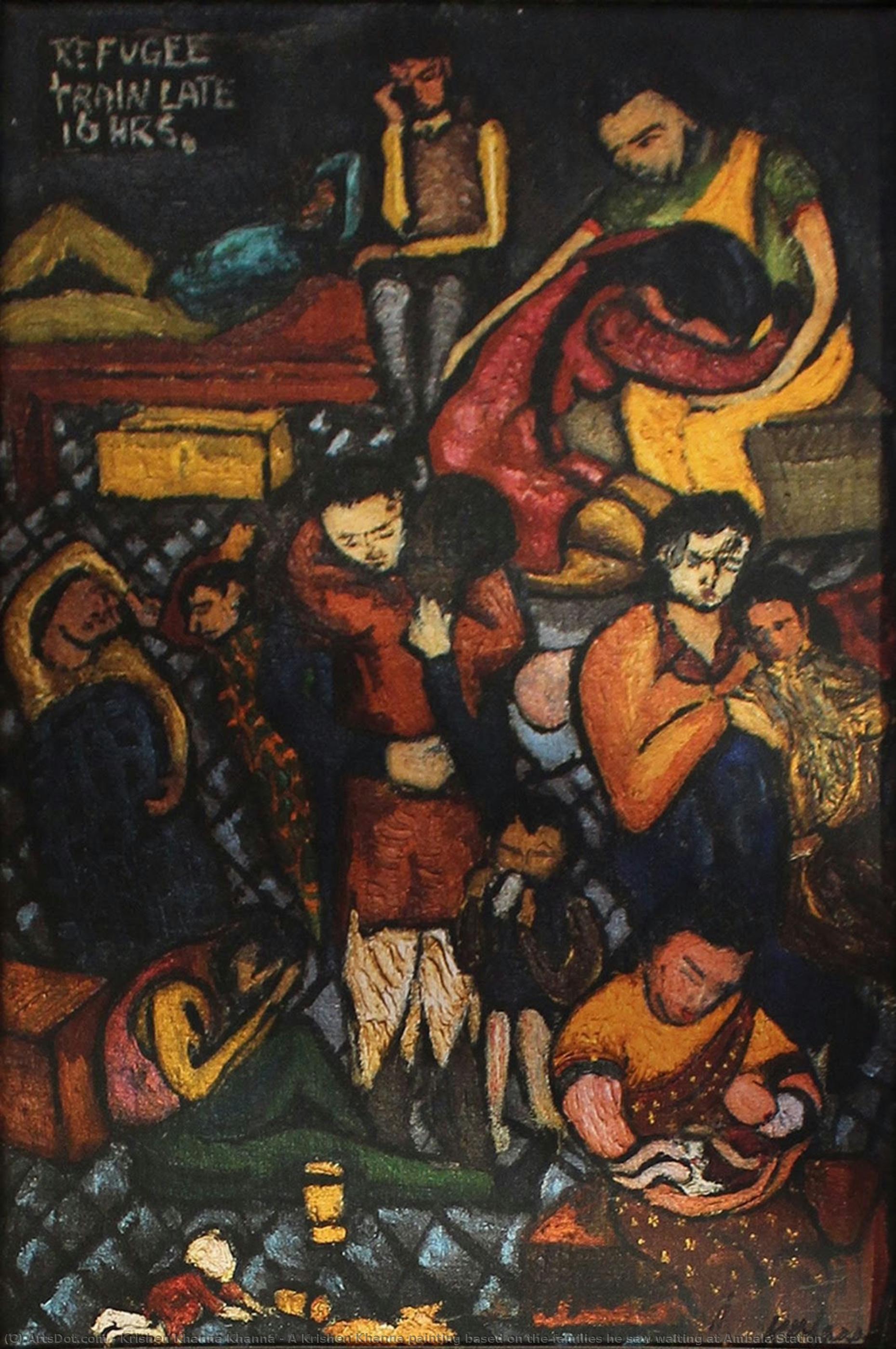
A Krishen Khanna painting based on the families he saw waiting at Ambala Station

 Read More
Hand Made Oil Reproduction
Hand-painted oil on canvas in your size and frame, made to order by our artists. ( Buy Print Buy Image)




































Pick from our preset sizes that match the artwork's original proportions.

You may enter your own dimensions to fit a specific frame or space. If your selected size does not match the original image's proportions, we will either crop the artwork or extend the painting with additional hand-painted elements. A digital mockup will be sent for your approval before production begins.
Please note that the on-screen preview does not reflect the actual cropping or extension. Only the mockup will accurately show the final composition.
While custom sizes are available, we recommend selecting a dimension from the predefined list to preserve the original proportions.
After order, ArtsDot.com team will email client for instructions and provide a mockup preview
Worldwide Delivery () in 3/4 weeks instead of standard 5 weeks. (4 September). No compromise on quality.

Free Worldwide Express Shipping

High-Quality Linen Canvas

Full Shipping Insurance

Customs Tax Refund Guarantee

True Color Matching Guarantee

60-Day Return Policy (Defects Only)

100% Money-Back Guarantee

Bulk Discount Offer
 Glass option is only available in size under 110 CM

A Krishen Khanna painting based on the families he saw waiting at Ambala Station
Reproduction Medium
Reproduction Size
-


Total Price
$ 263
Related Artworks






Artist Biography
The Soul of the Street: The Artistic Journey of Krishen Khanna
To encounter the work of Krishen Khanna is to step into a world where the mundane and the monumental coexist in a delicate, abstract dance. Born in 1925 in Lyallpur, a region then part of pre-partition Punjab, Khanna’s early life was shaped by the profound shifts of history and the rich cultural tapestry of India. His formative years were marked by a deep, almost spiritual connection to imagery; as a young boy, he was captivated by the reproductions of Leonardo da Vinci’s masterpieces brought home by his father. This early exposure to the classics planted the seeds for a lifelong fascination with the human form and its capacity to convey profound narratives. Though he would later become a self-taught master, these early encounters with the Renaissance masters provided a foundational language of composition and grace that would eventually merge with the vibrant, chaotic energy of the Indian subcontinent.
Khanna’s path to artistic prominence was anything but linear. His education took him from the Imperial Service College in England back to the intellectual heart of Lahore, yet for many years, his creative impulses were balanced against a conventional career in banking at Grindlay's Bank in Mumbai. It was not until 1961 that he made the transformative decision to resign from the financial world and commit himself entirely to the canvas. This leap of faith allowed him to join the ranks of the legendary Progressive Artists’ Group, a movement that sought to break free from colonial academic traditions and forge a new, modern Indian aesthetic. Within this circle, Khanna found the freedom to experiment with a style that would become his hallmark: a masterful blend of abstraction and figuration.
A Tapestry of Human Resilience and Urban Vibrancy
The true genius of Khanna lies in his ability to find the extraordinary within the ordinary. He became renowned for his evocative series, most notably the Truckwallahs and Bandwallahs, which serve as poetic chronicles of Indian street life. In these works, the artist does not merely depict people; he captures the very pulse of urban existence. Through a sophisticated use of abstracted forms, he portrays the drivers, musicians, and laborers of the streets with a dignity that transcends their social standing. His brushstrokes convey the dynamism of movement and the grit of the roadside, yet there is an underlying stillness—a sense of spiritual contemplation that invites the viewer to look beyond the surface of the bustling crowd.
Beyond the rhythmic energy of the streets, Khanna’s oeuvre explores deeper, more introspective themes. His fascination with Christian iconography, inspired by his childhood readings of the Bible and his time spent in the company of Franciscan brothers, manifests in powerful paintings that explore themes of faith, sacrifice, and transcendence. These works often utilize a more somber, reflective palette, contrasting sharply with the sun-drenched vitality of his street scenes. This duality—the ability to navigate between the external chaos of the world and the internal quietude of the soul—is what gives his work such enduring emotional resonance.
Legacy and Recognition
Throughout his storied career, Krishen Khanna has been recognized not only as a painter but as a vital custodian of Indian modernism. His contributions to the art world have been honored with some of India’s highest civilian distinctions, including the Padma Shri in 1990 and the Padma Bhushan in 2011. These accolades reflect his significance in shaping a visual language that is uniquely Indian yet universally understood. His work remains a testament to the power of the human spirit to find beauty amidst struggle and meaning within the fleeting moments of everyday life.
The historical significance of Khanna’s art can be summarized through several key pillars of his contribution:
- Pioneering Modernism: As a member of the Progressive Artists’ Group, he helped redefine Indian art by moving away from traditional realism toward a bold, abstract figurative style.
- Cultural Documentation: His series on Truckwallahs and Bandwallahs act as vital visual records of the socio-economic textures of mid-20th century India.
- Synthesis of Influences: He successfully bridged the gap between Western classical influences and indigenous Indian idioms, creating a truly globalized aesthetic.
- Humanistic Vision: His ability to imbue everyday subjects with profound dignity and spiritual depth continues to inspire generations of artists seeking to find the sacred in the secular.
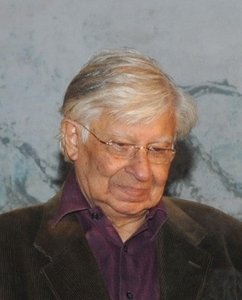
krishen khanna khanna
1925 - , India
Quick Facts
- Artistic Movement Or Style: Abstract figurative
- Date Of Birth: 5 July 1925
- Full Name: Krishen Khanna khanna
- Nationality: Indian
- Notable Artworks:
- Truckwallahs
- Bandwallahs
- Place Of Birth: Lyallpur, India