Menu
FREE ART CONSULTATION
PreviewPreview AR previewAR preview Buy Hand Made Painting Buy Hand Made PaintingBuy Image Buy Image SendSend
DetailsDetails Add to favorites Add to favorites DownloadDownload SimilarsSimilars X-RayX-Ray DiaporamaDiaporama

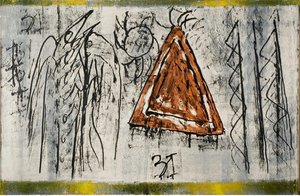
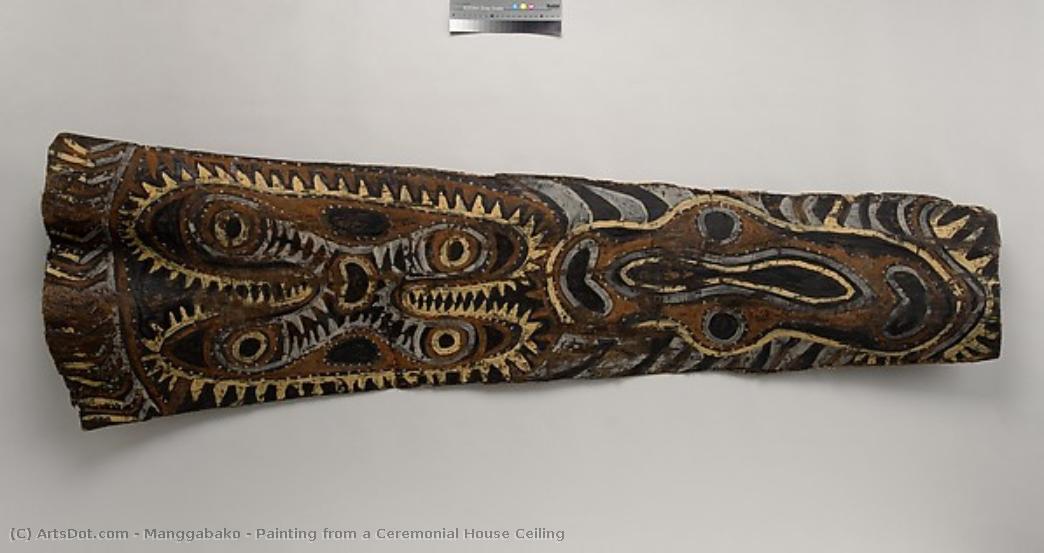
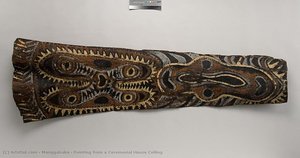
Painting from a Ceremonial House Ceiling

  • Creation date1973
  • Dimensions165.0 x 53.0 cm

Kuimbi Wanyi: Papua New Guinean artist creating intricate sago palm paintings from ceremonial house ceilings. Explore Kwoma clan art & tradition.

Giclée / Art Print

Museum-quality giclée or canvas print with fast production and flexible finish options. (Buy Hand Made Painting Buy Hand Made PaintingBuy Image Buy Image)

Standard
custom
CM
INCH

Pick from our preset sizes that match the artwork's original proportions.

width
height

You may enter your own dimensions to fit a specific frame or space. If your selected size does not match the original image's proportions, we will either crop the artwork or extend the image with a mirrored or solid-fill edge. A digital mockup will be sent for your approval before production begins.
Please note that the on-screen preview does not reflect the actual cropping or extension. Only the mockup will accurately show the final composition.
While custom sizes are available, we recommend selecting a dimension from the predefined list to preserve the original proportions.

Worldwide Delivery () in 2 weeks instead of standard 4/5 weeks. (29 August)

why_choose_icon
Free Worldwide Express Shipping
why_choose_icon
High-Quality Linen Canvas
why_choose_icon
Full Shipping Insurance
why_choose_icon
Customs Tax Refund Guarantee
why_choose_icon
True Color Matching Guarantee
why_choose_icon
60-Day Return Policy (Defects Only)
why_choose_icon
100% Money-Back Guarantee
why_choose_icon
Bulk Discount Offer

Total Price

$ 63

reproduction

Painting from a Ceremonial House Ceiling

Giclée / Art Print

Reproduction Size

-

Total Price

$ 63

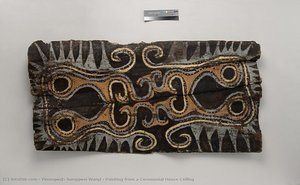
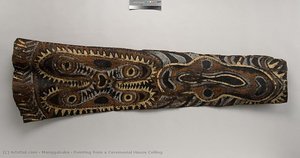
Throughout New Guinea, men’s ceremonial houses were, and in many places still are, the primary focus for painting and sculpture. Like the cathedrals of medieval Europe, they are generally the largest and most sacred buildings in the village, rising high above the ordinary dwellings that surround them. Typically, entry into the ceremonial house is restricted to initiated men, although in some cases, women and children can enter under certain circumstances for specific events. Ceremonial houses serve as the venue for nearly all important male religious rites – such as initiation rites for young boys - and at other times function as meeting houses or informal gathering places. Their structure and the way they are decorated can take on many different local forms and styles. The Kwoma are a small group of people living in the hills north of the Sepik River in northeast New Guinea. Among the Kwoma people of the Washkuk Hills ceremonial houses have no walls; instead, they consist of a huge steeply pitched roof, which extends nearly to the ground and is supported by a series of massive posts and beams. These structures have no walls and the sides are left open except when rituals are held inside. A finial, carved with images of mythical beings, projects from each gable. Some Kwoma ceremonial houses are unadorned. However, the construction of lavishly decorated examples is a source of pride for the village and its clans. The ceilings of the most ornate ceremonial houses are decorated with hundreds of brilliantly colored paintings and elaborately sculpted posts and rafters. Paintings are made on sheets of bark or sago petioles, the bark-like bases of the leaves of the sago palm tree, which are trimmed and flattened to create a flat roughly rectangular surface that tapers slightly according to the natural form of the petiole. After a curing process, the artist covers the smooth side of the sheet with a wash of black clay. The main outlines of the design are laid out in clear water, retraced in paint, and then filled in with color. Although one man lays out the design, an assistant may perform the work of infilling and painting the bordering dots. Each painting represents a specific animal, plant, object, supernatural being, or other phenomenon associated with one of the village clans, such as fruit bats or shooting stars for example. The manner in which these clan symbols are depicted varies greatly. Some of the more figurative imagery, such as a relatively naturalistic crocodile, typically do not depict ordinary creatures but rather represent supernatural beings who either are otherworldly animals or have assumed animal form. Many of the paintings employ abstract and geometric designs derived from features of the various animals, plants, and other subjects they portray. Paintings may also include images of natural objects such as the moon in its various phases or legendary figures from the clan’s oral traditions. While there is a fairly well-defined repertoire of specific geometric design types, the meaning of each design can vary according to the intention and clan affiliation of the artist. When completed, the paintings are tied to the rafters on the underside of the ceiling with lengths of split cane. The panels are arranged lengthwise along the axis of the house, with a few rows placed laterally at its midpoint. The midpoint forms not only the center of the structure--the most ritually important area--but also roughly indicates the sectors allotted to each clan. In general however, there is no prescribed arrangement. Instead the works form a stunning visual patchwork of clan symbols, evoking the strength, unity, and identity of the village clans, whose members gather on the earthen floor beneath them to perform religious rites or initiation ceremonies, hold meetings, or casually socialize. This panel is one of over 270 original paintings commissioned from Kwoma artists in the village of Mariwai in 1970 and 1973 by Douglas Newton, the first curator of Oceanic art in the Department of the Arts of Africa, Oceania and the Americas. Once completed, they were shipped to New York and installed in the galleries. In 2007, when the Oceania galleries at the Metropolitan Museum were renovated, the panels were attached to a new superstructure. Although less steeply pitched than the Kwoma houses found in villages today, the installation evokes the essential form of a ceremonial house ceiling. Together these suspended panels form an impressive and spectacular installation in the Metropolitan Museum which, at 80.4 feet (24.5 meters) end-to-end, is the largest contemporary art installation in the museum.

Artist Biography

A Visionary Echo of Tradition: Exploring the Art of Kuimbi Wanyi

Kuimbi Wanyi, born Mariweli Village in Papua New Guinea’s Upper Sepik River region, represents a remarkable confluence of artistic heritage and contemporary expression. His identity as a member of the Kwoma clan—a people deeply rooted in ritualistic practices and ancestral storytelling—shapes every aspect of his creative process, resulting in paintings that transcend mere visual representation; they are embodiments of Kwoma cosmology and cultural memory.
  • Early Life & Clan Affiliations: Growing up amidst the vibrant traditions of the Kwoma people instilled in Wanyi a profound understanding of symbolism and storytelling inherent to his clan’s worldview. The Kwoma culture emphasizes kinship ties, elaborate rituals surrounding death and rebirth, and a belief system centered on spirits inhabiting both the natural world and human beings.
  • The Art of Sago Palm Painting: Wanyi's distinctive medium—sago palm—is more than just pigment; it’s inextricably linked to Kwoma ceremonial life. Traditionally, sago palm sap is used in rituals marking significant events like initiation ceremonies and funerals. Applying this sap onto the ceilings of men’s ceremonial houses – spaces considered sacred and imbued with spiritual power – becomes Wanyi's artistic mission.
His signature work, “Painting from a Ceremonial House Ceiling,” exemplifies this approach perfectly. The paintings depict stylized figures—often representing ancestors or spirits—engaged in dynamic narratives that recount Kwoma myths and legends. These images aren’t simply decorative; they serve as visual records of rituals performed by the clan elders, ensuring continuity with their past and transmitting knowledge across generations. The meticulous application of sago palm sap creates textured surfaces that capture subtle nuances of color and form, mirroring the complexity of Kwoma beliefs.

Technique & Symbolism: Decoding the Visual Language

The technique employed by Kuimbi Wanyi is remarkably precise. He painstakingly transfers images from ceremonial house ceilings onto canvas using a method passed down through generations within his clan. This process involves transferring the image onto a temporary substrate, then meticulously applying sago palm sap to recreate the original design with astonishing accuracy. The resulting paintings possess an ethereal quality—a testament to the artist’s dedication and respect for tradition.
  • Color Palette: Wanyi's color palette draws heavily from natural pigments found in the Sepik River region, reflecting Kwoma reverence for the environment. Ochre reds and yellows dominate many of his paintings, symbolizing fertility, vitality, and connection to the earth—themes central to Kwoma spirituality.
  • Stylized Figures: The figures depicted in Wanyi’s artwork are stylized representations of ancestors and spirits, adhering to Kwoma artistic conventions. These figures aren't rendered realistically; instead, they convey emotional significance through simplified forms and expressive gestures.

Influence & Recognition

Kuimbi Wanyi’s work has garnered international acclaim for its authenticity and contribution to preserving Kwoma cultural heritage. His paintings have been exhibited in prestigious museums worldwide, including The Metropolitan Museum of Art, where “Painting from a Ceremonial House Ceiling” is currently showcased.

Historical Significance & Legacy

Kuimbi Wanyi’s art stands as a powerful reminder of the enduring strength of indigenous traditions. By documenting Kwoma myths and rituals through sago palm paintings, he ensures that these stories continue to resonate with future generations. His work transcends mere artistic merit; it embodies the spirit of his clan—a commitment to honoring ancestral wisdom and safeguarding cultural identity in an increasingly globalized world.
kuimbi wanyi

kuimbi wanyi

1973 - , Papua New Guinea

Quick Facts

  • Artistic Movement Or Style: Kwoma Clan Art
  • Date Of Birth: Mariweli Village, Papua New Guinea (1973)
  • Full Name: Kuimbi Wanyi
  • Nationality: PNG
  • Notable Artworks: ['Painting from a Ceremonial House Ceiling']
  • Other Names: Manggabako
  • Place Of Birth: Papua New Guinea
Explore artworks organized by themes, styles, and characteristics.