 Preview
 Send
Send Share
Share
 Details

 Download
 Similars
 X-Ray
X-Ray Diaporama
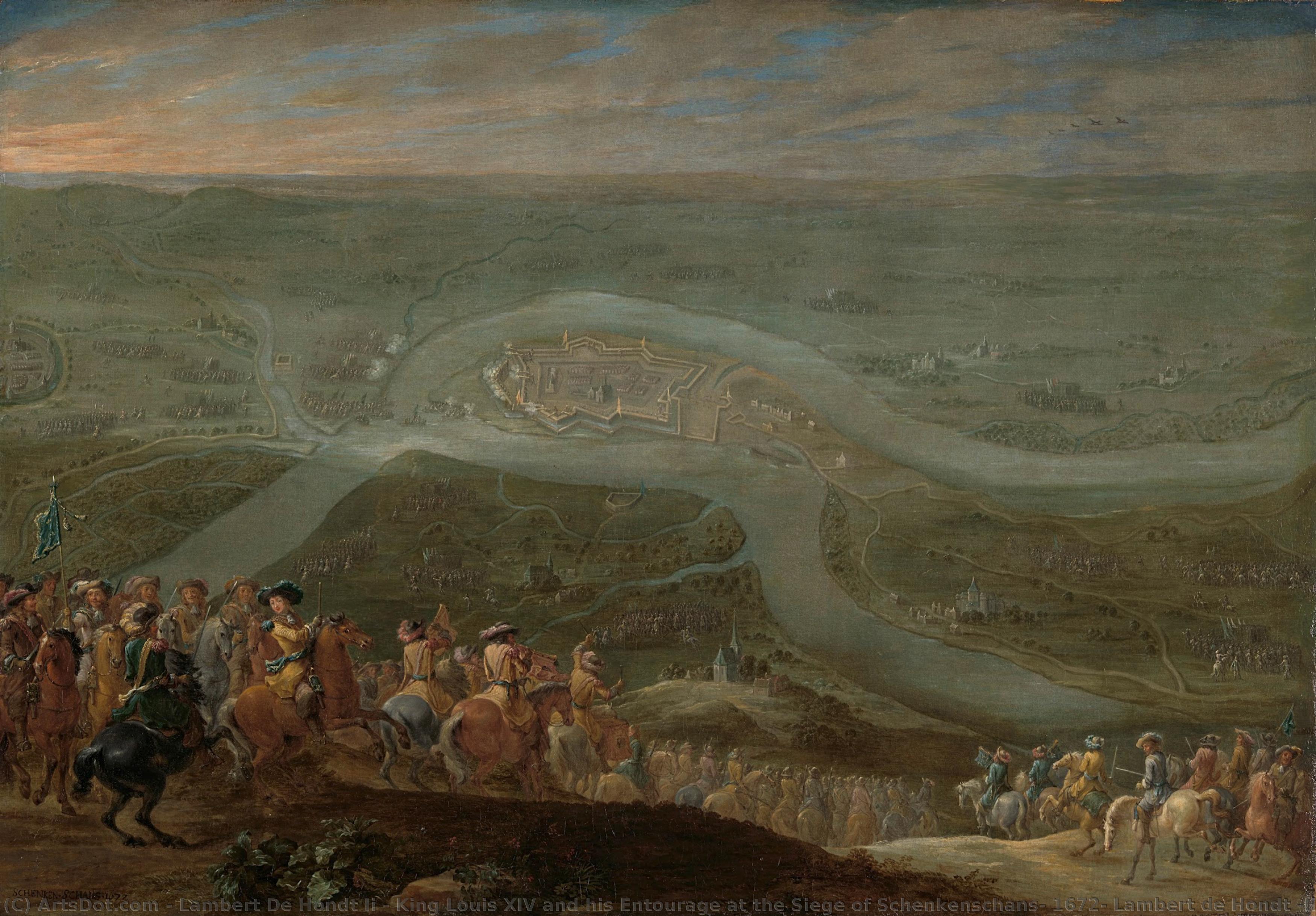
King Louis XIV and his Entourage at the Siege of Schenkenschans, 1672, Lambert de Hondt (II), c. 1675
 1675
1675 63.0 x 89.0 cm
 Read More
Giclée / Art Print
Museum-quality giclée or canvas print with fast production and flexible finish options. ( Buy Hand Made Painting Buy Image)




































Pick from our preset sizes that match the artwork's original proportions.

You may enter your own dimensions to fit a specific frame or space. If your selected size does not match the original image's proportions, we will either crop the artwork or extend the image with a mirrored or solid-fill edge. A digital mockup will be sent for your approval before production begins.
Please note that the on-screen preview does not reflect the actual cropping or extension. Only the mockup will accurately show the final composition.
While custom sizes are available, we recommend selecting a dimension from the predefined list to preserve the original proportions.
Worldwide Delivery () in 2 weeks instead of standard 4/5 weeks. (4 September)

Free Worldwide Express Shipping

High-Quality Linen Canvas

Full Shipping Insurance

Customs Tax Refund Guarantee

True Color Matching Guarantee

60-Day Return Policy (Defects Only)

100% Money-Back Guarantee

Bulk Discount Offer
 Glass option is only available in size under 110 CM

King Louis XIV and his Entourage at the Siege of Schenkenschans, 1672, Lambert de Hondt (II), c. 1675
Giclée / Art Print
Reproduction Size
-


Total Price
$ 63
Related Artworks







Artist Biography
The Legacy of Lambert de Hondt the Younger
Within the rich tapestry of seventeenth-century Flemish art, certain names flicker with a brilliance that transcends their often fragmented histories. Lambert de Hondt the Younger, also known as Lambert de Hondt II, stands as a compelling figure from this era, a painter whose work captures the kinetic energy and dramatic grandeur of his time. Born in Mechelen around 1642, he emerged from a tradition deeply rooted in the Southern Netherlands, carrying forward a legacy of technical precision and narrative power. While often overshadowed by the monumental reputation of his predecessor, Lambert de Hondt the Elder, the Younger carved out a distinct space for himself through his specialized mastery of movement, conflict, and the sweeping vistas of the landscape.
The artistic identity of de Hondt the Younger is inextricably linked to the themes of battle and equestrianism. He possessed a rare ability to translate the chaos of warfare into structured, visually arresting compositions. His canvases frequently depict the thunderous charge of cavalry and the strategic maneuvers of infantry, rendered with an eye for both the minute details of armor and the atmospheric haze of smoke-filled battlefields. This focus on military subjects allowed him to explore the interplay between human drama and the vast, often indifferent, natural world. Beyond the clash of steel, his repertoire extended into genre scenes and landscapes, where he demonstrated a versatile command over light and texture, breathing life into quiet moments of everyday existence and the rugged beauty of the Flemish countryside.
Technical Mastery and Artistic Vision
To observe a work by de Hondt the Younger is to witness a profound engagement with the Baroque sensibility. His technique was characterized by a meticulous attention to form, particularly in the depiction of equine anatomy and the complex folds of period drapery. He utilized light not merely as a tool for visibility, but as a dramatic instrument to guide the viewer's eye through the tumult of his compositions. This use of chiaroscuro—the stark contrast between deep shadows and brilliant highlights—lent his battle scenes an inherent sense of urgency and depth, making the viewer feel as though they were standing upon the very periphery of the fray.
His development as an artist was likely shaped by the vibrant artistic hubs of the Low Countries, where the influence of both Dutch realism and Flemish grandiosity converged. While his subject matter often leaned toward the heroic and the historical, there remains a grounded, observational quality in his work that prevents it from descending into mere spectacle. He had a remarkable talent for capturing the texture of reality—the sheen of a horse's coat, the grit of the earth, and the heavy atmosphere of an encampment. This dedication to detail ensured that even his most large-scale historical works maintained a sense of intimacy and visceral truth.
Historical Significance and Enduring Impression
The historical importance of Lambert de Hondt the Younger lies in his role as a chronicler of the era's martial spirit and landscape. His paintings served not only as aesthetic objects but as visual records of the tensions and triumphs that defined the seventeenth century. Through his work, we gain insight into the cultural fascination with heroism, nobility, and the organized chaos of the early modern military machine. His ability to blend the tapestry-like detail of Flemish tradition with a dynamic, almost cinematic approach to storytelling marks him as a significant contributor to the evolution of Northern European genre painting.
Today, his contributions are preserved in esteemed collections, such as the Royal Museums in Brussels, where they continue to offer scholars and art enthusiasts a window into a vanished world. Though the line between the Elder and the Younger de Hondt is sometimes blurred by history, the unmistakable vigor of the Younger's hand remains evident. He remains an artist whose work resonates with the pulse of history, reminding us of the power of paint to freeze the most fleeting and ferocious moments of human experience in a state of eternal, breathtaking grace.
lambert de hondt the younger
1708 , Belgium
Quick Facts
- Artistic Movement Or Style: World Goes Pop
- Artists Or Movements Influenced By This Artist: ['']
- Artists Who Influenced This Artist: ['']
- Date Of Death: 1708
- Notable Artworks:
- Evelyne Axell
- Joav BarEl
- Thomas Bayrle