 Preview
 Send
Send Share
Share
 Details

 Download
 Similars
 X-Ray
X-Ray Diaporama
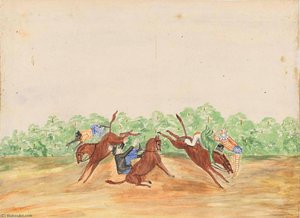
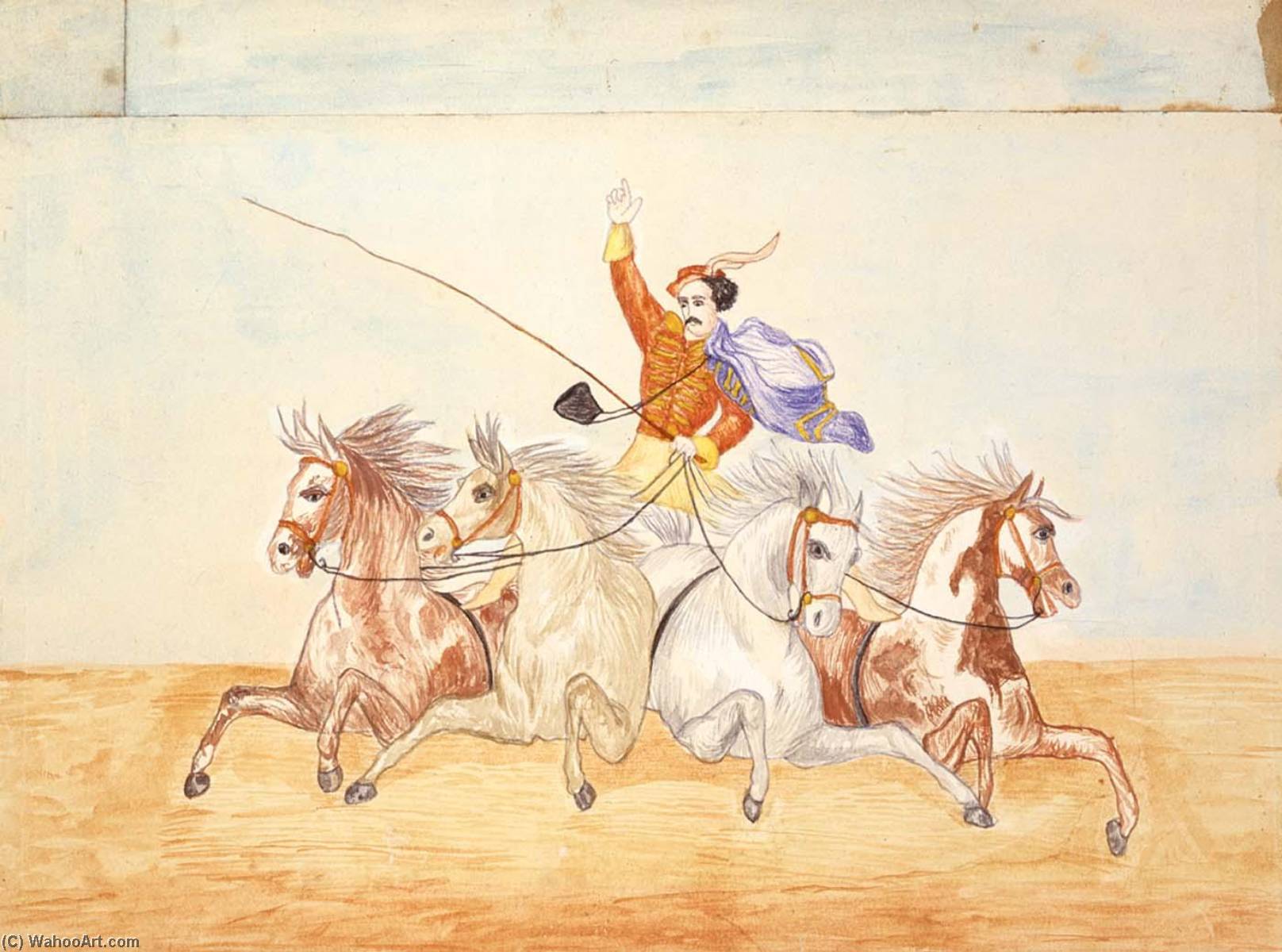
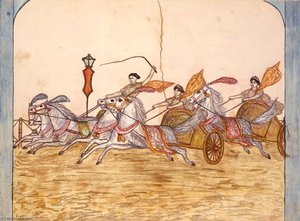
Acrobat Rider on Four Horses
 1880
1880 19.0 x 25.0 cm
 Read More
Giclée / Art Print
Museum-quality giclée or canvas print with fast production and flexible finish options. ( Buy Hand Made Painting Buy Image)




































Pick from our preset sizes that match the artwork's original proportions.

You may enter your own dimensions to fit a specific frame or space. If your selected size does not match the original image's proportions, we will either crop the artwork or extend the image with a mirrored or solid-fill edge. A digital mockup will be sent for your approval before production begins.
Please note that the on-screen preview does not reflect the actual cropping or extension. Only the mockup will accurately show the final composition.
While custom sizes are available, we recommend selecting a dimension from the predefined list to preserve the original proportions.
Worldwide Delivery () in 2 weeks instead of standard 4/5 weeks. (21 August)

Free Worldwide Express Shipping

High-Quality Linen Canvas

Full Shipping Insurance

Customs Tax Refund Guarantee

True Color Matching Guarantee

60-Day Return Policy (Defects Only)

100% Money-Back Guarantee

Bulk Discount Offer
 Glass option is only available in size under 110 CM

Acrobat Rider on Four Horses
Giclée / Art Print
Reproduction Size
-


Total Price
$ 63
Collectible Description
Artistic Style and Technique
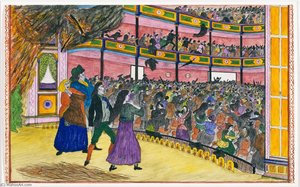
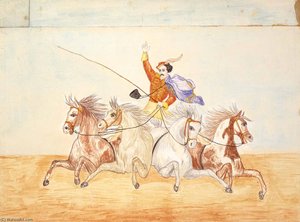
Lawrence W Ladd's artistic style is characterized by his use of vibrant colors and bold compositions. In "Acrobat Rider on Four Horses," he employs a range of blues and browns to create a sense of depth and dimensionality. The artist's technique is also notable for its emphasis on capturing the movement and tension of the acrobat and horses. Key Features of the painting include:- The acrobat's poised position on the backs of four horses, conveying a sense of balance and control
- The horses' individualized expressions and postures, adding to the overall sense of energy and movement
- The use of watercolor to create a sense of fluidity and spontaneity
Artist and Museum
Lawrence W Ladd was an American artist active during the late 19th century. His work is represented in several prominent museums, including the Smithsonian American Art Museum. This museum is renowned for its extensive collection of American art, featuring works by artists such as Daniel T. Cowell and William Henry Holmes. For more information on Lawrence W Ladd and his artwork, visit /art/list/?Filter=AQTJSL-Lawrence-W-Ladd-Acrobat-Rider-on-Four-Horses or explore the Smithsonian American Art Museum's collection at /en/art/show/art-aqtjsl-en/The captivating "Acrobat Rider on Four Horses" is a testament to Lawrence W Ladd's skill as an artist and his ability to create dynamic, engaging works of art.
Related Artworks

Artist Biography
Lawrence W. Ladd: A Painter of American Grit
Lawrence W. Ladd (1865-1895), an artist born in Utica, New York, stands as a compelling figure within the late 19th-century American art scene. Often categorized as a “Utica Master,” his work transcends simple regionalism, offering a potent blend of Western themes, dynamic movement, and a surprisingly nuanced understanding of human psychology. Ladd’s career, though tragically short, produced a body of paintings that continue to resonate with their raw energy and evocative storytelling – particularly in his depictions of equestrian subjects and scenes of American life.
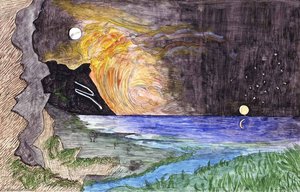
Ladd's early life remains somewhat shrouded in mystery, but it’s understood he received limited formal artistic training. He began his career as a mechanic before dedicating himself fully to painting around 1880. His style evolved rapidly, initially influenced by the Tonalist movement—a trend emphasizing atmospheric effects and subdued colors—but quickly developed into something far more assertive. He was deeply impacted by the American West, not just in terms of landscape but also through its people – cowboys, Native Americans, and frontiersmen – all rendered with a remarkable sense of immediacy and action. This fascination is powerfully evident in his most celebrated works, such as “The Creation,” currently housed at the Smithsonian American Art Museum, which depicts a biblical scene brimming with energy and dramatic composition.
Themes of Movement and Narrative
A defining characteristic of Ladd’s art is its dynamic sense of movement. Unlike many artists of his time who favored static compositions, Ladd captured fleeting moments – a charging horse, a daring acrobat, a tense confrontation—with remarkable skill. He employed loose brushwork and vibrant color to convey the feeling of speed and momentum, creating paintings that seem almost alive. This emphasis on motion is not merely decorative; it’s deeply intertwined with his narrative approach.
Ladd's paintings are rarely straightforward depictions of events. Instead, they often hint at underlying stories, inviting viewers to interpret the scene and imagine the characters’ motivations and emotions. “The Creation,” for example, isn’t simply a representation of God’s act of creation; it’s a visual metaphor for human ambition, struggle, and the relentless pursuit of progress. His scenes frequently incorporate elements of folklore and mythology, adding layers of symbolic meaning to his work.
Technique and Influences
Ladd's technique was characterized by a bold use of color and an expressive brushstroke. He favored bright, saturated hues—particularly reds, yellows, and blues—to create a sense of drama and vitality. His compositions were often asymmetrical, further contributing to the feeling of movement and dynamism. While his style is distinctly American, it’s also evident that Ladd was influenced by European artists such as Sir Lawrence Alma-Tadema, whose depictions of Victorian interiors and classical antiquity demonstrated a mastery of light and color. However, Ladd adapted these influences to create a uniquely American vision.
Interestingly, Ladd's work reflects the broader cultural currents of his time—the rise of industrialization, westward expansion, and increasing social tensions. His paintings capture both the excitement and the anxieties of this rapidly changing era. He was also influenced by the burgeoning interest in the Old West, fueled by dime novels and frontier legends.
Legacy and Historical Significance
Despite his relatively short career, Lawrence W. Ladd left a significant mark on American art. His paintings are now recognized as important examples of late 19th-century Western art, showcasing a distinctive blend of dynamism, narrative complexity, and emotional intensity. His work is particularly valued for its ability to capture the spirit of the American frontier—its rugged beauty, its inherent contradictions, and its enduring appeal.
Today, Ladd’s paintings are exhibited in museums across the United States, including the Smithsonian American Art Museum, where “The Creation” resides. His legacy continues to inspire artists and art enthusiasts alike, reminding us of the power of painting to capture a moment in time and tell a compelling story.
Quick Facts
- Artistic Movement Or Style: Western Americana
- Artists Or Movements Influenced By This Artist: ['George Elbert Burr']
- Artists Who Influenced This Artist: ['Sir Thomas Lawrence']
- Full Name: Lawrence W. Ladd
- Nationality: American
- Notable Artworks:
- The Creation
- Declaration of Independence
- Place Of Birth: Utica, New York, USA