 Preview
 Send
Send Share
Share
 Details

 Download
 Similars
 X-Ray
X-Ray Diaporama
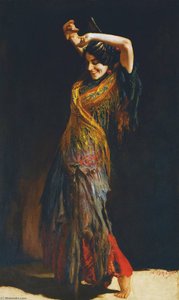
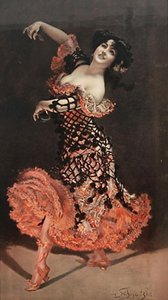
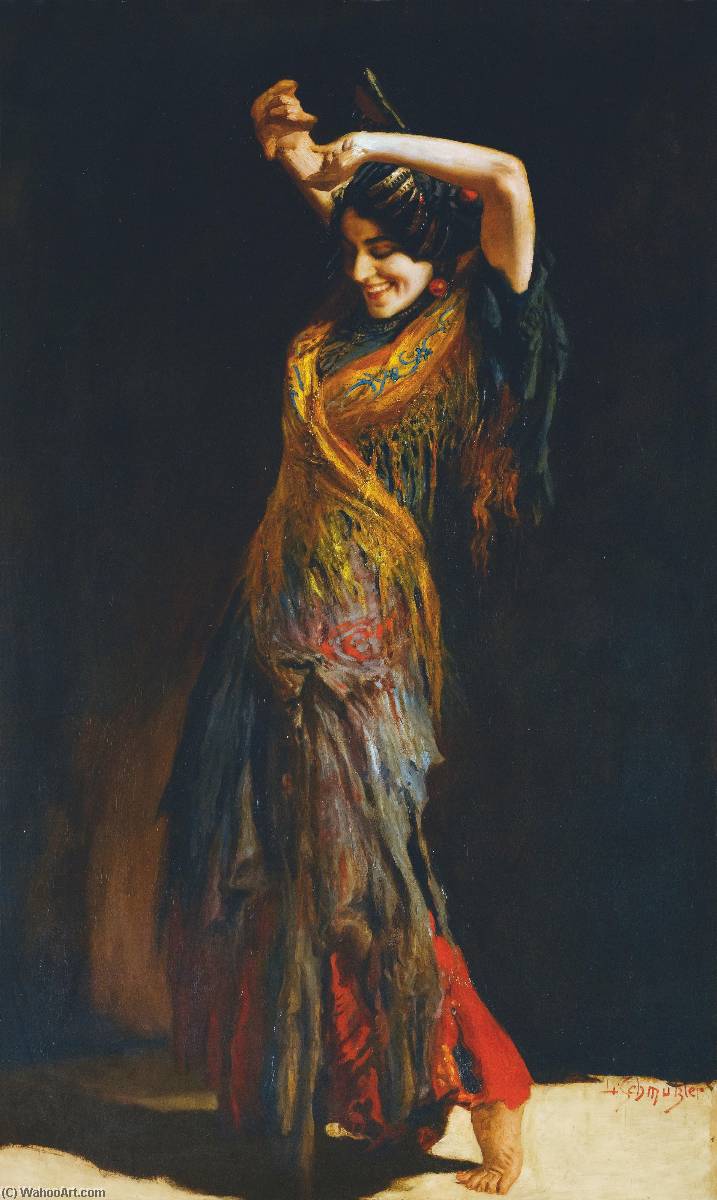
The Flamenco Dancer
 Read More
Hand Made Oil Reproduction
Hand-painted oil on canvas in your size and frame, made to order by our artists. ( Buy Print Buy Image)




































Pick from our preset sizes that match the artwork's original proportions.

You may enter your own dimensions to fit a specific frame or space. If your selected size does not match the original image's proportions, we will either crop the artwork or extend the painting with additional hand-painted elements. A digital mockup will be sent for your approval before production begins.
Please note that the on-screen preview does not reflect the actual cropping or extension. Only the mockup will accurately show the final composition.
While custom sizes are available, we recommend selecting a dimension from the predefined list to preserve the original proportions.
After order, ArtsDot.com team will email client for instructions and provide a mockup preview
Worldwide Delivery () in 3/4 weeks instead of standard 5 weeks. (17 August). No compromise on quality.

Free Worldwide Express Shipping

High-Quality Linen Canvas

Full Shipping Insurance

Customs Tax Refund Guarantee

True Color Matching Guarantee

60-Day Return Policy (Defects Only)

100% Money-Back Guarantee

Bulk Discount Offer
 Glass option is only available in size under 110 CM

The Flamenco Dancer
Reproduction Medium
Reproduction Size
-


Total Price
$ 263
Related Artworks
Artist Biography
Leopold Schmutzler: A Bohemian Painter Caught in the Shadow of Nazism
Leopold Schmutzler (1864–1940) was a German painter whose artistic journey spanned from bohemian beginnings to association with the Nazi regime, leaving behind a legacy marked by evocative portraits and genre scenes infused with rococo elegance. Born in Mies, Bohemia—now Czech Republic—Schmutzler’s formative years instilled within him an appreciation for craftsmanship honed by his father's trade as a saddler and innkeeper, who initially nurtured his artistic inclinations through drawing lessons. Despite aspirations to pursue musical studies at the Naval School of Music in Pula, Croatia, Schmutzler’s poor eyesight thwarted these ambitions, redirecting him towards formal art education. His formative years at the Academy of Fine Arts Vienna with Christian Griepenkerl proved pivotal, shaping his artistic sensibilities and introducing him to a broader understanding of artistic tradition. Griepenkerl's rejection of Hitler’s application to the academy served as an implicit critique of artistic ambition driven by ideology—a lesson Schmutzler would later grapple with himself. Following Vienna, he transferred to Munich’s Academy of Fine Arts where he studied under Otto Seitz, cementing his connection to Bavarian artistic circles and establishing a home base for decades of creative output. Brief stints in Rome and Paris broadened his horizons further, exposing him to diverse influences that enriched his stylistic repertoire. Schmutzler quickly gained renown as one of Munich's busiest portrait painters during the early 20th century. Commissions from the Bavarian royal family brought prestige and financial stability, yet he captivated audiences with depictions of dancers and performers—a testament to his keen observation of human behavior and artistic versatility. Perhaps his most celebrated work is Lili Marberg’s portrayal as Salomé, a dramatic depiction capturing the actress's captivating gaze and embodying the theatrical spirit of the era. His style blended realism with subtle art-deco elements, prioritizing meticulous attention to detail—particularly in clothing—while simultaneously exploring themes of sensuality through nude figures. The 1930s witnessed Schmutzler’s embrace of Nazism, a decision that fundamentally altered his artistic trajectory and tragically curtailed his career outside Germany. Driven by the Blut und Boden ideology prevalent at the time, he produced paintings reflecting nationalist sentiments and glorifying Germanic heritage. Notably, Jungfrauen nach der Arbeit (Maidens After Work), completed in 1940 shortly before his death, garnered considerable acclaim at the Großdeutsche Kunstausstellung (Great German Art Exhibition) hosted by Haus der Kunst in Munich—a venue closely aligned with Nazi propaganda. Hitler purchased the painting for 7,000 Reichsmarks, symbolizing the regime’s appropriation of artistic talent and its desire to legitimize its worldview. Despite Schmutzler's association with Nazism effectively erasing his reputation internationally, his artwork continues to be exhibited in museums across Europe, including the Frye Art Museum in Seattle—where his founder, Charles Frye (1858–1940), held a profound admiration for Schmutzler’s pre-Nazi oeuvre. This enduring fascination speaks to the artist's ability to capture timeless beauty and emotion through masterful technique and evocative imagery, securing his place as a significant figure in German art history.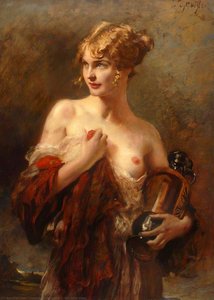
leopold schmutzler
1864 - 1940
Quick Facts
- Artistic Movement Or Style: Realistic with Art Deco elements
- Artists Who Influenced This Artist:
- Christian Griepenkerl
- Otto Seitz
- Date Of Birth: 1864
- Date Of Death: 1940
- Full Name: Leopold Schmutzler
- Nationality: German
- Notable Artworks:
- Junge Frau mit roten Haaren und einem Strauß...
- JUNGE FRAU MIT GEPFLÜCKTEN BLUMEN IN IHREN ARMEN
- Place Of Birth: Mies, Bohemia