

 Preview
 Send
Send Share
Share
 Details

 Download
 Similars
 X-Ray
X-Ray Diaporama
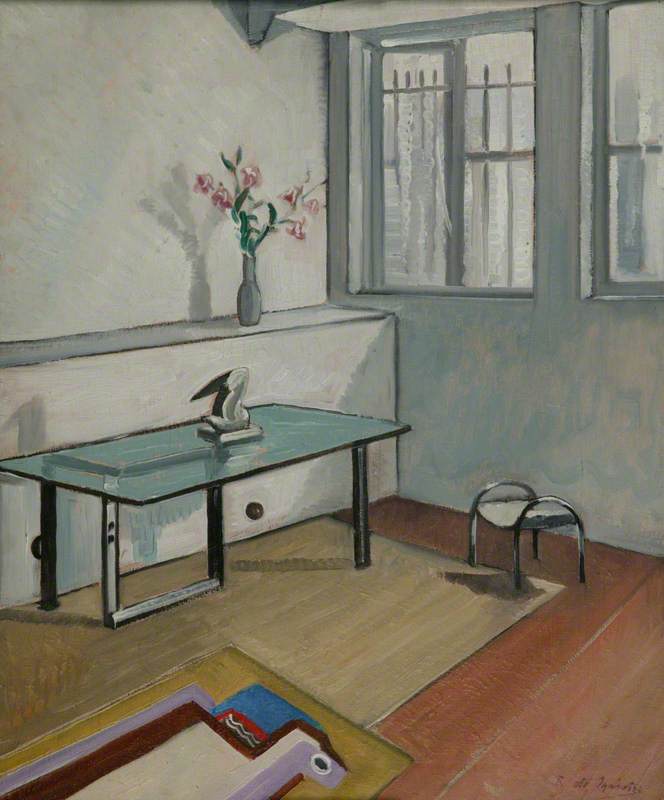
Interior
 1930
1930 61.0 x 51.0 cm
 Read More
Purchase a high-resolution, enhanced digital image, far superior to the online preview.
Each file is meticulously prepared by our in-house specialists using advanced tools and expert manual retouching. We ensure every image has exceptional clarity, precise color accuracy, and fine detail.
The final file is delivered via email within 72 hours, optimized for immediate use in professional, editorial, and print environments. This is the same quality trusted by top-tier design studios, publishers, and galleries.
Digital Image
Download a high-resolution file for personal display, printing, and creative projects. ( Buy Print Buy Hand Made Painting)
Included in Every Digital Image Order
Expert Digital Delivery, Guaranteed
When you choose ArtsDot.com, you're not just getting an image - you're receiving a professionally enhanced digital artwork, crafted with precision and backed by a satisfaction guarantee. Here's everything that comes with your order, automatically:

Fast Email Delivery
Your high-resolution digital image file will be emailed to you within 72 hours of ordering - ready for immediate use.

AI-Enhanced Digital File
Your artwork is professionally optimized using advanced AI tools and manual editing, ensuring maximum detail, clarity, and color accuracy.

Free Lifetime Re-Delivery
Accidentally deleted or lost your file? No worries - we'll resend it to you anytime, free of charge.

No Import Fees - Ever
Enjoy your artwork instantly with zero customs, duties, or delivery fees - digital downloads are always tax-free.

Color Accuracy Guarantee
We ensure your digital image reflects the original colors as closely as possible using professional tools and color management.

60-Day Satisfaction Guarantee
If you're not satisfied with your digital image, we'll revise it or refund 100% within 60 days - no questions asked.

100% Money-Back Guarantee
Not satisfied? Get a full refund within 60 days of receiving your digital file - no questions asked.

Bulk Order Discounts
Buy 3 images, save 10% - Buy 5, save 15% - Buy 10+, save 20%. Great for creative projects, galleries, and agencies.
Related Artworks









Artist Biography
A Pioneer of Australian Abstraction: The Visionary World of Roy De Maistre
Roy De Maistre, born Leroy Leveson Laurent Joseph De Maistre in 1894, occupies a unique and pivotal position in the history of Australian art. Often hailed as Australia’s first abstract artist, his journey was one of relentless experimentation, driven by a profound belief in the expressive power of colour and form. While biographical details remain somewhat elusive – a consequence perhaps of his intensely private nature and focus on artistic exploration rather than self-promotion – De Maistre's impact on the development of modern art in Australia is undeniable. He wasn’t simply *painting* pictures; he was attempting to translate musical harmonies into visual experiences, forging a path that would inspire generations of artists to come. His early life offered little indication of the radical artistic direction he would eventually take. Born into a relatively conventional background, his initial training focused on traditional art techniques, but these foundations were soon to be challenged and ultimately overturned by his encounter with the burgeoning avant-garde movements in Europe.From Realism to Colour-Music: A Transformation Forged in War
The outbreak of World War I proved a watershed moment for De Maistre. Serving as an ambulance driver on the Western Front, he witnessed firsthand the horrors of conflict, experiences that profoundly altered his artistic sensibilities. The trauma and chaos of war led him to question the representational capacity of traditional art forms. He began seeking a more universal language, one capable of expressing deeper emotional truths beyond the limitations of literal depiction. This search brought him into contact with the vibrant artistic community in London during the 1910s. There, he encountered Cubism and Futurism, movements that deconstructed form and embraced abstraction. However, De Maistre didn’t simply adopt these styles wholesale; he synthesized them with his own burgeoning theories about colour and music. He believed that colours possessed inherent harmonic relationships analogous to musical chords, and he sought to create paintings that functioned as visual equivalents of musical compositions – a concept he termed “colour-music.” This wasn't merely synesthesia; it was a rigorous attempt to establish a systematic correspondence between the chromatic spectrum and the principles of harmony.The Stations of the Cross and Pioneering Experiments
De Maistre’s most celebrated work, the series of *Stations of the Cross* (1927-1930), exemplifies his unique artistic vision. These twelve paintings represent a radical departure from traditional depictions of Christ's Passion. Eschewing narrative detail and figurative representation, De Maistre employed a highly abstracted visual language composed of bold colours, geometric shapes, and dynamic compositions. Each station is not an illustration of a biblical event but rather an emotional response to it, conveyed through the evocative power of colour and form. The series demonstrates his commitment to expressing spiritual themes through abstract means, challenging conventional notions of religious art. Beyond the *Stations*, De Maistre engaged in numerous other experiments throughout his career. He explored various techniques, including oil painting, tempera, and collage, constantly pushing the boundaries of artistic expression. His work often features a distinctive use of layered colours and rhythmic patterns, creating a sense of depth and movement. He was fascinated by the interplay of light and shadow, using these elements to create atmospheric effects and enhance the emotional impact of his paintings.Influence and Legacy: A Lasting Impact on Australian Art
Despite facing initial resistance from a conservative art establishment, De Maistre’s work gradually gained recognition in Australia. He exhibited regularly with prominent artist groups, including the Modern Art Society, and played a key role in promoting abstract art to a wider audience. His influence extended beyond his own paintings; he was also a respected teacher, inspiring numerous students to embrace experimentation and explore new artistic possibilities. While his “colour-music” theory wasn’t universally accepted, it sparked important debates about the nature of abstraction and the relationship between different art forms.- De Maistre's work paved the way for subsequent generations of Australian abstract artists.
- His emphasis on emotional expression and spiritual themes resonated with many artists seeking to move beyond representational conventions.
- He demonstrated that abstraction could be a powerful means of conveying complex ideas and experiences.
Quick Facts
- Artistic Movement Or Style: Abstract, Colour-Music
- Artists Or Movements Influenced By This Artist: ['Wassily Kandinsky']
- Artists Who Influenced This Artist:
- Cubism
- Post Impressionism
- Date Of Birth: March 27, 1894
- Date Of Death: March 1, 1968
- Full Name: Roy De Maistre
- Nationality: Australian
- Notable Artworks:
- Christ falling under the Weight
- The Deposition
- Third Station of the Cross
- Place Of Birth: Melbourne, Australia

