 Preview
 Send
Send Share
Share
 Details

 Download
 Similars
 X-Ray
X-Ray Diaporama
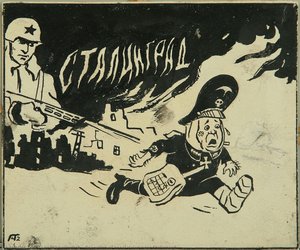
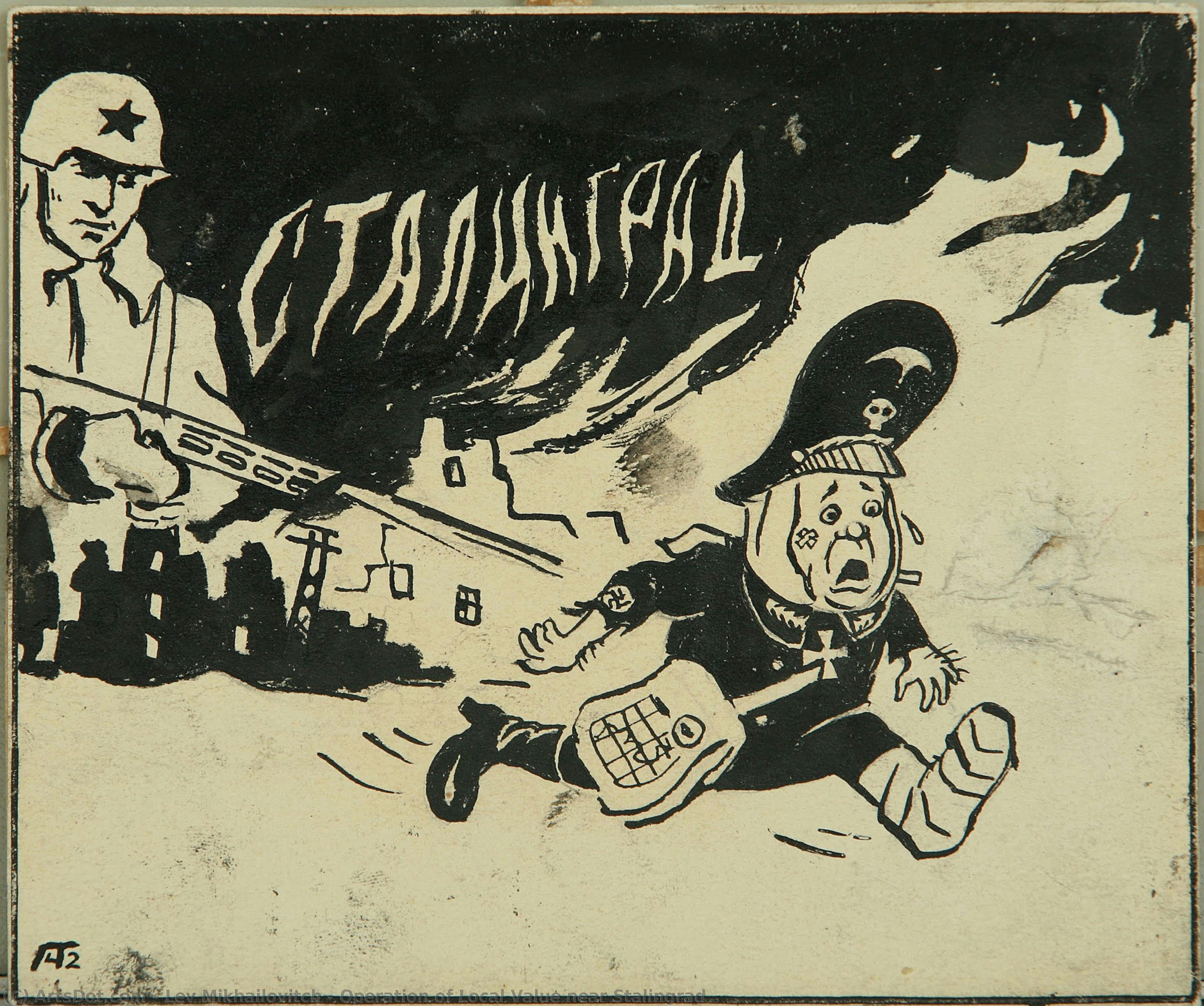
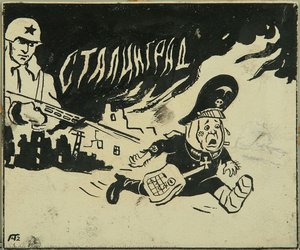
Operation of Local Value near Stalingrad
 Read More
Giclée / Art Print
Museum-quality giclée or canvas print with fast production and flexible finish options. ( Buy Hand Made Painting Buy Image)




































Pick from our preset sizes that match the artwork's original proportions.

You may enter your own dimensions to fit a specific frame or space. If your selected size does not match the original image's proportions, we will either crop the artwork or extend the image with a mirrored or solid-fill edge. A digital mockup will be sent for your approval before production begins.
Please note that the on-screen preview does not reflect the actual cropping or extension. Only the mockup will accurately show the final composition.
While custom sizes are available, we recommend selecting a dimension from the predefined list to preserve the original proportions.
Worldwide Delivery () in 2 weeks instead of standard 4/5 weeks. (24 August)

Free Worldwide Express Shipping

High-Quality Linen Canvas

Full Shipping Insurance

Customs Tax Refund Guarantee

True Color Matching Guarantee

60-Day Return Policy (Defects Only)

100% Money-Back Guarantee

Bulk Discount Offer
 Glass option is only available in size under 110 CM

Operation of Local Value near Stalingrad
Giclée / Art Print
Reproduction Size
-


Total Price
$ 63
Related Artworks








Artist Biography
The Soul of the Tundra: The Artistic Legacy of Lev Mikhailovitch Gabyshev
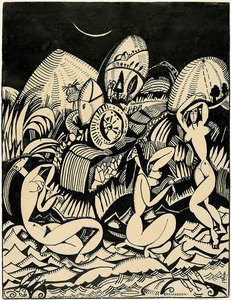
In the vast, frost-bitten expanse of the Sakha Republic, where the horizon stretches infinitely across the Siberian wilderness, the art of Lev Mikhailovitch Gabyshev was born from the very elements that define the Yakut landscape. Born in 1920 in the small, remote settlement of Tyubya, Gabyshev’s early life was an immersion in a world of profound natural rhythms and ancient cultural echoes. His formative years were shaped by the subarctic climate—a realm of long, biting winters and brief, luminous summers—which instilled in him a unique observational prowess. This deep-seated connection to the land would later become the heartbeat of his work, allowing him to translate the silent majesty of the frozen tundra, the winding vitality of mountain rivers, and the rugged beauty of the taiga into a visual language that is both intimate and epic.
As Gabyshev moved beyond the borders of his native Tyubya to study at Moscow State University, his artistic identity underwent a sophisticated transformation. While his roots remained firmly planted in the traditions of Sakha culture, his academic training introduced him to the rigorous structures of Socialist Realism alongside the avant-garde whispers of Constructivism and Surrealism. This intellectual duality allowed him to develop a graphic style that was remarkably multifaceted. He possessed the technical discipline required for meticulous, documentary-style illustration, yet he infused his compositions with an experimental spirit. His work often moved beyond mere representation, utilizing vibrant color palettes and intricate details to evoke the spiritual essence of Yakut folklore and the mythic weight of shamanic rituals.
A Tapestry of Folklore and War
The breadth of Gabyshev’s oeuvre is a testament to his role as a visual chronicler of both the eternal and the immediate. He was a master of the graphic medium, using line and tone to bridge the gap between scientific ethnography and poetic myth. His illustrations for historical texts are celebrated for their ability to capture the precise details of reindeer herding practices and traditional Yakut life with an almost archaeological accuracy. Yet, within these same works, one finds the ethereal presence of legends—the shimmering shadows of spirits and the rhythmic pulse of ancestral ceremonies that define the Sakha identity.
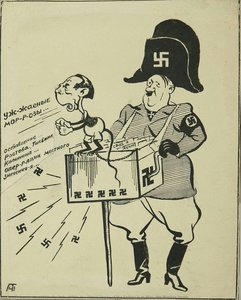
Beyond the timeless landscapes of his homeland, Gabyshev’s art also captured the turbulent currents of 20th-century history. His ability to pivot from the serene stillness of a snow-covered mountain to the visceral tension of wartime scenes demonstrates a profound emotional range. Works such as "Operation of Local Value near Stalingrad" and his evocative, allegorical pieces like "While the Street Organ of the Fuhrer is at War, the Monkey Howls" reveal an artist deeply engaged with the political and human struggles of his era. In these pieces, the graphic precision he honed in his studies meets a biting, symbolic commentary, reflecting the chaos and gravity of the Second World War through a lens that is uniquely his own.
Historical Significance and Enduring Spirit
Though his life was relatively brief, ending in 1975, Lev Mikhailovitch Gabyshev left behind an indelible mark on the visual culture of Siberia and Soviet graphic art. He stands as a pioneer who successfully synthesized regional indigenous heritage with broader international artistic movements. His achievement lies not only in the documentation of a disappearing way of life but in his elevation of Yakut themes to the level of high fine art. Through his meticulous attention to detail and his reverence for the natural world, Gabyshev ensured that the spirit of the Sakha Republic would resonate far beyond the borders of the Arctic Circle.
Today, his work serves as a vital bridge to the past, offering contemporary viewers a window into a world where nature and myth are inextricably linked. His legacy is characterized by:
- Cultural Preservation: The meticulous recording of Yakut ethnography, shamanic motifs, and traditional landscapes.
- Stylistic Innovation: The seamless integration of classical graphic techniques with modern influences like Constructivism.
- Emotional Resonance: An unwavering commitment to capturing the atmospheric truth of the Siberian wilderness and the human condition during wartime.
lev mikhailovitch
1920 - 1975 , Sakha Republic
Quick Facts
- Artistic Movement Or Style: Graphic Art
- Date Of Birth: 1920
- Date Of Death: 1975
- Full Name: Lev Mikhailovitch Gabyshev
- Nationality: Soviet
- Notable Artworks: ['While the Street Organ of the Fuhrer is at War, the Monkey Howls']
- Place Of Birth: Tyubya, Sakha Republic