 Preview
 Send
Send Share
Share
 Details

 Download
 Similars
 X-Ray
X-Ray Diaporama
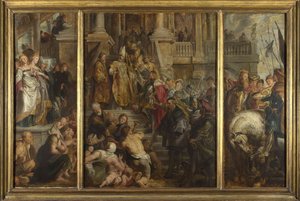
The Miniscalchi Altarpiece


 Read More
Hand Made Oil Reproduction
Hand-painted oil on canvas in your size and frame, made to order by our artists. ( Buy Print Buy Image)




P118B $10

P118H $10

P118W $10

P438Z $10

P508JH $12

P508YH $12

P805H $10

P805Z $10

P919BZ $10

P919G $10

P919XJ $10

P959ZH $10

P968JZ $12

W106C $8

W218G $10

W218JH $8

W218Y $10

W307PJ $10

W316G $10

W316PJ $8

W316Y $10

W398PJ $8

W4111J $10

W500HY $15

W500JH $15

W692G $12

W849H $8

W940BG $15

W953PJ $8




Pick from our preset sizes that match the artwork's original proportions.

You may enter your own dimensions to fit a specific frame or space. If your selected size does not match the original image's proportions, we will either crop the artwork or extend the painting with additional hand-painted elements. A digital mockup will be sent for your approval before production begins.
Please note that the on-screen preview does not reflect the actual cropping or extension. Only the mockup will accurately show the final composition.
While custom sizes are available, we recommend selecting a dimension from the predefined list to preserve the original proportions.
After order, ArtsDot.com team will email client for instructions and provide a mockup preview
Worldwide Delivery () in 3/4 weeks instead of standard 5 weeks. (16 August). No compromise on quality.

Free Worldwide Express Shipping

High-Quality Linen Canvas

Full Shipping Insurance

Customs Tax Refund Guarantee

True Color Matching Guarantee

60-Day Return Policy (Defects Only)

100% Money-Back Guarantee

Bulk Discount Offer
 Glass option is only available in size under 110 CM

The Miniscalchi Altarpiece
Reproduction Medium
Reproduction Size
-


Total Price
$ 263
Artwork Description
A Glimpse into Renaissance Devotion: The Miniscalchi Altarpiece
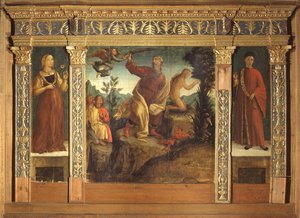
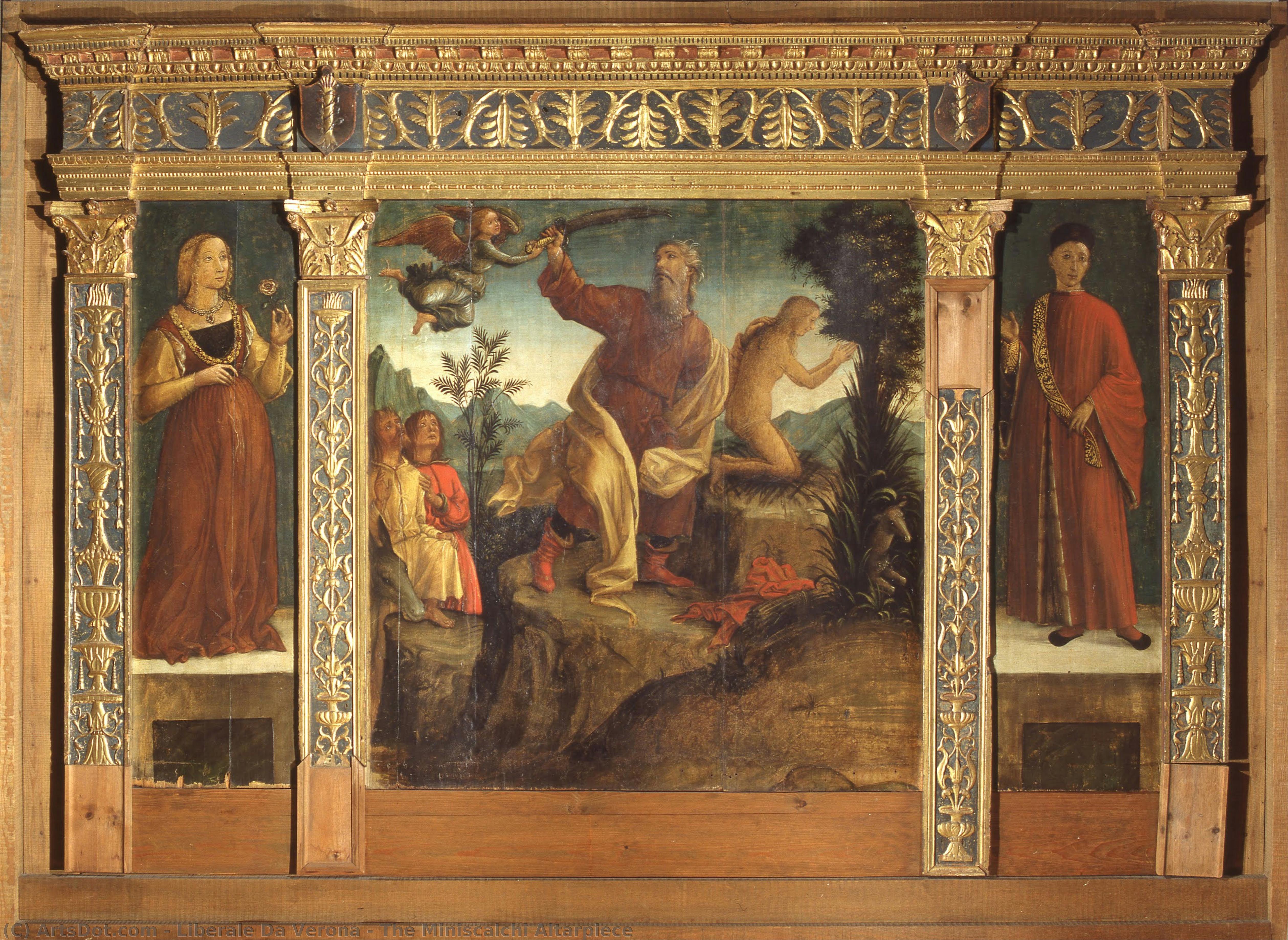
To stand before this magnificent panel is to step directly into the heart of the Italian High Renaissance, a period where piety met unparalleled artistic genius. The Miniscalchi Altarpiece, executed around 1520 by Liberale da Verona, is far more than a mere devotional object; it is a complex narrative tapestry woven from sacred drama and earthly portraiture. Its structure itself speaks to its function—a monumental piece designed to anchor the visual focus of a chapel or private altar. The central compartment, depicting the profound moment of the Sacrifice of Isaac (Genesis, 22), immediately draws the eye into the gravity of divine will confronting human obedience.
Mastery in Composition and Portraiture
What elevates this work beyond standard religious iconography is Verona’s groundbreaking inclusion of full-length donor portraits. On either side of the central sacred narrative stand the Miniscalchi family members—a noblewoman and a gentleman. These figures are not relegated to the periphery as mere witnesses; they possess an almost equal stature, standing with a naturalism that was revolutionary for its time. Liberale da Verona captures them looking outward, yet simultaneously directing the viewer's gaze inward toward Abraham’s plight. The subtle gesture of the gentleman pointing, and the woman holding a delicate rose, transforms the piece from a static tableau into an active conversation spanning centuries.
Symbolism Woven in Gold and Flesh
The symbolism here is rich and multi-layered. The classical derivation of the frame, with its pillars adorned by candelabra, speaks to the era's embrace of antique ideals alongside Christian doctrine. The inclusion of the family coats of arms serves as a tangible record of patronage—a powerful statement of piety and status for the Miniscalchi lineage. Symbolically, the donors’ direct engagement with the viewer suggests that their devotion was meant to be an active participation in the sacred drama unfolding before them. It is a visual contract between the earthly patrons and the divine narrative.
Technique and Enduring Allure
The technique employed showcases Liberale da Verona's sophisticated handling of paint on panel, blending the rigorous draftsmanship reminiscent of Andrea Mantegna with the luminous colorism associated with Jacopo Bellini. The interplay between the deep shadows defining the figures’ drapery and the brilliant accents of gold suggests an almost palpable texture to the materials—the richness of velvet, the gleam of metal, the softness of skin. For those who appreciate art that speaks across time, this piece offers a masterclass in Renaissance illusionism, making the sacred feel immediate and intensely personal.
Related Artworks
Artist Biography
Liberale da Verona: A Renaissance Master
Life and Origins
- Born in Verona, Italy, around 1441, Liberale da Verona was a prominent painter of the Italian Renaissance.
- He passed away in 1529, leaving behind a legacy of exquisite frescoes, panel paintings, and illuminated manuscripts.
- Early Training: Liberale began his artistic journey as a pupil of Vincenzo di Stefano, laying the foundation for his future style.
Influences and Artistic Development
- While trained by di Stefano, Liberale was profoundly influenced by the works of Andrea Mantegna and Jacopo Bellini. This influence is evident in his attention to detail, perspective, and dramatic compositions.
- Giorgio Vasari’s Account: He is notably mentioned in Giorgio Vasari's *Lives of the Most Excellent Painters, Sculptors, and Architects*, solidifying his place within the canon of Renaissance artists.
- His style evolved to incorporate elements of both Mantegna’s rigorous draftsmanship and Bellini’s refined color palettes.
Major Works and Achievements
- Veronese Commissions: In Verona, Liberale completed significant commissions such as the *Adoration of the Magi* in the Duomo (Cathedral) and another version for a chapel within the Bishopric.
- He also decorated the chapel of the Company of the Maddalena in the church of San Bernardino with paintings depicting the *Birth and Assumption of the Virgin*.
- Brera Gallery: A notable work, *St. Stephen*, is housed in the Brera Gallery, showcasing his skill in portraying religious figures.
- Illuminated Manuscripts: Liberale’s talent extended to illuminated books, with examples found in the Cathedral of Chiusi.
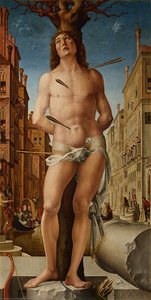
- *St. Sebastian* (attributed) at Princeton University Art Museum demonstrates his mastery of anatomical detail and emotional expression.
- Monte Oliveto Abbey: He traveled to Siena to work at the Abbey of Monte Oliveto, where he illuminated numerous manuscripts.
Pupils and Legacy
- Liberale da Verona played a crucial role in training the next generation of Veronese painters.
- Notable Students: Among his pupils were Giovanni and Giovanni Francesco Caroto, Francesco Torbido (also known as Il Moro), and Paolo Cavazzola. These artists continued to develop and disseminate his artistic principles.
Historical Significance
- Renaissance Contribution: Liberale da Verona contributed significantly to the flourishing of Renaissance art in Verona, bridging the gap between earlier styles and the emerging Mannerism.
- Cultural Impact: His works continue to be studied and admired for their technical skill, expressive power, and historical importance. He even appeared as a subject of forgery within popular culture – specifically, in an episode of the British TV series *Inspector Morse* titled “The Death of the Self.”
- His art provides valuable insights into the religious, cultural, and artistic climate of 15th and 16th-century Italy.
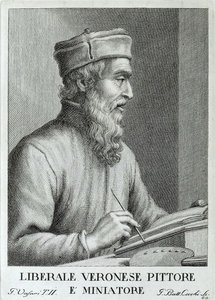
Liberale da Verona
1441 - 1529 , Italy
Quick Facts
- Birth Date: 1441
- Birth Place: Verona, Italy
- Death Date: 1529
- Influenced:
- Giovanni Caroto
- Giovanni Francesco Caroto
- Francesco Torbido
- Paolo Cavazzola
- Influenced By:
- Andrea Mantegna
- Jacopo Bellini
- Vincenzo di Stefano
- Movement: Renaissance
- Name: Liberale da Verona
- Nationality: Italian
- Notable Works:
- Adoration of the Magi
- St. Sebastian
- The Miniscalchi Altarpiece
Related Articles
Paolo Veronese: A Renaissance Master of Color, Composition, and Venetian Splendor
Explore the vibrant world of Paolo Veronese, a Renaissance master renowned for his opulent compositions, masterful use of color, and dramatic Venetian scenes. Discover key artworks & legacy.
Oil on Panel: A Historical Survey of Technique, Support & Aesthetic Evolution
Explore the rich history of oil on panel painting! Discover Renaissance techniques, support structures & aesthetic evolution. Expert insights for art collectors and enthusiasts.
Oil on Panel: A Historical Survey of Technique, Support, and Aesthetic Impact
Explore the rich history of oil on panel painting! Discover Renaissance techniques, support construction, & the enduring legacy of this masterful art form. Expert insights for collectors and enthusiasts.

Fra Angelico's Masterpieces: 25 Renaissance Paintings for Your Home | ArtsDot
Explore 25 breathtaking masterpieces by Fra Angelico, a Renaissance master. Discover the stories behind his iconic frescoes, Annunciations & religious art. Find museum-quality reproductions and elevate your home decor with ArtsDot.com.
Tempera's Timeless Legacy: 10 Masterpieces That Revolutionized Art | ArtsDot
Journey through 10 legendary tempera on panel masterpieces by Giotto, Duccio & Botticelli. Explore the history, symbolism & enduring beauty of these iconic artworks. Find museum-quality reproductions for your home at ArtsDot.com.