 Preview
 Send
Send Share
Share
 Details

 Download
 Similars
 X-Ray
X-Ray Diaporama
Mr Barton
 Drawing
- WallArt
- Satirical Illustration
 1900
1900 38.0 x 27.0 cm
 National Portrait Gallery
 Read More
Hand Made Oil Reproduction
Hand-painted oil on canvas in your size and frame, made to order by our artists. ( Buy Print Buy Image)




P118B $10

P118H $10

P118W $10

P438Z $10

P508JH $12

P508YH $12

P805H $10

P805Z $10

P919BZ $10

P919G $10

P919XJ $10

P959ZH $10

P968JZ $12

W106C $8

W218G $10

W218JH $8

W218Y $10

W307PJ $10

W316G $10

W316PJ $8

W316Y $10

W398PJ $8

W4111J $10

W500HY $15

W500JH $15

W692G $12

W849H $8

W940BG $15

W953PJ $8




Pick from our preset sizes that match the artwork's original proportions.

You may enter your own dimensions to fit a specific frame or space. If your selected size does not match the original image's proportions, we will either crop the artwork or extend the painting with additional hand-painted elements. A digital mockup will be sent for your approval before production begins.
Please note that the on-screen preview does not reflect the actual cropping or extension. Only the mockup will accurately show the final composition.
While custom sizes are available, we recommend selecting a dimension from the predefined list to preserve the original proportions.
After order, ArtsDot.com team will email client for instructions and provide a mockup preview
Worldwide Delivery () in 3/4 weeks instead of standard 5 weeks. (17 August). No compromise on quality.

Free Worldwide Express Shipping

High-Quality Linen Canvas

Full Shipping Insurance

Customs Tax Refund Guarantee

True Color Matching Guarantee

60-Day Return Policy (Defects Only)

100% Money-Back Guarantee

Bulk Discount Offer
 Glass option is only available in size under 110 CM

Mr Barton
Reproduction Medium
Reproduction Size
-


Total Price
$ 288
Artwork Description
Mr Barton: A Caricature of Social Satire by Livingston Hopkins
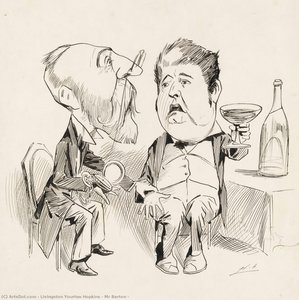
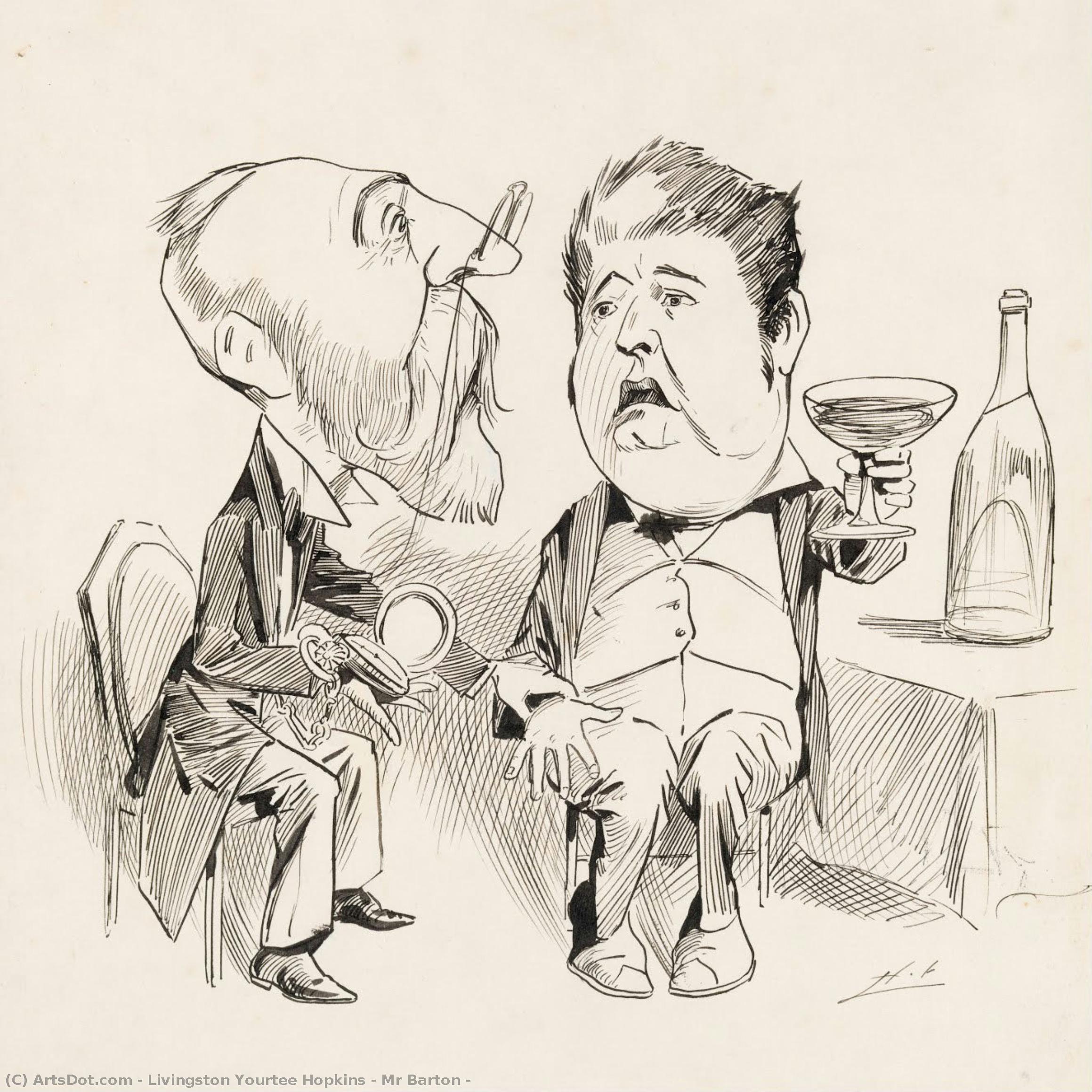
“Mr. Barton,” a meticulously rendered black and white drawing from 1900 by Livingston Hopkins, offers a captivating glimpse into the world of late 19th-century social commentary through the lens of caricature. Measuring 38 x 27 cm, this artwork transcends mere portraiture; it’s a carefully constructed piece brimming with subtle humor and a keen observation of human behavior. Hopkins, a prolific artist who spent much of his career at The Bulletin in Australia, masterfully employs hatching and cross-hatching to build depth and texture, creating an image that feels both immediate and intensely detailed.
- Subject Matter: The scene depicts two men seated around a table, enjoying wine – a common motif of convivial relaxation. However, the relaxed posture and exaggerated features immediately signal a satirical intent.
- Style & Technique: Hopkins’s style is firmly rooted in the tradition of caricature, characterized by deliberate distortions of form to emphasize personality and create humor. The extensive use of hatching and cross-hatching isn't simply about shading; it’s a fundamental element of the artwork’s expressive power, allowing him to control tonal values with remarkable precision.
- Historical Context: Created during a period of rapid social change in Australia, this drawing reflects the burgeoning spirit of satire prevalent in publications like The Bulletin, which often challenged Victorian sensibilities through witty and pointed illustrations. Hopkins's work aligns with late 19th-century illustration styles, showcasing a sophisticated understanding of visual storytelling.
Decoding the Lines: An Examination of Hopkins’s Technique
Hopkins’s technical prowess is immediately apparent in the drawing’s execution. The artist meticulously builds up tonal values through layers of hatching and cross-hatching, creating a remarkably rich surface texture. Notice how the denser lines define the contours of the men's faces and clothing, while lighter areas suggest smoother surfaces like the table top. This technique isn’t just about realism; it’s about controlling the viewer’s perception of depth and form. The deliberate use of bold, sweeping lines further amplifies the caricatured effect, exaggerating proportions and expressions with a playful disregard for anatomical accuracy.
- Hatching & Cross-hatching: These techniques are central to Hopkins's style, allowing him to create a wide range of tones and textures.
- Linear Emphasis: The artwork’s strength lies in its precise linework, which contributes significantly to the overall expressive quality.
Symbolism and Emotional Resonance
"Mr. Barton" is more than just a humorous depiction; it subtly explores themes of social interaction, perhaps even hinting at underlying tensions or absurdities within the seemingly relaxed setting. The presence of wine – a symbol of celebration and conviviality – juxtaposed with the men’s expressions creates an intriguing ambiguity. Is this a genuine moment of camaraderie, or is there a layer of veiled critique beneath the surface? Hopkins skillfully uses these visual cues to evoke a sense of amusement and gentle mockery, inviting viewers to engage in their own interpretations.
- Conviviality & Critique: The artwork balances the pleasures of social gathering with subtle hints of satire.
- Ambiguity: Hopkins leaves room for interpretation, encouraging viewers to consider the underlying emotions and potential critiques within the scene.
A Collector’s Perspective
This hand-painted reproduction offers a unique opportunity to own a piece of art history – a testament to Livingston Hopkins's skill as a caricaturist and social observer. “Mr. Barton” is an ideal addition to any collection, bringing a touch of Victorian wit and artistic mastery into your home or office. Its timeless appeal ensures that it will remain a captivating conversation starter for years to come. Consider this artwork not just as a depiction, but as a window into a bygone era, skillfully rendered with meticulous detail and infused with the spirit of satirical illustration.
Related Artworks
Artist Biography
Early Life and American Career
- Born: July 7, 1846, Bellefontaine, Ohio, USA
- Died: August 21, 1927, Mosman, New South Wales, Australia
- Parents: Daniel Hopkins and Sarah (née Carter)
- Early life was spent on a farm in Ohio. His family had Puritan roots and migrated from the New England region.
- He briefly served in the 130th Ohio Volunteer Regiment during the American Civil War.
- From 1870 to 1882, Hopkins worked as a freelance cartoonist and illustrator in New York City.
- He contributed to various periodicals and specialty publications.
- Notable work included *A Comic History of the United States* (1876), which received mixed reception.
Move to Australia and Career with The Bulletin
- In 1882, William Traill from The Bulletin in Sydney invited Hopkins to join their staff.
- He relocated to Sydney with his family in February 1883.
- Hopkins became a central figure at The Bulletin for over thirty years.
- He worked under the pseudonym "Hop" and produced thousands of cartoons.
- His work satirized political figures, social issues, and events like the Sudan War and the Federation movement.
- He established Sydney’s first artists' camp at Balmoral, attracting prominent Australian artists.
- Became a part-owner of The Bulletin.
Artistic Style and Influences
- Style: Cartoonist and caricaturist with a focus on political satire and humorous commentary.
- His draftsmanship was considered less refined than that of Phil May, another prominent cartoonist at The Bulletin.
- Despite this, his work was immensely popular due to its accessible humor and relatable observations.
- Influences likely included contemporary American cartoonists and illustrators of the period.
- His cartoons often featured symbolic figures and allegorical animals, contributing to a broader cultural understanding of political issues.
Major Achievements and Historical Significance
- Prolific Output: Produced over 19,000 drawings throughout his career, primarily for The Bulletin.
- Cultural Impact: His cartoons played a significant role in shaping public opinion during the lead-up to Federation of Australia.
- Popularity with Readers: He was consistently the most popular cartoonist at The Bulletin, contributing significantly to its success and influence.
- Establishment of Artists' Camp: His creation of the Balmoral artists’ camp fostered a vibrant artistic community in Sydney.
- Contribution to Australian Cartooning: Hopkins is considered a key figure in the development of Australian cartooning and political satire.
Later Life and Legacy
- Retired from full-time work at The Bulletin in 1913, though he continued occasional contributions until 1921.
- Pursued hobbies including violin making, whittling, and gardening.
- Died on August 21, 1927, in Mosman, New South Wales.
- His work remains a valuable historical record of late 19th and early 20th century Australia, offering insights into the political climate and social attitudes of the time.

livingston yourtee hopkins
1846 - 1927 , United States of America
Quick Facts
- Artistic Movement Or Style: Cartoonist and caricaturist
- Date Of Birth: July 7, 1846
- Date Of Death: August 21, 1927
- Full Name: Livingston Yourtee Hopkins
- Nationality: American/Australian
- Notable Artworks:
- A Comic History of United States
- The Bulletin cartoons
- Place Of Birth: Bellefontaine, USA
Related Articles

White on Canvas: 10 Masterpieces & Timeless Elegance for Your Home Decor
Explore 10 iconic white paintings by Monet, Whistler & Rothko! Discover the stories behind these serene masterpieces and their impact on art history. Find museum-quality reproductions for your home decor at .

Dark Masterpieces: 10 Iconic Paintings Dominated by Black Tones |
Explore 10 iconic paintings dominated by black tones, from Rembrandt’s chiaroscuro to Goya's dark expressions. Discover the stories behind these masterpieces & find museum-quality art reproductions for your home at .

Giclée Prints: Archival Quality & Aesthetic Nuances for the Discerning Collector
Explore the world of giclée prints with ArtsDot. Learn about archival quality, aesthetic nuances & investment potential. Expert guidance for discerning art collectors seeking museum-quality reproductions and lasting value.

Monochrome Visions: Exploring the Aesthetic & Historical Significance of Black & White Photography
Explore the rich history & artistic power of black and white photography. From early techniques to iconic masters like Ansel Adams, discover why monochrome continues to captivate art lovers today. Expert insights for collectors.

The Enduring Legacy of Fine Art Prints: Technique, History & Aesthetic Impact
Explore the rich history & techniques of fine art prints. Discover investment potential, assess authenticity, and learn how to preserve your collection with expert guidance. Trusted insights for discerning collectors.