 Preview
 Send
Send Share
Share
 Details

 Download
 Similars
 X-Ray
X-Ray Diaporama
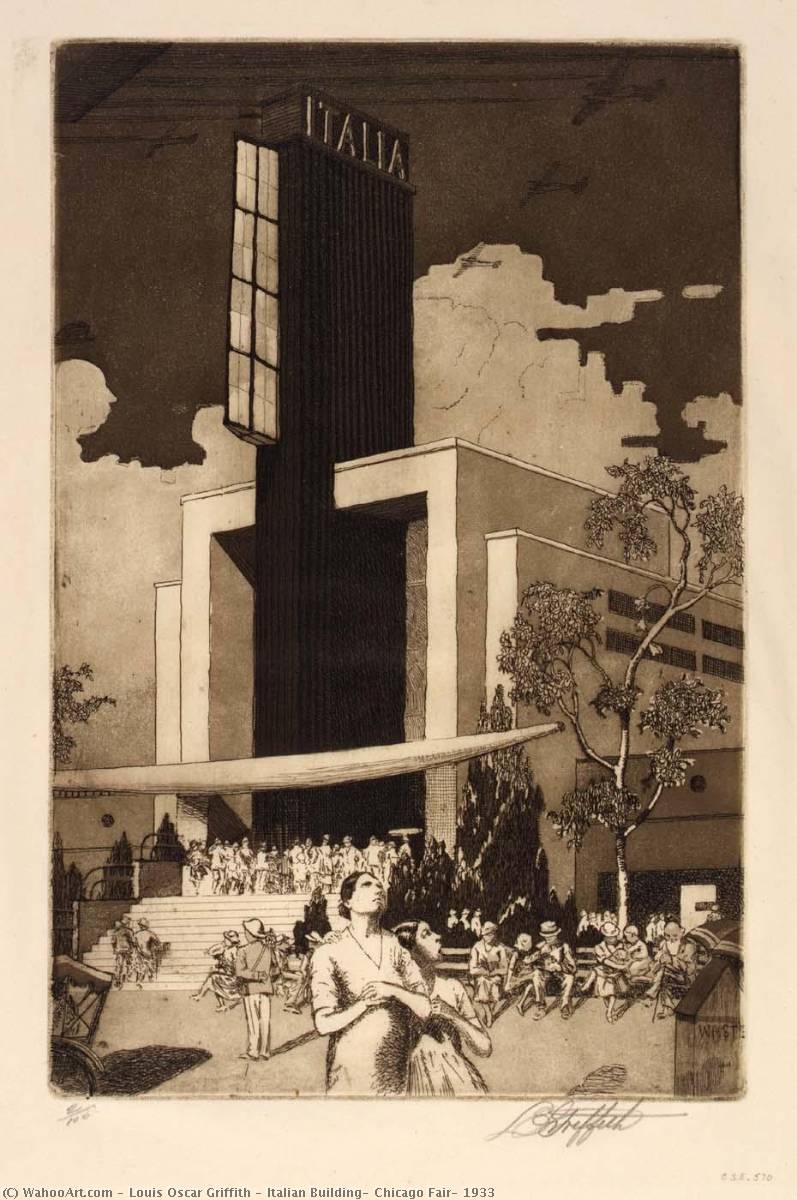
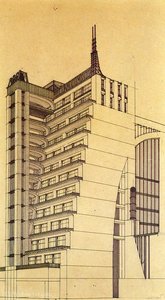
Italian Building, Chicago Fair, 1933

 Read More
Hand Made Oil Reproduction
Hand-painted oil on canvas in your size and frame, made to order by our artists. ( Buy Print Buy Image)




































Pick from our preset sizes that match the artwork's original proportions.

You may enter your own dimensions to fit a specific frame or space. If your selected size does not match the original image's proportions, we will either crop the artwork or extend the painting with additional hand-painted elements. A digital mockup will be sent for your approval before production begins.
Please note that the on-screen preview does not reflect the actual cropping or extension. Only the mockup will accurately show the final composition.
While custom sizes are available, we recommend selecting a dimension from the predefined list to preserve the original proportions.
After order, ArtsDot.com team will email client for instructions and provide a mockup preview
Worldwide Delivery () in 3/4 weeks instead of standard 5 weeks. (27 August). No compromise on quality.

Free Worldwide Express Shipping

High-Quality Linen Canvas

Full Shipping Insurance

Customs Tax Refund Guarantee

True Color Matching Guarantee

60-Day Return Policy (Defects Only)

100% Money-Back Guarantee

Bulk Discount Offer
 Glass option is only available in size under 110 CM

Italian Building, Chicago Fair, 1933
Reproduction Medium
Reproduction Size
-


Total Price
$ 263
Related Artworks









Artist Biography
The Soul of the American Landscape: The Life of Louis Oscar Griffith
To wander through the works of Louis Oscar Griffith is to embark on a journey through the very heart of the American wilderness, where the light of the Midwest meets the rugged spirit of the Texas plains. Born in 1875 in Newcastle, Indiana, Griffith’s life was a tapestry woven from the diverse textures of the American landscape. His early years were steeped in the quiet beauty of rural Indiana, but it was his move to Dallas, Texas, as a young boy that would profoundly shape his artistic eye. In the sun-drenched expanses of the Texas Hill Country, he encountered the legendary Frank Reaugh, an artist who championed the plein air tradition. Under Reaugh’s mentorship, Griffith learned not merely to paint what he saw, but to feel the atmospheric shifts and the raw, unyielding vitality of nature, a skill that would become the cornerstone of his celebrated career.
Griffith’s artistic evolution was marked by a remarkable ability to blend technical precision with emotional resonance. After honing his craft at the St. Louis School of Fine Arts and later navigating the bustling commercial art world of Chicago, he emerged as a master of multiple mediums. Whether working in the delicate, monochromatic intricacies of etchings and aquatints or the rich, luminous layers of oil painting, Griffith possessed an uncanny ability to capture the subtle nuances of light and shadow. His time as a commercial illustrator for the Barnes Crosby Engraving Company provided him with a disciplined eye for detail, allowing him to translate the grandeur of the natural world into works that felt both intimately observed and epic in scale.
A Legacy Written in Light and Earth
The true magic of Griffith’s oeuvre lies in his profound connection to specific geographies, most notably the wooded hills of Brown County, Indiana. This region became a sanctuary for his creativity, inspiring a vast collection of works that celebrate the serene waterways and dense, seasonal forests of his homeland. His depictions of Brown County are far more than mere topographical records; they are poetic meditations on the passage of time and the enduring spirit of the land. Through meticulous cross-hatching in his prints and a sensitive touch with his brush, he captured the way morning mist clings to a valley or how the autumn sun filters through a canopy of changing leaves.
Beyond the forests of Indiana, Griffith’s artistic identity remained forever tethered to the rugged landscapes of Texas. His ability to oscillate between the lush, verdant textures of the Midwest and the stark, dramatic vistas of the West demonstrates a versatility that few of his contemporaries could claim. This duality allowed him to become a pivotal figure in American landscape painting, bridging different regional aesthetics through a unified vision of natural beauty. His achievements were not merely measured in completed canvases, but in his ability to foster a sense of shared heritage through the Palette & Chisel Club and other artistic communities, ensuring that the tradition of observing nature firsthand would endure for generations.
Today, the significance of Louis Oscar Griffith resides in his role as a visual chronicler of an era. His works serve as windows into a vanishing American landscape, preserved through a technique that honors both the scientific accuracy of light and the romanticism of the wild. To study his life is to understand the profound impact that a deep, lifelong devotion to one's environment can have on the creation of enduring art.
louis oscar griffith
1875 - 1956
Quick Facts
- Artistic Movement Or Style: Landscape Painting
- Artists Or Movements Influenced By This Artist: Hugh Griffith
- Artists Who Influenced This Artist: Frank Reaugh
- Date Of Birth: 1875
- Date Of Death: 1956
- Full Name: Louis Oscar Griffith
- Nationality: American
- Notable Artworks:
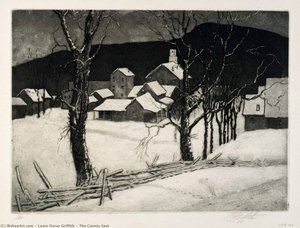
- The County Seat
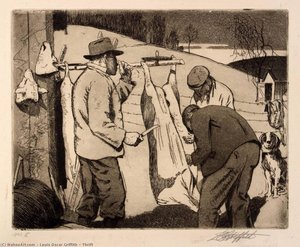
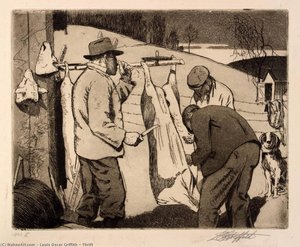
- Thrift
- Italian Building, Chicago Fair, 1933
- Place Of Birth: Newcastle, Indiana