 Preview
 Send
Send Share
Share
 Details

 Download
 Similars
 X-Ray
X-Ray Diaporama
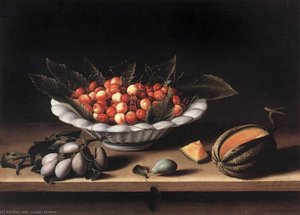
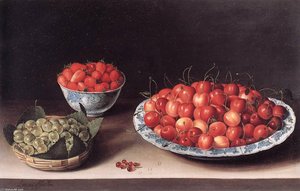
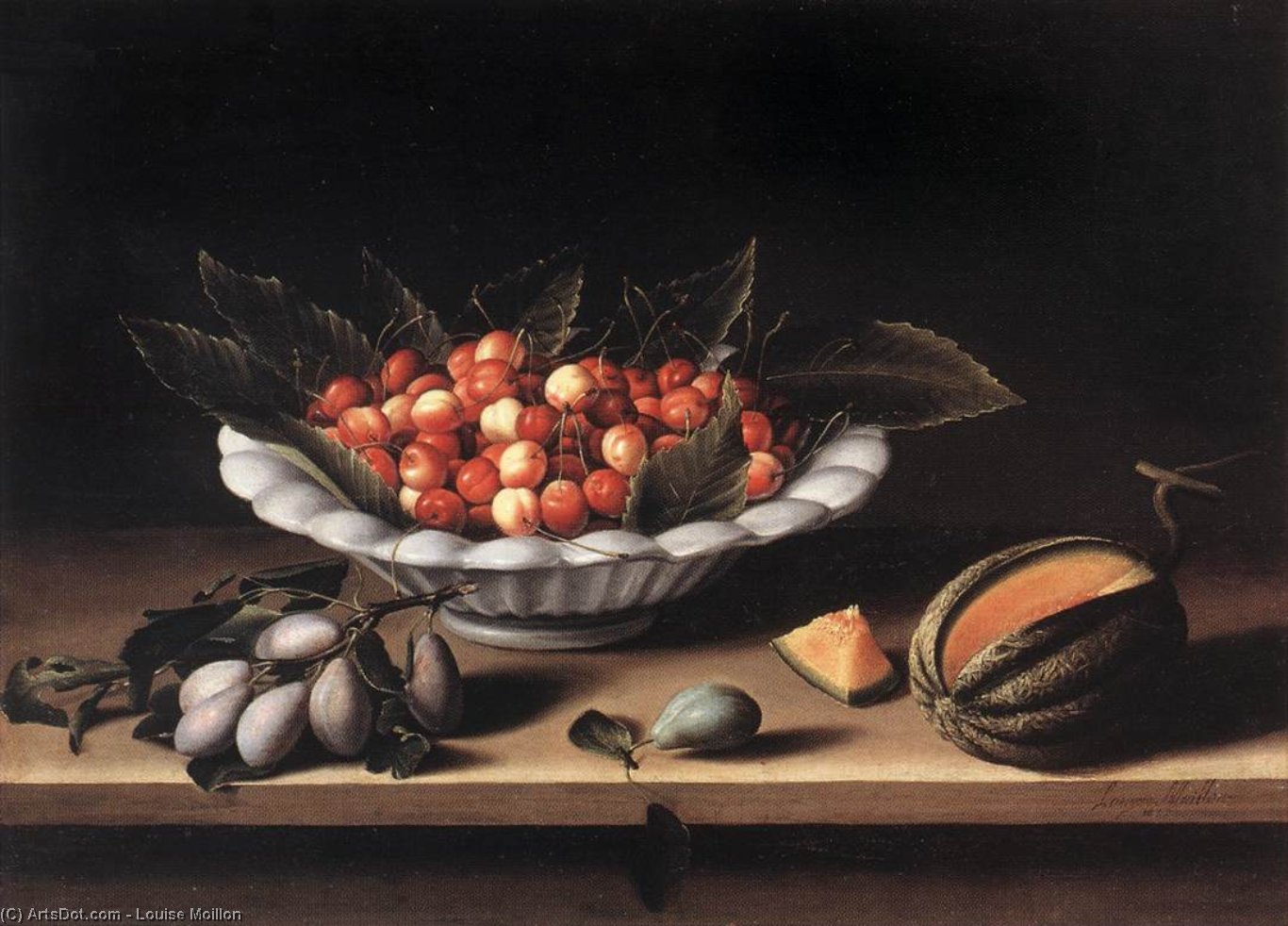
Cup of Cherries and Melon
 Oil On Canvas
- WallArt
- Baroque Still Life
 1633
1633- Early Modern
 48.0 x 65.0 cm
 The Louvre
 Read More
Hand Made Oil Reproduction
Hand-painted oil on canvas in your size and frame, made to order by our artists. ( Buy Print Buy Image)




P118B $10

P118H $10

P118W $10

P438Z $10

P508JH $12

P508YH $12

P805H $10

P805Z $10

P919BZ $10

P919G $10

P919XJ $10

P959ZH $10

P968JZ $12

W106C $8

W218G $10

W218JH $8

W218Y $10

W307PJ $10

W316G $10

W316PJ $8

W316Y $10

W398PJ $8

W4111J $10

W500HY $15

W500JH $15

W692G $12

W849H $8

W940BG $15

W953PJ $8




Pick from our preset sizes that match the artwork's original proportions.

You may enter your own dimensions to fit a specific frame or space. If your selected size does not match the original image's proportions, we will either crop the artwork or extend the painting with additional hand-painted elements. A digital mockup will be sent for your approval before production begins.
Please note that the on-screen preview does not reflect the actual cropping or extension. Only the mockup will accurately show the final composition.
While custom sizes are available, we recommend selecting a dimension from the predefined list to preserve the original proportions.
After order, ArtsDot.com team will email client for instructions and provide a mockup preview
Worldwide Delivery () in 3/4 weeks instead of standard 5 weeks. (30 August). No compromise on quality.

Free Worldwide Express Shipping

High-Quality Linen Canvas

Full Shipping Insurance

Customs Tax Refund Guarantee

True Color Matching Guarantee

60-Day Return Policy (Defects Only)

100% Money-Back Guarantee

Bulk Discount Offer
 Glass option is only available in size under 110 CM

Cup of Cherries and Melon
Reproduction Medium
Reproduction Size
-


Total Price
$ 263
A Symphony of Stillness: The Luminous World of Louise Moillon
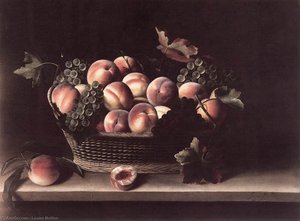
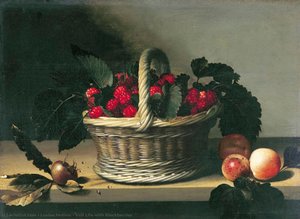
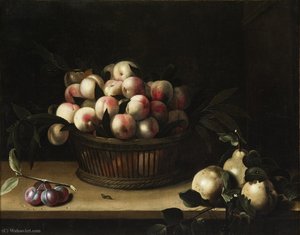
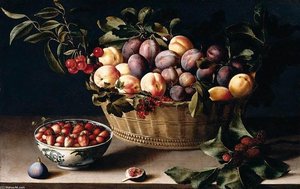
In the grand, sweeping narratives of the Baroque era, where drama and movement often dominate the canvas with thunderous intensity, Louise Moillon’s “Cup of Cherries and Melon” offers a profound and meditative alternative. Completed in 1633, this masterpiece serves as a quiet sanctuary of color and form. At first glance, the composition appears to be a simple arrangement of nature's bounty: a pristine white bowl overflowing with ruby-red cherries, nestled among the pale, textured flesh of a melon and scattered plums. Yet, beneath this unassuming surface lies a sophisticated dialogue between light and shadow that captures the very essence of 17th-century French elegance.
The painting is a masterclass in the Baroque technique of chiaroscuro, though Moillon employs it with a delicacy that avoids the heavy shadows of her contemporaries. Instead, she uses light to sculpt the fruit, giving each cherry a jewel-like translucency and the melon a palpable, succulent weight. Through the meticulous application of oil glazes—thin, translucent layers of pigment—she achieves a breathtaking luminosity. This painstaking process allows the viewer to almost sense the velvety sheen of the skins and the cool moisture of the fruit, creating an illusion of depth that invites the eye to linger on every meticulously rendered leaf and droplet.
Heritage, Symbolism, and the Art of Observation
Moillon’s artistic vision was deeply rooted in her unique cultural lineage. Born into a family of Huguenot refugees in Paris, she was immersed in a tradition that valued the meticulous observation of the natural world—a hallmark of the Dutch masters like Rembrandt and Frans Hals. This influence is visible in her trompe l'oeil effects, where the boundaries between the painted surface and reality begin to blur. While her technique draws from the Flemish tradition of hyper-realism, the soul of the work remains characteristically French: poised, balanced, and exquisitely refined.
Beyond its visual splendor, the painting carries a weight of symbolic meaning common to the 17th century. In the language of still life, the abundance of ripe fruit often served as a memento mori—a gentle reminder of the fleeting nature of life and the transient beauty of earthly pleasures. The sweetness of the cherries and the ripeness of the melon represent the peak of vitality, yet their very perfection hints at the inevitable passage of time. For the modern collector or interior designer, this duality offers a profound emotional resonance; it is a piece that celebrates the joy of the present moment while maintaining a sophisticated, contemplative grace.
An Enduring Inspiration for the Modern Interior
For those seeking to infuse a contemporary space with historical depth and quiet luxury, “Cup of Cherries and Melon” provides unparalleled inspiration. Its palette—a harmonious blend of deep reds, soft creams, and earthy tones—possesses a versatile elegance that complements both classical and modern decor. A high-quality reproduction of this work does more than merely decorate a wall; it introduces a focal point of stillness and intellectual curiosity into a room.
Whether placed in a sunlit breakfast nook to evoke the freshness of a summer morning or anchored in a formal study to provide a sense of timeless stability, Moillon’s work acts as a window into a more deliberate era. It is an invitation to slow down, to observe the intricate details of the world around us, and to appreciate the quiet brilliance found in the simplest of natural forms.
Related Artworks




Artist Biography
The Quiet Brilliance of Louise Moillon
In the grand, sweeping narratives of the Baroque era, where drama and movement often dominate the canvas, the work of Louise Moillon offers a profound and meditative alternative. Born in Paris in 1610, Moillon emerged from a world shaped by the intense religious and cultural shifts of 17th-century France. Her very lineage tells a story of resilience and artistic heritage; as a descendant of Huguenot refugees from Holland, she was immersed in a tradition that valued the meticulous observation of the natural world. This background provided more than just a family history—it offered a stylistic vocabulary rooted in the Dutch mastery of light, texture, and symbolic realism.
Moillon’s early life was marked by both loss and profound artistic mentorship. The death of her father, the landscape painter and dealer Nicolas Moillon, when she was only ten, could have altered her path, yet her upbringing remained deeply embedded in the arts. Under the guidance of her stepfather, François Garnier, a skilled artist and dealer, she refined a technique that would become her hallmark. Her education was not merely about the application of pigment to canvas, but an immersion into the humanist values of her time, learning to see the divine within the minute details of a ripening fruit or the delicate curve of a petal.
A Mastery of Texture and Light
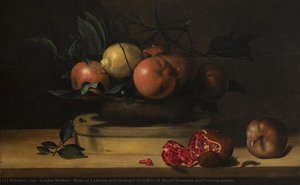
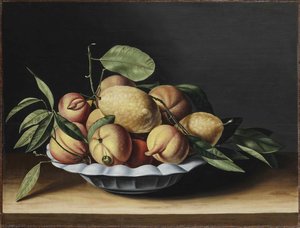
The true genius of Moillon lies in her ability to transform the mundane into the extraordinary. Her compositions are characterized by a serene stillness, a quietude that invites the viewer to linger and observe. She possessed an almost supernatural ability to capture the tactile qualities of her subjects—the waxy skin of a citron, the soft fuzz of a peach, or the translucent juice of a crushed berry. In works such as Still Life of Citrons and Curaçao Oranges in a White Polylobed Dish, one can sense the cool moisture of the fruit against the hard, glazed surface of the porcelain, creating a sensory experience that transcends the two-dimensional plane.
Her technique was deeply influenced by the naturalistic traditions of the Protestant circles in which she moved. This approach favored clarity and precision over the theatrical shadows of the more flamboyant Baroque masters. Instead, Moillon utilized light to sculpt her subjects, using subtle gradations of tone to create volume and depth. Her palette, while often focused on the vibrant hues of nature, was used with such restraint that each color felt luminous, as if lit from within. This mastery allowed her to bridge the gap between mere botanical illustration and high art, imbuing every piece with a sense of life and vitality.
Legacy and Historical Significance
Throughout her long life, which spanned nearly nine decades, Moillon achieved a level of renown that was rare for female artists of her era. Her ability to secure commissions from prestigious patrons, including members of the royal court, speaks to the undeniable quality and sophistication of her oeuvre. While her work often focused on the intimate scale of still life, its impact was expansive, contributing significantly to the development of the French still-life tradition.
The historical significance of Louise Moillon extends beyond her technical skill; she represents a vital link between the Dutch naturalistic tradition and the burgeoning French aesthetic of the 17th century. Her paintings serve as windows into a lost world of Parisian markets and private gardens, capturing a sense of abundance and ephemeral beauty. Today, her works remain cherished treasures in institutions such as the Louvre, standing as enduring testaments to a life dedicated to finding the extraordinary within the ordinary. Her legacy is found in every brushstroke that celebrates the quiet, breathtaking splendor of the natural world.
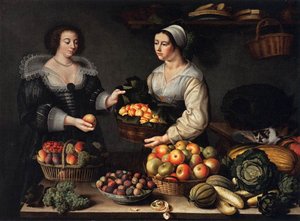
Louise Moillon
1610 - 1696 , France
Quick Facts
- Artistic Movement Or Style: Baroque Still Life
- Artists Or Movements Influenced By This Artist:
- Michelangelo
- Raphael
- Titian
- Artists Who Influenced This Artist:
- Isaac Moillon
- François Garnier
- Date Of Birth: Paris, France (1610)
- Date Of Death: 1696
- Full Name: Louise Moillon
- Nationality: French
- Notable Artworks:
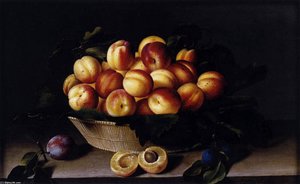
- Basket of Apricots
- COUPE DE CERISES, PRUNES ET MELON
- Basket of Peaches, with Quinces, and Plums
- Place Of Birth: Paris
Related Articles
The Bountiful Still Life: Symbolism & Artistic Representation of Fruit Across Art History
Explore the rich history of still life painting & the symbolism of fruit across art movements. Discover masterpieces from Caravaggio to Cézanne with ArtsDot – expert guidance & museum-quality reproductions.
Silent Narratives: Exploring the Enduring Appeal of Still Life Painting Across Centuries
Explore the rich history of still life painting with ArtsDot. Discover Dutch Masters, decode vanitas symbolism & learn about collecting timeless art. Expert insights and museum-quality reproductions.
The Enduring Appeal of Still Life: A Historical & Contemporary Exploration
Explore the rich history & symbolism of still life painting with ArtsDot. Discover masterpieces from the Dutch Golden Age, learn about vanitas art, and find expert guidance for collecting timeless artworks.

Baroque Masterpieces: 10 Paintings That Defined an Era |
Journey through the drama & grandeur of Baroque art! Explore 10 masterpieces by Caravaggio, Rembrandt, Rubens & more. Discover stunning oil paintings, rich colors & timeless stories. Find museum-quality reproductions at .

The Dramatic Flourish: Exploring the Baroque Movement's Enduring Legacy in Art History
Explore the dramatic world of Baroque art! Discover iconic artists like Caravaggio & Rubens, defining techniques, and its lasting impact on art history. Expert insights for collectors & enthusiasts at ArtsDot.