 Preview
 Send
Send Share
Share
 Details

 Download
 Similars
 X-Ray
X-Ray Diaporama
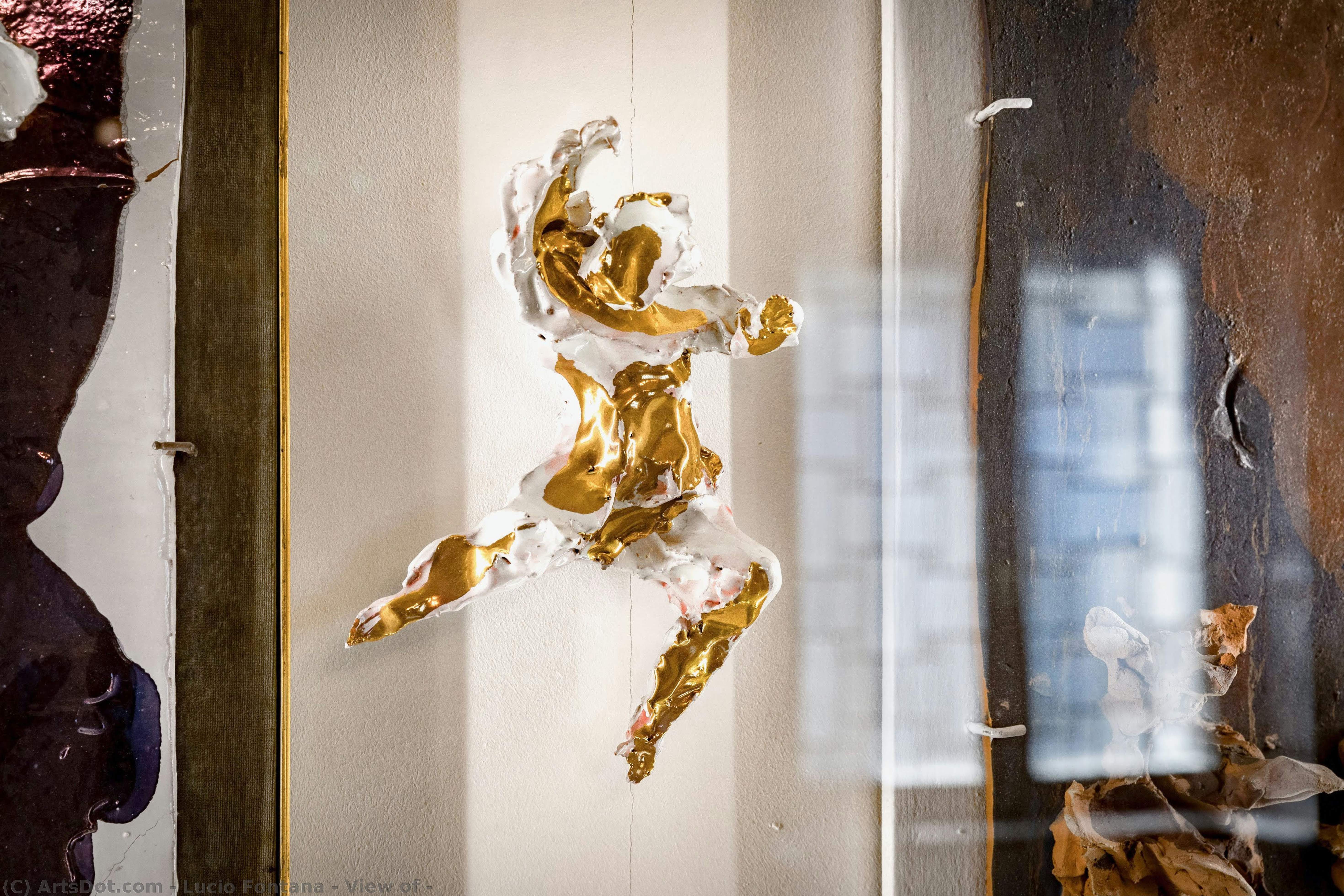
View of


 Read More
Giclée / Art Print
Museum-quality giclée or canvas print with fast production and flexible finish options. ( Buy Hand Made Painting Buy Image)




P118B $10

P118H $10

P118W $10

P438Z $10

P508JH $12

P508YH $12

P805H $10

P805Z $10

P919BZ $10

P919G $10

P919XJ $10

P959ZH $10

P968JZ $12

W106C $8

W218G $10

W218JH $8

W218Y $10

W307PJ $10

W316G $10

W316PJ $8

W316Y $10

W398PJ $8

W4111J $10

W500HY $15

W500JH $15

W692G $12

W849H $8

W940BG $15

W953PJ $8




Pick from our preset sizes that match the artwork's original proportions.

You may enter your own dimensions to fit a specific frame or space. If your selected size does not match the original image's proportions, we will either crop the artwork or extend the image with a mirrored or solid-fill edge. A digital mockup will be sent for your approval before production begins.
Please note that the on-screen preview does not reflect the actual cropping or extension. Only the mockup will accurately show the final composition.
While custom sizes are available, we recommend selecting a dimension from the predefined list to preserve the original proportions.
Worldwide Delivery () in 2 weeks instead of standard 4/5 weeks. (17 August)

Free Worldwide Express Shipping

High-Quality Linen Canvas

Full Shipping Insurance

Customs Tax Refund Guarantee

True Color Matching Guarantee

60-Day Return Policy (Defects Only)

100% Money-Back Guarantee

Bulk Discount Offer
 Glass option is only available in size under 110 CM

View of
Giclée / Art Print
Reproduction Size
-


Total Price
$ 63
Collectible Description
A Window into Spatialism: Examining Lucio Fontana’s “View”
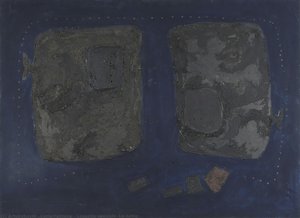
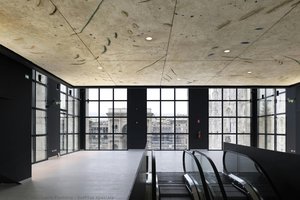
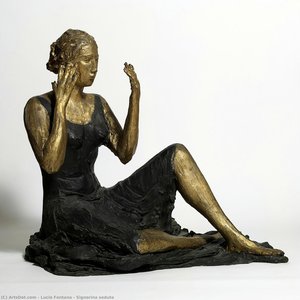
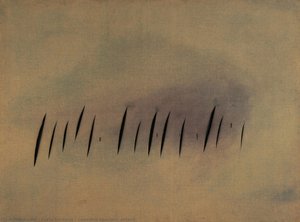
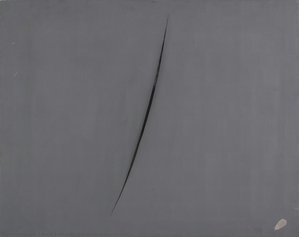
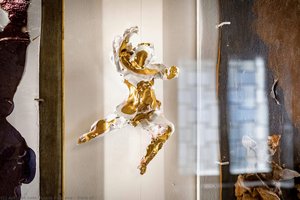
Fontana's "View," painted in 1956, represents a pivotal moment in the evolution of abstract art and embodies the core tenets of Spatialism—a movement that sought to liberate painting from representational constraints and explore the fundamental nature of space itself. The photograph captures a striking depiction of a man engaged in activity, possibly dancing or playing tennis, draped in opulent gold attire. This visual choice immediately draws attention, highlighting Fontana’s deliberate manipulation of color and texture to convey an emotional resonance beyond mere observation. Behind him hangs a clock – a symbol of time and progression—and a window framing a distant landscape, contributing to the painting's contemplative atmosphere. The inclusion of these elements isn’t accidental; Fontana aimed to disrupt traditional perspectives on composition and invite viewers into a dialogue with the artwork itself.- Style: Spatialism – Fontana’s work decisively abandons illusionistic representation, prioritizing instead the exploration of geometric forms and their relationship to space.
- Technique: Fontana employed a technique known as *bonta*, which involved perforating or incising the surface of his canvases with nails or other instruments. This groundbreaking method created visible punctures that disrupt the flatness of the canvas, transforming it into an open space—a conceptual gesture as much as a physical one.
- Historical Context: Spatialism emerged in Italy during the mid-1950s, reacting against the dominance of Surrealism and Expressionism. It was influenced by developments in mathematics and physics, particularly Einstein’s theory of relativity, which challenged Newtonian conceptions of space and time.
Symbolic Layers: Beyond Form and Color
The golden clothing worn by the figure is more than just a decorative element; it symbolizes aspiration and transcendence. Fontana deliberately chose gold to elevate the subject matter, suggesting an attempt to capture not simply physicality but also spiritual essence. The clock serves as a reminder of mortality and the passage of time—a counterpoint to the dynamism represented by the man’s movement. Simultaneously, the window represents openness and connection to the external world, inviting contemplation on themes of solitude and observation. Fontana's masterful use of visual cues communicates profound ideas about human experience and artistic ambition.Emotional Impact: Disrupting Perception
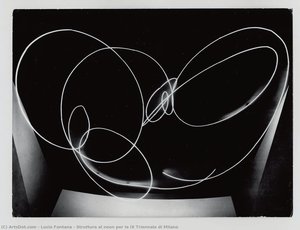
“View” isn’t merely a depiction; it’s an invitation to reconsider how we perceive reality. Fontana’s bold intervention in painting disrupts the viewer's accustomed gaze, forcing them to confront the materiality of the canvas and engage with its conceptual implications. The photograph itself underscores this effect—the stark black and white contrasts heighten the visual drama and emphasize the geometric precision of Fontana’s work. Ultimately, the painting evokes a feeling of wonder and intellectual curiosity, prompting viewers to contemplate the boundaries between art and thought.A Legacy of Innovation
Lucio Fontana's “View” stands as an enduring testament to his unwavering commitment to artistic experimentation. It solidified Spatialism’s position as one of the most influential movements in postwar art and continues to inspire artists today. Reproductions offer a remarkable opportunity to experience this seminal artwork firsthand, allowing collectors and interior designers alike to incorporate its distinctive aesthetic into their spaces—a celebration of form, color, and the transformative power of artistic vision.Related Artworks


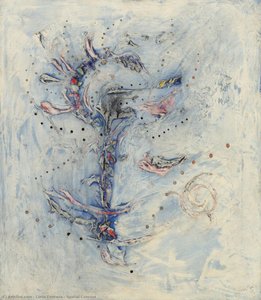
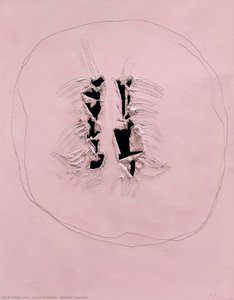
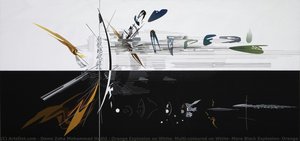
Artist Biography
A Life Forged in Spatialism
Lucio Fontana, a name synonymous with radical innovation in 20th-century art, was born into a world poised between tradition and modernity. His journey began not in Italy, the nation he would come to define within the artistic landscape, but in Rosario, Argentina, in 1899. The son of an Italian sculptor, Luigi Fontana, young Lucio inherited a craftsman’s sensibility alongside a burgeoning artistic vision. This early exposure to form and material proved foundational, even as his life became a series of geographical and stylistic explorations. Returning to Italy with his family, he absorbed the rich cultural heritage of Europe, studying at the Brera Academy in Milan and immersing himself in the avant-garde movements that were beginning to challenge established norms. However, the pull of his origins remained strong; multiple returns to Argentina punctuated his career, shaping his perspective and fueling a desire to transcend conventional artistic boundaries. Fontana’s early work reflected this duality – initially rooted in figurative sculpture and painting, it gradually evolved towards abstraction, hinting at the revolutionary path he was destined to forge.Breaking the Canvas: The Birth of Spatialism
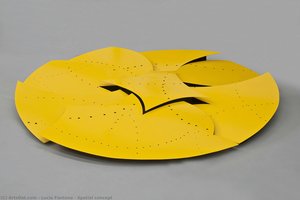
The devastation of World War II proved a catalyst for Fontana's most groundbreaking artistic endeavor. Witnessing the destruction and upheaval firsthand, he felt compelled to redefine art’s purpose in a world irrevocably altered. This led to the formulation of *Spatialism*, a movement that sought not merely to represent space but to incorporate it as an integral element of the artwork itself. Fontana believed traditional painting was limited by its two-dimensionality, confining art within a static plane. He envisioned a new form of expression that would break down these barriers, acknowledging the infinite depth and potential of space beyond the canvas. This wasn’t simply about creating illusions of depth; it was about physically opening up the artwork to reveal what lay *beyond*. Beginning in the late 1940s, Fontana began his now-iconic series of slashed and punctured canvases – the *Concetti Spaziali* (Spatial Concepts). These weren't acts of destruction but rather deliberate interventions, revealing a void that symbolized the vastness of the cosmos. The slashes, often executed with a razor blade, were precise and purposeful, transforming the canvas into a window onto another dimension. He wasn’t destroying the painting; he was liberating it from its limitations.Influences and Artistic Kinship
Fontana's artistic development wasn’t born in isolation. He engaged with a diverse range of influences, absorbing and transforming them into his unique visual language. The expressive power of Vincent van Gogh resonated deeply within him, particularly the emotional intensity conveyed through brushwork. He also admired the satirical edge of Pieter Bruegel the Elder, finding inspiration in the older master’s ability to critique societal flaws. However, a pivotal encounter with the work of Polish artist Jan Grzegorz Stanisławski proved particularly transformative. Stanisławski's exploration of light and color within his 'Mullein' series profoundly impacted Fontana’s approach to abstraction and spatial representation. Furthermore, his participation in groups like *Abstraction-Création* in Paris exposed him to a broader network of avant-garde artists, fostering an exchange of ideas that fueled his experimentation. While distinctively original, Fontana’s work also shares affinities with other post-war movements such as Zero and Nouveau Réalisme, all striving to redefine the boundaries of art and challenge conventional perceptions.Beyond the Slash: A Legacy of Dimensionality
While the slashed canvases remain his most recognizable achievement, Fontana's exploration of space extended beyond this singular technique. He created *hole paintings*, meticulously piercing the canvas to create actual openings that further emphasized spatial depth. He also ventured into sculpture, producing works that echoed the themes of volume and void found in his two-dimensional pieces. His *Soffitto Spaziale* (Spatial Ceiling) installations were particularly ambitious, transforming entire environments into immersive experiences designed to evoke a sense of infinite space. These large-scale creations enveloped viewers, blurring the lines between art and architecture, painting and sculpture. Fontana’s impact on subsequent generations of artists is undeniable. He paved the way for movements like Minimalism, encouraging a reductionist aesthetic focused on form and materiality. His emphasis on process and conceptual intent also anticipated aspects of Arte Povera, which embraced unconventional materials and challenged traditional notions of artistic value.A Lasting Resonance
Lucio Fontana’s death in Comabbio, Italy, in 1968, marked the end of a remarkable career but not the end of his influence. Today, his works are held in prestigious museum collections worldwide – from The Metropolitan Museum of Art to the Ballarat Fine Art Gallery in Australia – testament to his enduring legacy. He remains a pivotal figure in post-war abstract art, celebrated for his courage to challenge conventions and redefine the very essence of artistic expression. Fontana didn’t simply paint *on* canvas; he engaged with space itself, creating works that invite viewers to contemplate the infinite possibilities beyond the visible world. His legacy is not merely a collection of slashed canvases but a profound invitation to perceive reality in new and expansive ways. He demonstrated that art could be more than representation—it could be an exploration of existence itself.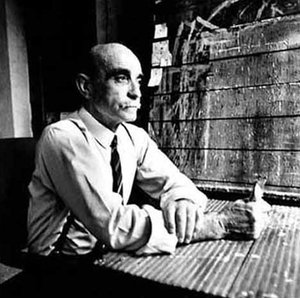
Lucio Fontana
1899 - 1968 , Argentina
Quick Facts
- Artistic Movement Or Style: Spatialism
- Artists Or Movements Influenced By This Artist:
- Zero
- Nouveau Réalisme
- Minimalism
- Artists Who Influenced This Artist:
- Jan Grzegorz Stanisławski
- Vincent van Gogh
- Pieter Bruegel the Elder
- Date Of Birth: 1899
- Date Of Death: 1968
- Full Name: Lucio Fontana
- Nationality: Argentine-Italian
- Notable Artworks:
- Concetto Spaziale, Attese
- Spatial Concept
- Soffitto Spaziale
- Place Of Birth: Rosario, Argentina
Related Articles

White on Canvas: 10 Masterpieces & Timeless Elegance for Your Home Decor
Explore 10 iconic white paintings by Monet, Whistler & Rothko! Discover the stories behind these serene masterpieces and their impact on art history. Find museum-quality reproductions for your home decor at .

Dark Masterpieces: 10 Iconic Paintings Dominated by Black Tones |
Explore 10 iconic paintings dominated by black tones, from Rembrandt’s chiaroscuro to Goya's dark expressions. Discover the stories behind these masterpieces & find museum-quality art reproductions for your home at .
The Subtleties of Shade: Exploring Black, White & Gray Abstraction in Modern Interior Design
Explore the power of black, white & gray abstraction in modern interior design. Discover how minimalist art impacts spatial perception & creates sophisticated hotel spaces. Expert insights for designers.

Monochrome Visions: Exploring the Aesthetic & Historical Significance of Black & White Photography
Explore the rich history & artistic power of black and white photography. From early techniques to iconic masters like Ansel Adams, discover why monochrome continues to captivate art lovers today. Expert insights for collectors.
The Subtleties of White: Exploring Absence, Light & Symbolism in Art History
Explore the profound symbolism & history of white in art! From ancient purity to modern abstraction, discover how artists have used absence & light. Expert insights from ArtsDot.