 Preview
 Send
Send Share
Share
 Details

 Download
 Similars
 X-Ray
X-Ray Diaporama
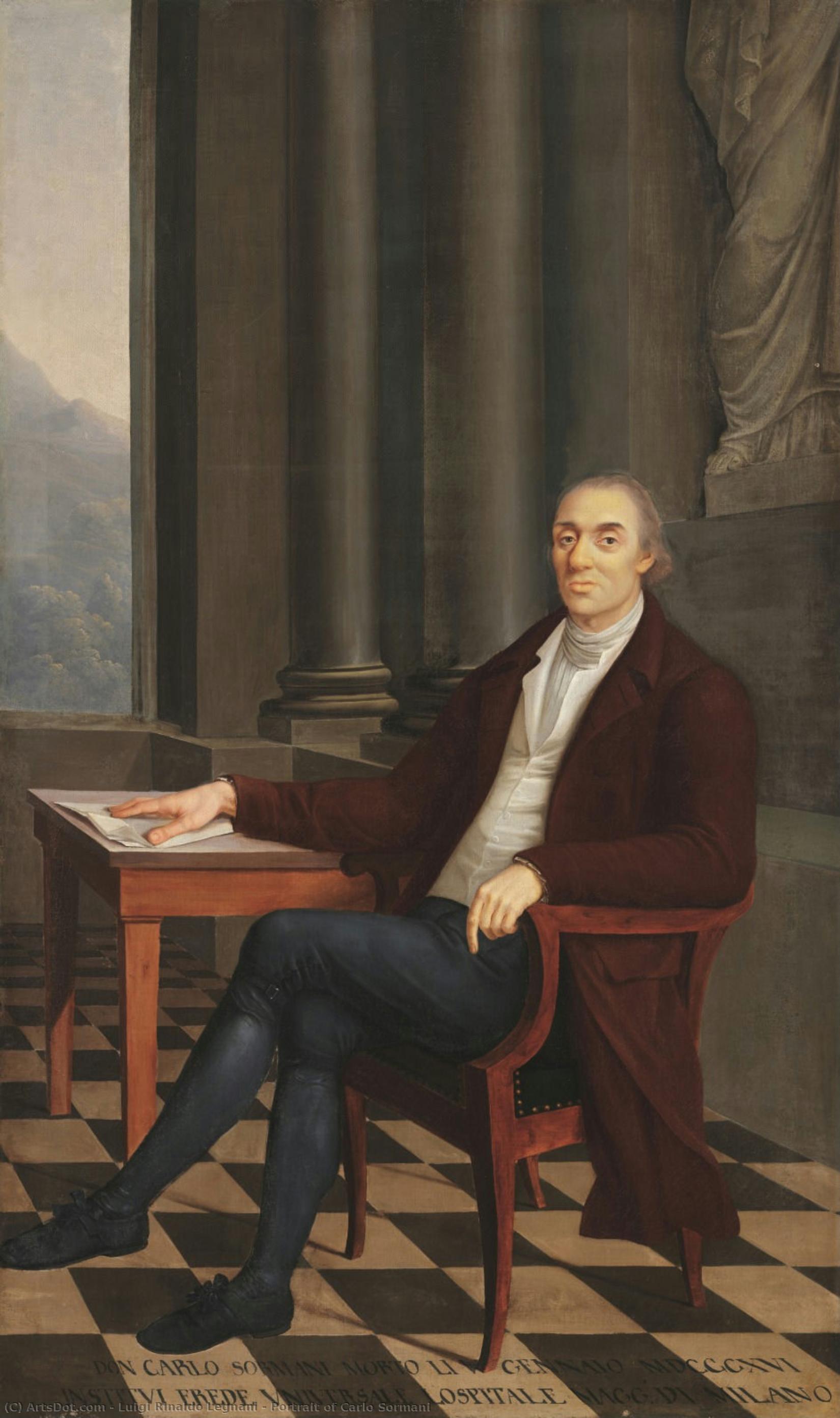
Portrait of Carlo Sormani
 1817
1817 220.0 x 131.0 cm
 Ca’ Granda – Ospedale Maggiore Policlinico
 Read More
Hand Made Oil Reproduction
Hand-painted oil on canvas in your size and frame, made to order by our artists. ( Buy Print Buy Image)




































Pick from our preset sizes that match the artwork's original proportions.

You may enter your own dimensions to fit a specific frame or space. If your selected size does not match the original image's proportions, we will either crop the artwork or extend the painting with additional hand-painted elements. A digital mockup will be sent for your approval before production begins.
Please note that the on-screen preview does not reflect the actual cropping or extension. Only the mockup will accurately show the final composition.
While custom sizes are available, we recommend selecting a dimension from the predefined list to preserve the original proportions.
After order, ArtsDot.com team will email client for instructions and provide a mockup preview
Worldwide Delivery () in 3/4 weeks instead of standard 5 weeks. (31 August). No compromise on quality.

Free Worldwide Express Shipping

High-Quality Linen Canvas

Full Shipping Insurance

Customs Tax Refund Guarantee

True Color Matching Guarantee

60-Day Return Policy (Defects Only)

100% Money-Back Guarantee

Bulk Discount Offer
 Glass option is only available in size under 110 CM

Portrait of Carlo Sormani
Reproduction Medium
Reproduction Size
-


Total Price
$ 263
Related Artworks









Artist Biography
The Melodic Soul of Ravenna: The Life of Luigi Rinaldo Legnani
In the heart of nineteenth-century Italy, amidst the romantic echoes of Ravenna, a musical legend was forged in the delicate strings of the guitar. Luigi Rinaldo Legnani was not merely a performer; he was a polymath of sound—a virtuoso guitarist, a captivating singer, a prolific composer, and a master luthier. His life, spanning from 1790 to 1877, mirrored the very essence of the Romantic era: a period defined by intense emotion, technical brilliance, and an unyielding pursuit of beauty. To understand Legnani is to understand the evolution of the classical guitar itself, as he transitioned from the operatic stages of his youth to the intimate, intricate world of instrumental mastery.
Legnani’s musical journey began with a profound connection to stringed instruments, receiving rigorous training as a young player. However, it was the expressive potential of the guitar and the human voice that truly captured his spirit. Before he became a titan of the guitar, he graced the operatic stage as a tenor, making his debut at Ravenna’s Teatro Comununitativo in 1807. This seventeen-year career as a vocalist endowed his later instrumental compositions with a unique, lyrical quality; even when playing solely on strings, one can hear the breath and phrasing of an opera singer within his melodies. His early travels through Milan and Vienna allowed him to walk in the footsteps of the great Mauro Giuliani, seeking to uphold and expand the prestigious guitar traditions of his era.
Virtuosity and the Architecture of Sound
The true hallmark of Legnani’s genius lies in his ability to push the technical boundaries of his instrument without sacrificing emotional depth. He is perhaps most celebrated for his monumental 36 Caprices, Op. 20, a collection that serves as a masterclass in both difficulty and artistry. Much like Niccolò Paganini’s legendary violin caprices, Legnani’s work traverses every major and minor key, demanding an unprecedented level of dexterity from the performer. These pieces are not merely exercises in speed; they are evocative narratives that capture the shifting moods of the Romantic soul, ranging from the playful to the profoundly melancholic.
Beyond his compositions, Legnani’s contribution to the physical instrument was equally significant. As a luthier, he possessed an intimate understanding of the wood and tension required to produce a superior tone. His work as an instrument maker led to the creation of the "Legnani model" guitar, a design that gained immense popularity across Central Europe during the mid-nineteenth century. This dual mastery—the ability to both conceive the music and craft the vessel through which it flows—placed him in a rare echelon of musical artists.
A Lasting Legacy in the Romantic Canon
As the decades progressed, Legnani’s role shifted from the spotlight of the concert hall to the quiet sanctuary of the workshop. After the 1850s, he retired from active performance to focus on his craft as a maker of guitars and violins, yet his influence remained pervasive through his extensive body of work. With approximately 250 compositions published throughout Europe, his musical language became a cornerstone for subsequent generations of guitarists.
The historical significance of Luigi Rinaldo Legnani cannot be overstated. He stands as a bridge between the classical elegance of the early century and the dramatic intensity of the late Romantic period. His life remains a testament to the interconnectedness of music, craft, and voice:
- Technical Innovation: His 36 Caprices redefined the technical possibilities of the classical guitar.
- Luthier Excellence: The development of the Legnani model guitar influenced European instrument design.
- Artistic Versatility: His background as an operatic tenor infused his instrumental compositions with a rare, vocal lyricism.
- Cultural Impact: He successfully carried forward and expanded the Italian guitar tradition established by masters like Giuliani.
Today, when a guitarist navigates the complex arpeggios and haunting melodies of Legnani’s repertoire, they are not just playing notes; they are engaging in a direct conversation with the Poet of the Guitar, keeping alive a flame that was ignited in Ravenna over two centuries ago.

luigi rinaldo legnani
1790 - 1877 , Italy
Quick Facts
- Artistic Movement Or Style: Romantic
- Artists Or Movements Influenced By This Artist: ['Classical Guitar']
- Artists Who Influenced This Artist:
- Mauro Giuliani
- Niccolo Paganini
- Date Of Birth: November 7, 1790
- Date Of Death: August 5, 1877
- Full Name: Luigi Rinaldo Legnani
- Nationality: Italian
- Notable Artworks:
- The Gathering of the Manna
- St Catherine of Alexandria
- Judith with the Head of Holofernes
- Place Of Birth: Ravenna, Italy