

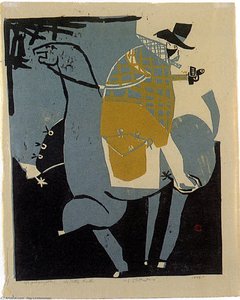
![K. Kobro Is Ironing/ironing [project] — Marek Sobczyk](/media/artworks/images-full/f2/3d/f23d17c475639ad912706878fa6a13bf.jpg)
 Preview
 Send
Send Share
Share
 Details

 Download
 Similars
 X-Ray
X-Ray Diaporama
 Stats
StatsK. Kobro is ironing/ironing [project]
 124.0 x 136.0 cm
 Centre of Contemporary Art Znaki Czasu
 Read More
Purchase a high-resolution, enhanced digital image, far superior to the online preview.
Each file is meticulously prepared by our in-house specialists using advanced tools and expert manual retouching. We ensure every image has exceptional clarity, precise color accuracy, and fine detail.
The final file is delivered via email within 72 hours, optimized for immediate use in professional, editorial, and print environments. This is the same quality trusted by top-tier design studios, publishers, and galleries.
Digital Image
Download a high-resolution file for personal display, printing, and creative projects. ( Switch to Print Buy Hand Made Painting)
Included in Every Digital Image Order
Expert Digital Delivery, Guaranteed
When you choose ArtsDot.com, you're not just getting an image - you're receiving a professionally enhanced digital artwork, crafted with precision and backed by a satisfaction guarantee. Here's everything that comes with your order, automatically:

Fast Email Delivery
Your high-resolution digital image file will be emailed to you within 72 hours of ordering - ready for immediate use.

AI-Enhanced Digital File
Your artwork is professionally optimized using advanced AI tools and manual editing, ensuring maximum detail, clarity, and color accuracy.

Free Lifetime Re-Delivery
Accidentally deleted or lost your file? No worries - we'll resend it to you anytime, free of charge.

No Import Fees - Ever
Enjoy your artwork instantly with zero customs, duties, or delivery fees - digital downloads are always tax-free.

Color Accuracy Guarantee
We ensure your digital image reflects the original colors as closely as possible using professional tools and color management.

100-Day Satisfaction Guarantee
If you're not satisfied with your digital image, we'll revise it or refund 100% within 100 days - no questions asked.

100% Money-Back Guarantee
Not satisfied? Get a full refund within 100 days of receiving your digital file - no questions asked.

Bulk Order Discounts
Buy 3 images, save 10% - Buy 5, save 15% - Buy 10+, save 20%. Great for creative projects, galleries, and agencies.
Related Artworks





Artist Biography
Early Life and Artistic Foundations
Marek Sobczyk, born in Warsaw, Poland, in 1955, emerged as a significant voice within the vibrant yet often politically constrained Polish art scene of the late 20th century. His formative years were deeply influenced by the atmosphere of post-war reconstruction and the subsequent era of socialist realism, conditions that would later fuel his critical engagement with artistic norms and societal structures. Sobczyk’s pursuit of formal training led him to the Academy of Fine Arts in Warsaw between 1975 and 1980, where he studied under the tutelage of Stefan Gierowski—a pivotal figure known for his abstract expressionism and philosophical approach to art. This mentorship proved crucial, instilling in Sobczyk a foundation rooted in color theory, compositional dynamics, and an intellectual curiosity that extended beyond purely aesthetic concerns.
Early works from this period reveal a nascent rebellion against the prevailing artistic doctrines. While initially exploring abstract forms and vibrant palettes, Sobczyk quickly began to imbue his canvases with subtle critiques of the mundane realities of life in Poland under socialist rule. His thesis project, for instance, attempted to capture the “ugliness and cheapness” of mass housing and everyday existence, a gesture that drew censure from school authorities but signaled a burgeoning artistic conscience.
Gruppa and Collaborative Exploration
The early 1980s marked a turning point in Sobczyk’s career with his involvement in the formation of Gruppa—an artist collective that became synonymous with neo-expressionist tendencies in Poland. Alongside Ryszard Grzyb, Jarosław Modzelewski, Paweł Kowalewski, Włodzimierz Pawlak, and Ryszard Woźniak, Sobczyk participated actively in exhibitions, collaborative “papiery” (large-scale drawings or collages), and the production of ‘Oj dobrze już’ (‘All Right Already’), a self-published art zine that served as a platform for critical discourse. Gruppa was not merely an artistic endeavor; it was a defiant act of intellectual resistance against the backdrop of martial law, offering a space for experimentation, dialogue, and the articulation of alternative perspectives.
Within Gruppa, Sobczyk’s contributions were multifaceted. He co-edited ‘Oj dobrze już’, publishing theoretical texts that explored themes of abstraction, symbolism, and the role of art in society. His paintings from this era often reflected the anxieties and tensions of the time, incorporating provocative juxtapositions of religious motifs, political imagery, and contemporary cultural references. Works like “Gandzia” (1983) directly addressed the realities of martial law, while his exploration of “Indian” themes served as a metaphorical commentary on broader issues of identity and displacement.
Polychromy, Performance, and Thematic Cycles
Sobczyk’s artistic practice extends beyond painting to encompass polychromy—the decoration of architectural surfaces—and performance art. Between 1985 and 1989, he collaborated with Ryszard Grzyb on the polychromy of the neo-Greek Catholic Church of St. Nicholas in Kostomloty, Podlaskie Voivodeship. This project was particularly significant, representing a bold intervention within a traditional religious space and challenging conventional notions of sacred art. The resulting work is characterized by its vibrant colors, dynamic compositions, and unconventional iconography.
Throughout the 1990s and beyond, Sobczyk developed several long-term thematic cycles that demonstrate his sustained engagement with complex ideas. “Badania Mózgu w Polsce” (Brain Research in Poland) explores the intricacies of human consciousness and the socio-political factors that shape perception. “Seksreligiapolityka” (SexReligionPolitics) delves into the intertwined relationships between these fundamental aspects of human experience, often employing provocative imagery and symbolic language. “Pomniki dyskursów” (Monuments to Discourses) examines the ways in which power structures are perpetuated through cultural narratives and ideological constructs.
Legacy and Contemporary Relevance
Marek Sobczyk’s work has been exhibited extensively in galleries and museums across Poland, including the Center for Contemporary Art in Ujazdów Castle, Warsaw, and the Museum of Modern Art in Warsaw. His influence extends beyond his own artistic production to encompass education, having lectured at private art schools and run a painting studio at the University of Zielona Góra since the early 1990s.
Sobczyk’s legacy lies in his unwavering commitment to critical inquiry, his willingness to challenge established norms, and his ability to synthesize diverse artistic influences into a uniquely compelling visual language. His paintings, polychromies, and theoretical writings continue to resonate with contemporary audiences, offering insightful commentary on the complexities of Polish history, identity, and the enduring power of art as a form of resistance and self-expression. He remains an active figure in the Warsaw art scene, continuing to explore new avenues of creative expression and inspire generations of artists.
marek sobczyk
1955 - , Poland
Quick Facts
- Artistic Movement Or Style: Abstract Expressionism
- Artists Who Influenced This Artist: ['Stefan Gierowski']
- Date Of Birth: 1955
- Full Name: Marek Sobczyk
- Nationality: Polish
- Notable Artworks:
- K. Kobro is ironing/ironing project
- Gandzia
- Biczowanie Chrystusa
- Boże Narodzenie
- Place Of Birth: Warsaw, Poland