 Preview
 Send
Send Share
Share
 Details

 Download
 Similars
 X-Ray
X-Ray Diaporama
Title in Swedish: Tors strid med jättarna
 1872
1872 3330.0 x 4840.0 cm
 Nationalmuseum
 Read More
Hand Made Oil Reproduction
Hand-painted oil on canvas in your size and frame, made to order by our artists. ( Buy Print Buy Image)




































Pick from our preset sizes that match the artwork's original proportions.

You may enter your own dimensions to fit a specific frame or space. If your selected size does not match the original image's proportions, we will either crop the artwork or extend the painting with additional hand-painted elements. A digital mockup will be sent for your approval before production begins.
Please note that the on-screen preview does not reflect the actual cropping or extension. Only the mockup will accurately show the final composition.
While custom sizes are available, we recommend selecting a dimension from the predefined list to preserve the original proportions.
After order, ArtsDot.com team will email client for instructions and provide a mockup preview
Worldwide Delivery () in 3/4 weeks instead of standard 5 weeks. (28 August). No compromise on quality.

Free Worldwide Express Shipping

High-Quality Linen Canvas

Full Shipping Insurance

Customs Tax Refund Guarantee

True Color Matching Guarantee

60-Day Return Policy (Defects Only)

100% Money-Back Guarantee

Bulk Discount Offer
 Glass option is only available in size under 110 CM

Title in Swedish: Tors strid med jättarna
Reproduction Medium
Reproduction Size
-


Total Price
$ 263
Historical Context
Winge was a professor at the Royal Swedish Academy of Arts, where history painting was considered the pinnacle of artistic achievement. His association with the Düsseldorf school of painting and his influence by Norse mythology themes, also found in works by Nils Blommér (1816–1853) and Carl Wahlbom (1810-1858), are evident in this work.The Painting
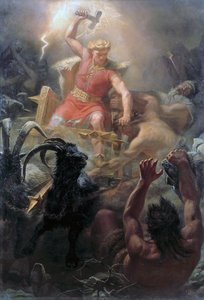
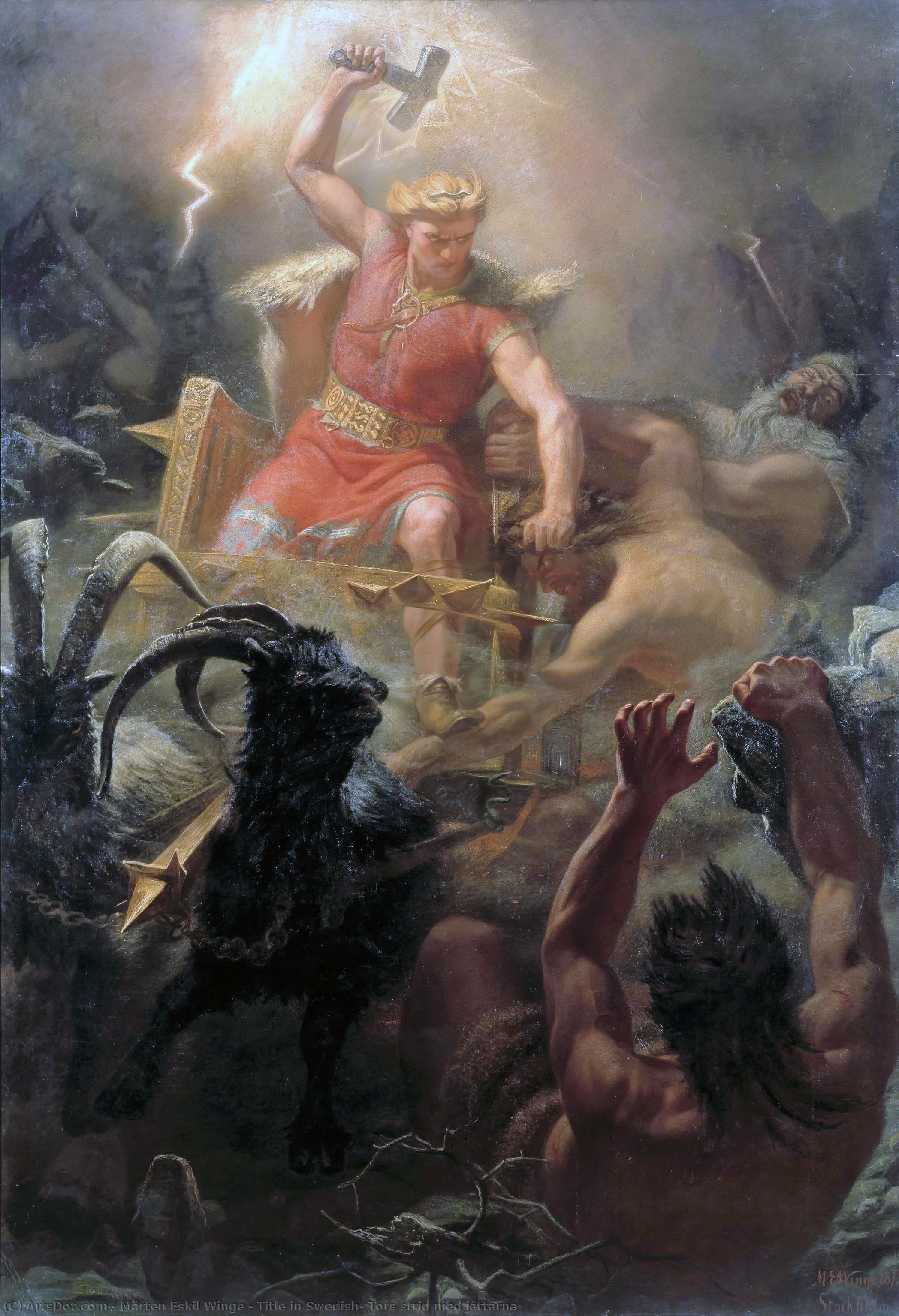
The painting measures 484 x 333 centimeters and is housed at the Nationalmuseum in Stockholm. It depicts Thor, the Norse god of thunder, riding his chariot pulled by the goats Tanngrisnir and Tanngnjóstr. He wears his belt Megingjörð and swings his hammer Mjölnir, which is wreathed in lightning. The scene is set against a backdrop of a fierce battle between Thor and the giants (Jötnar), symbolizing the eternal struggle between good and evil.Reception
Upon its public exhibition at Nationalmuseum in 1872, the painting was met with widespread acclaim. It drew large crowds, with some people waiting for hours to catch a glimpse of it. The young August Strindberg wrote a positive review, interpreting the subject matter as a depiction of truth's struggle against falsehood.Symbolism and Interpretation
The swastika on Thor's belt of power has been a point of contention due to its later association with extremist ideologies. However, for Winge and his contemporaries, it was an ancient decorative symbol representing the sun, appearing in architectural decoration and various logos.Legacy
"Thor's Fight with the Giants" is not only a masterpiece of Scandinavian art but also a reflection of the national liberal movement that used Norse motifs to extol democracy and the fight against ignorance. It continues to influence our ideas about Vikings and the Æsir gods, making it a significant piece in the history of art.Conclusion
Mårten Eskil Winge's "Tors strid med jättarna" is a powerful representation of Norse mythology, capturing the essence of Thor's battle against the giants. Its historical significance and artistic merit make it a must-see for anyone interested in Scandinavian art and culture.- Painting by 'Mårten Eskil Winge' | Mårten Eskil Winge: Title in Swedish: Tors strid med jättarna
- Painting by 'Giuseppe Arcimboldo' | Giuseppe Arcimboldo: The Cook
- Thor's Fight with the Giants - Wikipedia
For those interested in Scandinavian art, Thielska Galleriet is a hidden gem worth exploring: Thielska Galleriet, Sweden: A Hidden Gem of Scandinavian Art
Related Artworks



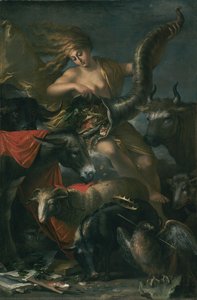
Artist Biography
Mårten Eskil Winge: A Visionary of Norse Mythology and Gothicismus
Mårten Eskil Winge, born in Stockholm in 1825 and tragically passing away in 1896, stands as a pivotal figure in late 19th-century Swedish art. More than simply a painter, he was a dedicated interpreter of Norse mythology, skillfully blending historical research with the dramatic intensity of Gothicismus – a movement that sought to revive the heroic narratives and visual language of the Viking Age. His work, deeply rooted in the artistic traditions of Düsseldorf, yet uniquely informed by his Swedish heritage, continues to captivate viewers with its powerful imagery and meticulous detail.
Winge’s early life was marked by a fascination with the sagas and folklore of Scandinavia. Educated at Uppsala Cathedral School and later at the Royal Swedish Academy of Fine Arts, he quickly distinguished himself through his detailed drawings depicting Norse legends. This interest wasn't merely academic; it reflected a broader cultural yearning within Sweden to reconnect with its ancient past – a desire for national identity forged in the fires of heroic mythology. His illustrations for Adam Oehlenschläger’s epic poems, such as Fosterbröderna and Heidi, demonstrated his ability to translate complex narratives into visually compelling forms.
The Düsseldorf School and Artistic Influences
Winge's artistic journey took a significant turn when he traveled to Düsseldorf in the mid-1850s. This period of study within the renowned Düsseldorf School of Painting profoundly shaped his style. The school emphasized realism, meticulous draftsmanship, and a dramatic use of light and shadow – techniques that Winge readily adopted. He benefited from instruction under Johan Christoffer Boklund, a respected teacher known for his ability to cultivate artistic talent. However, it was his time in Paris, where he studied with Thomas Couture and explored the Louvre’s vast collection, that truly broadened his horizons.
Crucially, Winge wasn't simply replicating Düsseldorf techniques; he synthesized them with the influences of other artists. He drew inspiration from the works of Nils Blommér, a contemporary who similarly explored Norse mythology, and Carl Wahlbom, whose dramatic depictions of Viking history provided a crucial foundation for Winge’s own artistic vision. These figures shared a common interest in reclaiming the heroic narratives of the past, offering a counterpoint to prevailing Romantic ideals.
Norse Mythology Brought to Life
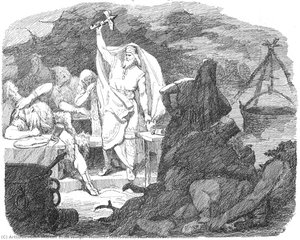
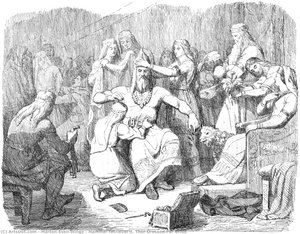
Winge's most celebrated work lies in his depictions of Norse mythology. His engravings and paintings are characterized by an almost theatrical quality – a sense of grandeur and drama that perfectly captures the epic scale of these ancient tales. His meticulous attention to detail, particularly evident in works like ‘Thor Dressed for Bride’ (1865), showcases intricate line work and a masterful understanding of composition. This engraving, depicting Thor preparing for his wedding with Sif, exemplifies the Gothicismus movement's fascination with heroic figures and dramatic narratives.
Notable examples of his mythological works include ‘Hammar Retrieval II’ (1865) and ‘Hammar Retrieval III’ (1865), both powerfully illustrating Thor’s quest for Mjölnir, his legendary hammer. These scenes are rendered with a stark realism that emphasizes the raw power and elemental forces at play. His painting of “Tors strid med jättarna” (Thor's Fight with the Giants) is considered a quintessential example of 19th-century depictions of the Norse god, embodying both his strength and vulnerability.
Royal Portraits and Later Works
Beyond his mythological subjects, Winge was also a highly sought-after portrait painter. He created numerous portraits of members of the Swedish royal family, demonstrating his skill in capturing likenesses with remarkable accuracy and sensitivity. His commission to paint King Charles XV’s portrait at the deathbed of Axel Oxenstierna is particularly noteworthy, showcasing his ability to convey both dignity and pathos.
In his later years, Winge turned increasingly towards landscapes, specifically depictions of crashing waves – a testament to his lifelong fascination with nature and its raw power. His work continued to evolve, reflecting the changing artistic landscape of the late 19th century while retaining the distinctive qualities that had defined his career. Mårten Eskil Winge’s legacy endures as a significant voice in Swedish art history, a master storyteller who brought the legends of Norse mythology to life with unparalleled skill and dramatic vision.
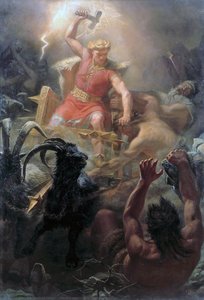
mårten eskil winge
1825 - 1896 , Sweden
Quick Facts
- Artistic Movement Or Style: Norse Mythology & Gothicismus
- Artists Or Movements Influenced By This Artist: ['Düsseldorf School']
- Artists Who Influenced This Artist:
- Nils Blommér
- Carl Wahlbom
- Date Of Birth: September 21, 1825
- Date Of Death: April 22, 1896
- Full Name: Mårten Eskil Winge
- Nationality: Swedish
- Notable Artworks:
- Thor Dressed For Bride
- Tors strid med jättarna
- Place Of Birth: Stockholm, Sweden