 Preview
 Send
Send Share
Share
 Details

 Download
 Similars
 X-Ray
X-Ray Diaporama
Mobile (Being With You Is Like The New Past)


 Read More
Giclée / Art Print
Museum-quality giclée or canvas print with fast production and flexible finish options. ( Buy Hand Made Painting Buy Image)




P118B $10

P118H $10

P118W $10

P438Z $10

P508JH $12

P508YH $12

P805H $10

P805Z $10

P919BZ $10

P919G $10

P919XJ $10

P959ZH $10

P968JZ $12

W106C $8

W218G $10

W218JH $8

W218Y $10

W307PJ $10

W316G $10

W316PJ $8

W316Y $10

W398PJ $8

W4111J $10

W500HY $15

W500JH $15

W692G $12

W849H $8

W940BG $15

W953PJ $8




Pick from our preset sizes that match the artwork's original proportions.

You may enter your own dimensions to fit a specific frame or space. If your selected size does not match the original image's proportions, we will either crop the artwork or extend the image with a mirrored or solid-fill edge. A digital mockup will be sent for your approval before production begins.
Please note that the on-screen preview does not reflect the actual cropping or extension. Only the mockup will accurately show the final composition.
While custom sizes are available, we recommend selecting a dimension from the predefined list to preserve the original proportions.
Worldwide Delivery () in 2 weeks instead of standard 4/5 weeks. (27 August)

Free Worldwide Express Shipping

High-Quality Linen Canvas

Full Shipping Insurance

Customs Tax Refund Guarantee

True Color Matching Guarantee

60-Day Return Policy (Defects Only)

100% Money-Back Guarantee

Bulk Discount Offer
 Glass option is only available in size under 110 CM

Mobile (Being With You Is Like The New Past)
Giclée / Art Print
Reproduction Size
-


Total Price
$ 63
Collectible Description
A Haunting Dialogue of Design: Exploring 'Mobile (Being With You Is Like The New Past)' by Martin Boyce
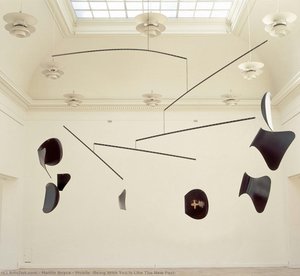
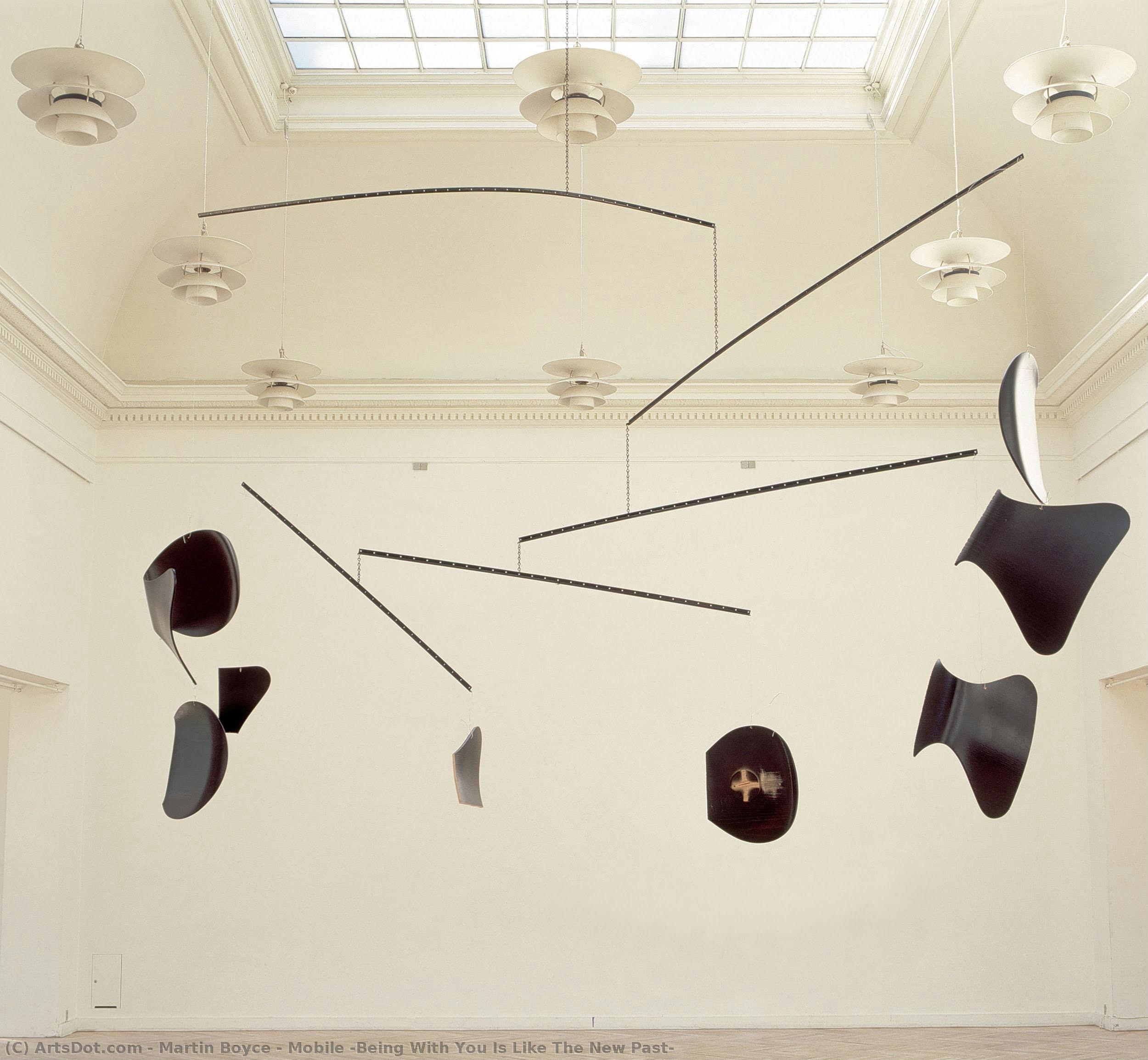
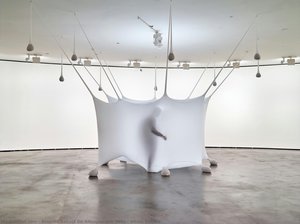
Martin Boyce’s ‘Mobile (Being with you is like the new past)’ isn't merely a sculpture; it’s an excavation of memory, obsolescence, and the lingering presence of design icons. Painted in 2002, this work immediately draws the viewer into a subtly unsettling space, dominated by floating forms that seem to both grace and disturb. The composition – a stark white wall acting as a stage for these suspended objects – amplifies the sense of detachment and invites contemplation on the passage of time and the nature of value.
- The Architecture of Ghosts: Boyce masterfully employs recognizable fragments, primarily from Arne Jacobsen’s iconic ‘Series 7’ chair (famously known as the ‘3107 Chair’), alongside elements reminiscent of Charles and Ray Eames' designs. These aren’t presented as pristine examples of Modernist perfection; instead, they are fractured, repurposed, and imbued with a spectral quality. The deliberate inclusion of these familiar forms – particularly Jacobsen’s celebrated chair – speaks to a fascination with the enduring power of design and its ability to evoke specific eras and emotional responses.
- A Mid-Century Lament: The work resonates deeply within the context of mid-20th century America, a period defined by rapid economic growth, consumerism, and a willingness to discard objects deemed ‘obsolete.’ Boyce’s sculptures subtly critique this culture of disposability, presenting these once-cherished pieces as remnants – “undead dreams” as the artist himself termed them – suggesting a poignant awareness of lost ideals and the fleeting nature of modern design.
- Technique and Atmosphere: Boyce's technique is characterized by a meticulous attention to detail in replicating the forms, combined with an expressive manipulation of texture and light. The slightly imperfect surfaces and subtle variations in color contribute significantly to the work’s ghostly atmosphere, enhancing its emotional impact. The use of white as a dominant background further emphasizes the sculptural elements, creating a sense of weightlessness and ethereal beauty.
Symbolism: Fragments of a Lost Utopia
Beyond the obvious references to Jacobsen and Eames, ‘Mobile (Being with You Is Like The New Past)’ operates on multiple symbolic levels. The mobile itself – an inherently unstable structure reliant on delicate balances – becomes a metaphor for memory, constantly shifting and rearranging itself over time. The fragmented chair parts represent broken narratives, lost connections, and the inevitable decay of even the most meticulously designed objects. The title itself, “Being with you is like the new past,” adds another layer of complexity, hinting at nostalgia, longing, and the way our relationships shape our memories.
Historical Context: Modernism's Echoes
Understanding the historical context surrounding Boyce’s work is crucial to appreciating its significance. The late 20th century witnessed a renewed interest in Mid-Century Modern design, fueled by a desire for simplicity and functionality. However, Boyce doesn’t simply celebrate this aesthetic; he interrogates it, exposing its underlying contradictions and questioning its utopian promises. His use of ‘Splint Sculpture,’ referencing Eames' work, further underscores this critical engagement with the history of American design.
Emotional Impact & Artistic Significance
'Mobile (Being With You Is Like The New Past)' is a powerfully evocative piece that invites viewers to confront questions about memory, loss, and the enduring influence of design. Boyce’s ability to transform familiar objects into haunting symbols elevates this work beyond mere representation, creating a deeply resonant experience for the viewer. It's a testament to his skill as an artist and his profound understanding of the relationship between art, design, and human emotion.
Related Artworks


Artist Biography
Edward Hopper: A Portrait of American Solitude
Edward Hopper, born in Nyack, New York, on July 22, 1882, remains one of America’s most enduring and enigmatic figures in the art world. His paintings, characterized by their stark realism, evocative lighting, and poignant sense of isolation, have captivated audiences for over a century. While often categorized as an American realist, Hopper's work transcends simple representation; he meticulously crafted scenes that explored themes of loneliness, urban alienation, and the quiet dramas of everyday life—a visual language profoundly shaped by his personal experiences and artistic influences. His career, though initially slow to gain recognition, ultimately cemented his place as a pivotal voice in 20th-century American art.Early Influences and Artistic Training
Hopper’s early exposure to art was nurtured by his supportive parents, who recognized and encouraged his nascent talent. He began his artistic journey at the Correspondence School of Illustrating in New York City (1899–1900), a stepping stone that introduced him to the fundamentals of drawing and design. However, it was his studies under William Merritt Chase at the New York School of Art (1900–1906) and, crucially, Robert Henri’s influential class that truly shaped his artistic trajectory. Henri's philosophy—to paint “from life” and to capture the essence of American experience—proved particularly transformative. Hopper embraced Henri’s emphasis on depicting the realities of modern urban and rural America, moving away from purely academic styles. His classmates included notable artists like George Bellows and Rockwell Kent, fostering a vibrant artistic community that influenced his development. A brief sojourn in Paris during 1906-7 exposed him to European art movements, notably Impressionism and Post-Impressionism, particularly the work of Edgar Degas and Édouard Manet, whose compositional techniques and depictions of modern urban life would become recurring motifs in Hopper’s own paintings.Thematic Concerns and Artistic Style
Hopper's artistic vision consistently revolved around a select group of themes: the tensions between individuals—particularly men and women—the conflict between tradition and progress in both rural and urban settings, and the moods evoked by various times of day. His most famous work, *Nighthawks* (1942), exemplifies this focus on quiet, introspective scenes from everyday life, capturing a sense of unease and isolation within a brightly lit diner at night. His paintings are characterized by a deliberate use of light and shadow to create mood and atmosphere; often, the stark contrast between illumination and darkness emphasizes the solitude of his subjects. Hopper’s compositions frequently employ cropped perspectives, creating a cinematic effect that draws the viewer into the scene while simultaneously suggesting a sense of detachment. He meticulously rendered architectural details—particularly those of New York City and the New England countryside—which served as both settings and symbolic elements within his works. His use of color was restrained, favoring muted tones to enhance the feeling of quiet contemplation.A Career Marked by Slow Recognition
Despite demonstrating considerable talent early in his career, Hopper’s path to recognition was initially slow and fraught with challenges. He struggled for years to gain acceptance within the established art world, exhibiting his work sporadically and facing periods of financial hardship. However, a pivotal moment arrived in 1920 when the Whitney Studio Club, founded by Gertrude Vanderbilt Whitney, organized a one-person exhibition showcasing sixteen of his paintings. While this event didn’t immediately catapult him to fame, it provided a crucial platform for exposure and marked a significant turning point in his career. The following decade saw continued exhibitions and increasing commercial success, culminating in the sale of every painting at a 1930s show organized by the Frank K. M. Rehn Galleries. Hopper’s work gained wider recognition during World War II, with many museums acquiring his paintings—a testament to their enduring appeal and relevance.Legacy and Influence
Edward Hopper died on May 15, 1967, leaving behind a remarkably consistent body of work that continues to resonate deeply with audiences today. His paintings are not merely depictions of scenes; they are explorations of the human condition—a poignant meditation on loneliness, isolation, and the complexities of modern life. Hopper’s influence extends far beyond the realm of painting, impacting film, literature, and popular culture. His evocative imagery has been widely imitated and referenced, solidifying his status as an iconic figure in American art history. The quiet drama and psychological depth of his work ensure that Edward Hopper's legacy will endure for generations to come, reminding us of the beauty and melancholy inherent in the everyday moments of our lives.
martin boyce
1967 - , United Kingdom
Quick Facts
- Artistic Movement Or Style: Realism, American Realism
- Artists Or Movements Influenced By This Artist:
- Degas
- Manet
- Artists Who Influenced This Artist:
- William Merritt Chase
- Robert Henri
- Date Of Birth: July 22, 1882
- Date Of Death: May 15, 1967
- Full Name: Edward Hopper
- Nationality: American
- Notable Artworks:
- Nighthawks
- Automat
- Chop Suey
- Place Of Birth: Nyack, New York, USA
Related Articles

Bronze Sculptures That Defined Art History | ArtsDot
Journey through art history with our Top 10 bronze sculptures! Explore masterpieces by Rodin, Michelangelo & more. Discover stories behind iconic statues and find museum-quality reproductions for your home decor at ArtsDot.com.

The Enduring Form: Exploring Themes & Techniques in Sculpture Across Historical Periods
Explore the rich history of sculpture from ancient masterpieces to contemporary innovations. Discover key techniques, influential artists & investment potential for discerning art collectors.

Bronze Age to Modern Masters: 10 Sculptures That Redefined Art | ArtsDot
Journey through art history with 10 legendary bronze sculptures – from Michelangelo's David to Rodin’s Thinker. Explore the stories, techniques & timeless beauty of these masterpieces. Find museum-quality reproductions & elevate your home decor on ArtsDot.com.

Giclée Prints: Archival Quality & Aesthetic Nuances for the Discerning Collector
Explore the world of giclée prints with ArtsDot. Learn about archival quality, aesthetic nuances & investment potential. Expert guidance for discerning art collectors seeking museum-quality reproductions and lasting value.

The Enduring Form: Sculpture Across History, Technique & Emotional Resonance
Explore the rich history of sculpture with ArtsDot. Discover key techniques, influential artists & investment potential for discerning collectors. Expert insights into valuing and collecting timeless masterpieces.