

![Madonna And Child With The Blessing Christ, And Saints Peter, James Major, Anthony Abbott, And A Deacon Saint [entire Triptych] — Martino Di Bartolomeo](/media/artworks/images-full/d5/13/d513bed68c38238ab75e51680dae1b28.jpg)
 Preview
 Send
Send Share
Share
 Details

 Download
 Similars
 X-Ray
X-Ray Diaporama
Madonna and Child with the Blessing Christ, and Saints Peter, James Major, Anthony Abbott, and a Deacon Saint [entire triptych]

 Read More
Giclée / Art Print
Museum-quality giclée or canvas print with fast production and flexible finish options. ( Buy Hand Made Painting Buy Image)




































Pick from our preset sizes that match the artwork's original proportions.

You may enter your own dimensions to fit a specific frame or space. If your selected size does not match the original image's proportions, we will either crop the artwork or extend the image with a mirrored or solid-fill edge. A digital mockup will be sent for your approval before production begins.
Please note that the on-screen preview does not reflect the actual cropping or extension. Only the mockup will accurately show the final composition.
While custom sizes are available, we recommend selecting a dimension from the predefined list to preserve the original proportions.
Worldwide Delivery () in 2 weeks instead of standard 4/5 weeks. (30 August)

Free Worldwide Express Shipping

High-Quality Linen Canvas

Full Shipping Insurance

Customs Tax Refund Guarantee

True Color Matching Guarantee

60-Day Return Policy (Defects Only)

100% Money-Back Guarantee

Bulk Discount Offer
 Glass option is only available in size under 110 CM

Madonna and Child with the Blessing Christ, and Saints Peter, James Major, Anthony Abbott, and a Deacon Saint [entire triptych]
Giclée / Art Print
Reproduction Size
-


Total Price
$ 63
Related Artworks







Artist Biography
The Bridge Between Eras: The Life and Legacy of Martino Di Bartolomeo
In the transformative twilight of the Trecento and the luminous dawn of the Quattrocento, few artists embodied the profound cultural metamorphosis of the Italian peninsula as gracefully as Martino di Bartolomeo. Often revered by historians as the last great master of the Sienese Trecento, Martino served as a vital aesthetic bridge, connecting the decorative, rhythmic elegance of the medieval tradition with the burgeoning humanism and spatial depth of the early Renaissance. His brush did not merely apply pigment to panel; it captured the very essence of an era caught between the spiritual intensity of a storied past and the perspectival promise of a new, more structured future.
The foundations of Martino’s artistry were laid within the prestigious workshops of his homeland, Siena. While the precise details of his earliest years remain shrouded in the soft mists of historical uncertainty, scholars widely believe he received his formative training under the tutored guidance of Taddeo di Bartolo. From this master, Martino inherited a meticulous devotion to detail and an extraordinary ability to imbue sacred subjects with a palpable, expressive dynamism. This early immersion into the visual language of spiritual intensity provided him with a technical rigor that would define his later, more complex compositions.
A Journey Through the Tuscan Landscape
Martino’s career was marked by a remarkable geographical and stylistic fluidity, as he moved beyond the walls of Siena to engage with a broader Mediterranean aesthetic. As a young man, his presence was felt in Pisa, where he collaborated with artists such as Giovanni di Pietro da Napoli. This period of exploration allowed him to absorb the burgeoning influences of Florentine painting, particularly the more structured and spatial approaches that were beginning to redefine the Tuscan landscape. His ability to synthesize the lyrical grace of Sienese tradition with these newer, more anatomical and perspectival elements made his work uniquely compelling.
His versatility was perhaps his greatest strength, allowing him to command various mediums with equal mastery. His reach extended from the delicate, intimate world of manuscript illumination—notably seen in his hand within the choirbooks commissioned for the cathedral of Lucca—to the monumental scale of fresco cycles. The frescoes in the church of San Giovanni Battista di Cascina, bearing his signature and the date 1398, stand as enduring testaments to his burgeoning talent and his capacity to lead large-scale narratives with both grace and authority.
Mastery of Form and Sacred Narrative
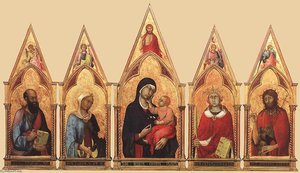
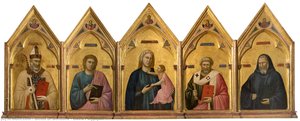
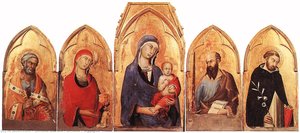
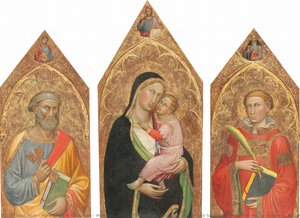
The works of Martino di Bartolomeo are characterized by a profound emotional depth and a sophisticated use of color. Whether working in tempera on panel or executing complex polychromy for sculptures, he possessed an uncanny ability to breathe life into the divine. His altarpieces, such as the magnificent triptych featuring the Madonna and Child with the Blessing Christ alongside Saints Peter and James Major, showcase a masterful command of composition. In these works, the figures are not merely icons but are imbued with a human presence that invites the viewer into a state of contemplation.
His significance in the history of art is cemented by his role as an official artist of Siena, contributing to the most prestigious civic and religious sites, including the Duomo and the Palazzo Pubblico. His legacy is defined by several key artistic contributions:
- Stylistic Synthesis: The seamless integration of medieval decorative elegance with early Renaissance humanism.
- Technical Versatility: Mastery across diverse media, including fresco, tempera panel painting, manuscript illumination, and sculptural polychromy.
- Cultural Impact: Acting as a pivotal figure in the transition of the Sienese School during one of the most significant shifts in Western art history.
Ultimately, Martino di Bartolomeo remains an artist of profound importance—a painter who stood at the crossroads of history, capturing the movement of a soul and a civilization transitioning from the shadows of the Middle Ages into the light of the Renaissance.
![Madonna and Child, with the Blessing Christ [middle panel]](/media/artworks/images-thumb/d5/3a/d53ac599fbd64f2ccaa18c52178965ef.jpg)
![Madonna and Child with the Blessing Christ, and Saints Peter, James Major, Anthony Abbott, and a Deacon Saint [entire triptych]](/media/artworks/images-thumb/dd/56/dd5623ad3ba7da573de1adeb2942c4c9.jpg)
![Saint Peter, with Saint James Major [left panel]](/media/artworks/images-thumb/9d/31/9d312e70f79fbce12989e71f06c3fc2e.jpg)

