Menu
FREE ART CONSULTATION
PreviewPreview AR previewAR preview Buy Hand Made Painting Buy Hand Made PaintingBuy Image Buy Image SendSend
DetailsDetails Add to favorites Add to favorites DownloadDownload SimilarsSimilars X-RayX-Ray DiaporamaDiaporama

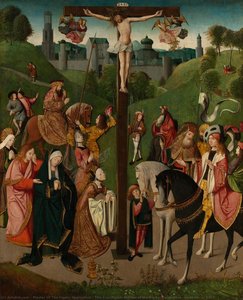
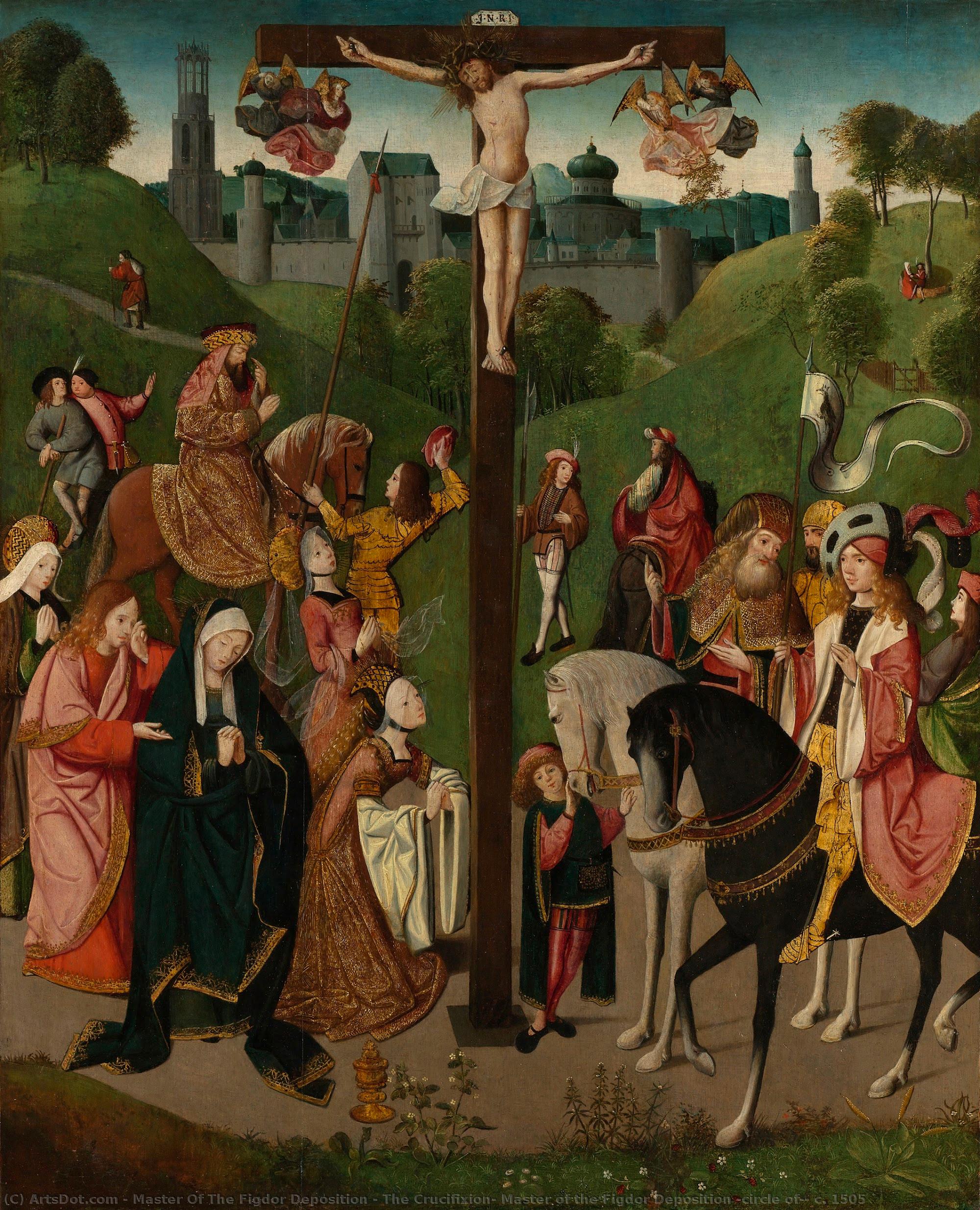
The Crucifixion, Master of the Figdor Deposition (circle of), c. 1505

  • Creation date1505
  • Dimensions103.0 x 85.0 cm

Explore the enigmatic Master of the Figdor Deposition (c. 1480-1500), a key Early Netherlandish painter known for rich colors, emotive realism & poignant religious scenes like 'The Martyrdom of St. Lucy.' Discover his legacy on ArtsDot!

Giclée / Art Print

Museum-quality giclée or canvas print with fast production and flexible finish options. (Buy Hand Made Painting Buy Hand Made PaintingBuy Image Buy Image)

Standard
custom
CM
INCH

Pick from our preset sizes that match the artwork's original proportions.

width
height

You may enter your own dimensions to fit a specific frame or space. If your selected size does not match the original image's proportions, we will either crop the artwork or extend the image with a mirrored or solid-fill edge. A digital mockup will be sent for your approval before production begins.
Please note that the on-screen preview does not reflect the actual cropping or extension. Only the mockup will accurately show the final composition.
While custom sizes are available, we recommend selecting a dimension from the predefined list to preserve the original proportions.

Worldwide Delivery () in 2 weeks instead of standard 4/5 weeks. (5 September)

why_choose_icon
Free Worldwide Express Shipping
why_choose_icon
High-Quality Linen Canvas
why_choose_icon
Full Shipping Insurance
why_choose_icon
Customs Tax Refund Guarantee
why_choose_icon
True Color Matching Guarantee
why_choose_icon
60-Day Return Policy (Defects Only)
why_choose_icon
100% Money-Back Guarantee
why_choose_icon
Bulk Discount Offer

Total Price

$ 63

reproduction

The Crucifixion, Master of the Figdor Deposition (circle of), c. 1505

Giclée / Art Print

Reproduction Size

-

Total Price

$ 63

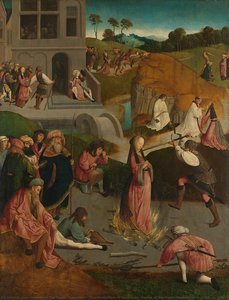
Like The Martyrdom of St Lucy (SK-A-1688), this composition with Christ on the Cross is divided into several levels. Christ on the cross is in the centre. Two angels hover around him, catching the blood flowing from the wounds in his hands in golden chalices in an allusion to the Eucharist. In the foreground to the left of the cross are St John, the Virgin, and two other Marys. Mary Magdalen, also on the left, is kneeling at the foot of the cross and is identified by her attribute of the jar of ointment on the ground beside her. On the right are several horsemen, among them the centurion who was later converted, who is pointing up at the crucified Christ with his right hand. His white horse is being held by a small page who is looking out at the viewer. Behind the figure group in the left foreground are Longinus and the centurion, with two shepherds and a man out walking beyond them. In the right middleground are a young man with a halberd and a rider seen from the back. Further towards the background are a courting couple seated under a tree. The figures are set in a hilly stretch of countryside with a walled city in the background. It is dominated on the left by a tower that is similar to that of Utrecht Cathedral. This element led to the suggestion that the commission for the painting came from Utrecht.4 As with The Martyrdom of St Lucy, there are stylistic and compositional elements in this painting which appear to support the theory that the Master of the Figdor Deposition trained in Haarlem and was then active in Amsterdam.5 The split-level composition in a fairly bare landscape with trees whose leaves were painted with short horizontal strokes displays the influence of Geertgen tot Sint Jans’s panels in Vienna.6 It was on those grounds that it was suggested in the past that the Amsterdam painting may be a free copy after the lost centre panel of Geertgen’s high altarpiece for the Knights of St John (‘Sint Jansheeren’) in Haarlem.7 In 1914, Valentiner attributed this Christ on the Cross and a work in Utrecht that is related in style and subject matter to the Master of the Figdor Deposition (fig. a).8 The background of the Utrecht painting has the entry into Jerusalem and the carrying of the cross, and there are twice as many angels around Christ as in the Amsterdam panel. The suspected tower of Utrecht Cathedral is absent in the Utrecht painting. Apart from Mary Magdalen, the foreground figures are almost identical in both works. The connection between the Master of the Figdor Deposition and Amsterdam is clear if one compares these two variants of Christ on the Cross on the one hand, and Jacob Cornelisz van Oostsanen’s Crucifixion of c. 1507-10 (SK-A-1967) on the other. The Utrecht composition probably served as the model for the latter. A comparison of the poses and figure types of St John, the Virgin and the woman between her and the cross in both paintings is particularly illustrative. The centurion and his companion on the right in Jacob Cornelisz’s work, including the page holding the white horse, also appear to have been derived from the Master of the Figdor Deposition. In addition, Jacob Cornelisz repeated the scenes of the entry into Jerusalem and the carrying of the cross in the background, as well as the angels. There are also remarkable correspondences in the painting technique which make one suspect that there was a relationship between the anonymous master and Jacob Cornelisz. The way in which both artists surround the hands and faces with reddish brown contours and use painted hatchings in the brocade cloaks and shaded passages in the faces is the same, too. It is for these reasons that the Amsterdam painting is dated somewhat earlier, around 1505, than Jacob Cornelisz’s Crucifixion of c. 1507-10. From the moment when Valentiner attributed the Amsterdam panel to the Master of the Figdor Deposition, authors have variously regarded it as autograph, a panel from the master’s workshop, or a work by a follower. The Amsterdam and Utrecht paintings of Christ on the Cross and The Martyrdom of St Lucy are unmistakably linked in both composition and style. Nevertheless, the two Crucifixion scenes are less detailed and more coarsely executed than The Martyrdom. Although Friedländer saw a close relationship between the Crucifixion scenes and the work of the Master of the Figdor Deposition, he considered the Utrecht and Amsterdam panels to be ‘fairly inconsequential’ and attributed them to a follower.9 He assigned to the same hand a Nativity in Berlin that is in the same manner and also has an abundance of gold leaf.10 Hoogewerff felt that the Amsterdam painting was better than the one in Utrecht, and thought that the former came from the master’s workshop.11 Since The Deposition from which the master takes his name is lost, and only a few works can be attributed to him, it is difficult to place the Amsterdam panel precisely. Both versions of Christ on the Cross lack the quality of The Martyrdom of S../..

Artist Biography

a glimpse into the life and artistry of a 15th-century netherlandish painter

in the realm of early netherlandish painting, few names have garnered as much intrigue as master of the figdor deposition, an enigmatic figure active in the netherlands from approximately 1480 to 1500. this artist's existence is shrouded in mystery, with his name being a direct result of his association with a specific altarpiece, now lost to the annals of time.

early life and artistic beginnings

despite the scarcity of information regarding master of the figdor deposition's early life, it is believed that he was active in haarlem or amsterdam. his artistic style, often described as a blend of naturalism and realism, suggests a connection to the early netherlandish movement, which was characterized by its detailed and emotive depictions.

notable works and style

key characteristics:
  • use of rich, warm colorization.
  • sympathetic expressions in his subjects.
  • blend of naturalism and realism.

influence and legacy

though the master of the figdor deposition's influence may not have been as widespread as some of his contemporaries, his unique style has contributed to the rich tapestry of early netherlandish painting. for more on this artist and others like him, explore ArtsDot's extensive collection: master of the figdor deposition's works on ArtsDot wikipedia: master of the figdor deposition
master of the figdor deposition

master of the figdor deposition

1480 - 1500 , Netherlands

Quick Facts

  • Artistic Movement Or Style: High Renaissance
  • Artists Or Movements Influenced By This Artist:
    • Venetian School
    • Mannerism
  • Artists Who Influenced This Artist:
    • Giovanni Bellini
    • Giorgione
  • Date Of Birth: c. 1480
  • Date Of Death: 1556/57
  • Full Name: Lorenzo Lotto
  • Nationality: Italian Renaissance
  • Notable Artworks:
    • Virgin and Child with St. Jerome
    • Allegory of Virtue and Vice
    • Portrait of an Old Man with a Boy
  • Place Of Birth: Venice, Italy
Explore artworks organized by themes, styles, and characteristics.